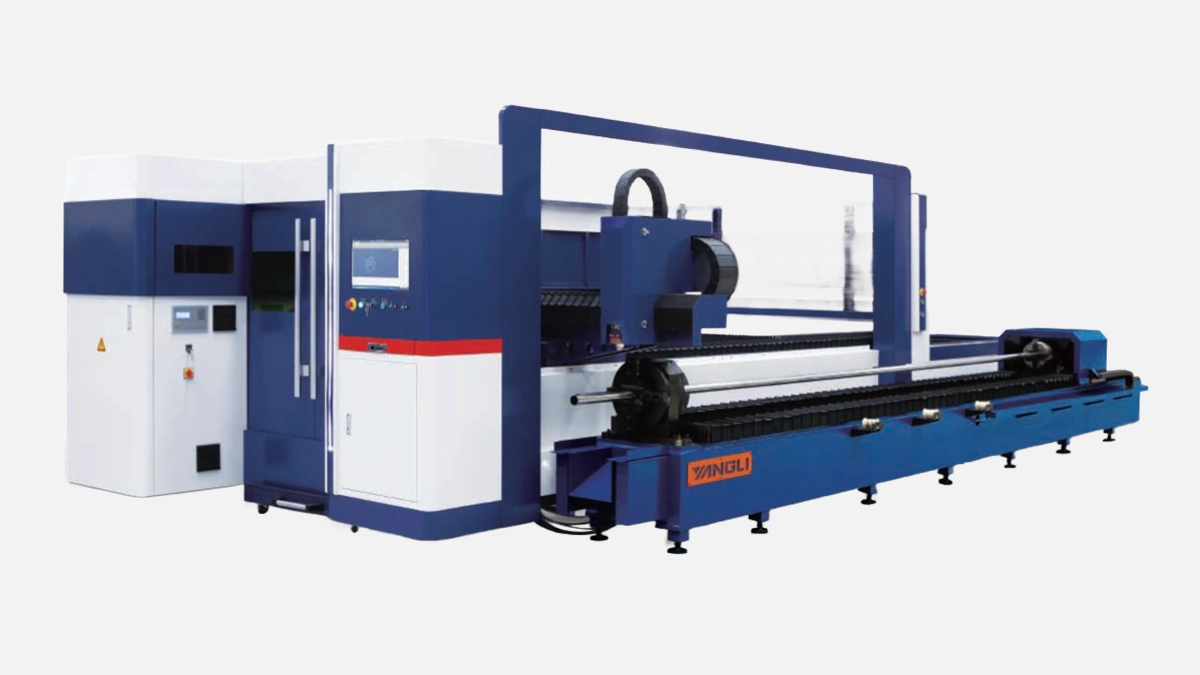
 Yangli — GL Series CNC Fiber Laser Cutting Machine GL3015FT
Yangli GL3015FT cuts 3×1.5 m sheet and 6 m tube in one frame, 1–6 kW fiber source, ±0.02 mm repeatability.
Founded in 1966 in Yangzhou, Jiangsu province, YANGLI has grown from a small tool-shop into one of China’s biggest press manufacturers. The public annual report for 2022 cites more than 2 300 employees and a yearly output of roughly 12 000 machines, including mechanical presses, hydraulic presses, CNC press brakes, turret punch presses and fiber-laser cutting centers. According to the China Forging & Press Association, YANGLI has ranked among the country’s top five press suppliers by revenue for four consecutive years.
The company operates 6 production plants that cover about 680 000 m² of floor space. Core components – flywheels, rams, hydraulic blocks and CNC control cabinets – are machined in-house, so spare parts availability is usually measured in days rather than weeks. The group also runs a joint R&D center with Nanjing University of Aeronautics and Astronautics, which allows them to test new frame alloys under real load cycles before launching a series.
YANGLI catalogues list more than 80 base models, grouped into five product lines:
Before looking at the practical implications, it is helpful to see how the catalog is structured.
Each line is available with peripheral options such as coil feeders, automatic tool changers and robotized stacking cells. The wide range lets board members standardize on a single brand across blanking, bending and drawing operations, simplifying staff training and service contracts.
A press or brake is only as good as its frame. YANGLI uses steel plates with a certified yield strength of ≥ 355 MPa. Plates are stress-relieved in an oven at 600 °C for 8 hours, then shot-blasted and CNC-milled in one setup. The resulting flatness tolerance is ±0.03 mm per meter, verified with laser interferometers made by Renishaw. Users on the PracticalMachinist forum mention that ‘ram tilt under a 100 t load is hardly visible’ – a point worth noting when tight bending angles are required.
Hydraulic presses in the HTF series are fitted with Rexroth proportional valves and dual redundancy pressure sensors. Should one sensor drift by more than 1 %, the PLC triggers a stop in under 40 ms, preventing die damage.
Since 2019, all export models ship with an Ethernet-based motion bus. Delem DA-69T or ESA S640 controls are common on press brakes, while the company’s own YL-P3 CNC is supplied on turret punches. The built-in post-processor reads STEP and DXF files directly, saving programming time on the shop floor.
To help production engineers calculate takt times, YANGLI offers the free Y-Sim package. It imports the NC code and shows part throughput, energy consumption and tool life estimates. In an interview with China Machine Press Magazine (issue 4/2023), a senior engineer at Geely Auto stated that adopting Y-Sim on three lines ‘cut manual scheduling work by 70 %’.
Below is a concise table that sums up the numbers buyers usually ask for. The figures are taken from YANGLI’s 2023 English catalogue and two user case studies published by Volvo Trucks and Arçelik.
Before we dive into the table, remember that values may differ slightly once a frame is customized. Always request a factory data sheet for the exact configuration.
| Model | Nominal force | Slide stroke | Repeat accuracy | Cycle rate |
|---|---|---|---|---|
| JH21-110 | 110 t | 180 mm | ±0.02 mm | 120 SPM |
| H1F-400 | 400 t | 250 mm | ±0.03 mm | 35 SPM |
| PB-160/3100 | 160 t | 3100 mm | ±0.01 mm | 11 bends/min |
| HTF-2000 | 2 000 t | 600 mm | ±0.05 mm | 10 SPM |
| HPD-3000 | 30 t | 32 mm | ±0.04 mm | 420 hits/min |
Consistent repeat accuracy is mainly the result of closed-loop encoders mounted directly on the ram, bypassing gear backlash. For fabricators running 3 or more shifts, this stability means you can leave the dies clamped overnight without a first-piece inspection every morning.
YANGLI adopted servo drives on presses up to 250 t in 2021. Internal test data shows a median power draw reduction of 25 % compared with conventional clutch-flywheel setups. Maintenance managers on several EU plants confirm that oil temperatures stay below 45 °C even during summer peaks, extending seal life.
The recommended service interval for mechanical presses is 2 000 operating hours or 12 months, whichever comes first. A standard kit includes:
Routine maintenance is not rocket science, but having a predictable list helps planners align spare part budgets with fiscal years.
After the replacement, a verification chart is printed out by the PLC and stored in the machine memory, aiding ISO 9001 traceability.
Decision makers often ask how YANGLI fares against well-known brands like Amada, Trumpf and Durma. The table highlights the practical differences observed in side-by-side demos at the EuroBLECH 2022 show.
To make sense of the figures, keep your production mix in mind. If you mostly bend 2–4 mm mild steel parts, the higher speed of Trumpf may pay off. For deeper draws or thicker material, the rigid YANGLI frames provide a safety margin that translates into longer die life.
| Feature | YANGLI PB-160 | Amada HRB-170 | Trumpf TruBend 5230 | Durma AD-R 30175 |
|---|---|---|---|---|
| Frame stiffness (kN/mm) | 4.8 | 4.1 | 4.0 | 3.9 |
| Max open height (mm) | 520 | 480 | 500 | 470 |
| Control language support | 12 | 8 | 10 | 6 |
| Base price in EU (k€) | 92 | 124 | 139 | 101 |
| Warranty (months) | 24 | 24 | 18 | 18 |
Apart from the obvious cost benefit, many buyers appreciate that YANGLI machine ladders are open, meaning the customer or an independent integrator can add sensors without locked passwords. This openness simplifies Industry 4.0 projects, for example connecting press brakes to an in-house MES via OPC UA.
Over the last five years YANGLI exported to 68 countries. End-users range from family-owned job shops producing 1-5 ton batches per month to automotive Tier-1 suppliers stamping 20 000 parts per shift. The brand is especially popular among European subcontractors who need CE-marked machines with mid-range pricing and straightforward service requirements.
All presses for the EU carry CE certificates based on EN 693 for hydraulic presses and EN 692 for mechanical presses. Safety relays come from Pilz or Euchner, and stop-time diagrams are included in the manual, which speeds up risk assessments under the Machinery Directive 2006/42/EC.
YANGLI maintains a European parts warehouse near Rotterdam with over 1 200 SKUs. Lead time for critical components such as cylinders and servo packs averages 48 hours door to door. Remote diagnostics is handled via a built-in Anybus router, so software engineers in China can log in outside local working hours, reducing downtime.
Operator training typically lasts 3 days on-site. Day one covers CNC basics, day two focuses on die setup, and day three simulates fault scenarios. Feedback from a Belgian sheet-metal contractor indicates that new operators reached 85 % of target cycle time within the first production week.
The move to servo presses lowered not only electricity bills but also noise levels. Measurements performed by TÜV Rheinland recorded 72 dB(A) during idle mode on a JH21-125, compared with 86 dB(A) on a similar clutch press. Lower noise contributes to a healthier work environment and may reduce investments in acoustic enclosures.
YANGLI press brakes use standard Promecam punch holders, so shops can keep existing tool libraries. Turret punch presses follow the A/B/C/D station layout common to Amada tooling. This cross-compatibility is handy when urgent orders arrive and local tool suppliers have limited stock.
Over nearly six decades in the market, YANGLI has earned a reputation for sturdy frames, open control architecture and swift parts delivery. These attributes resonate with metalworking plants that operate mixed-material batches and cannot afford long stops. Whether you aim to expand capacity with a single 160 t press brake or plan a fully automated blank-to-bend line, the brand provides a range broad enough to match the technical brief without inflating capital expenditure.
In short, buyers appreciate three things:
The final observation: a press or brake only pays its way when uptime stays high. YANGLI’s focus on frame rigidity, accessible software and rapid parts logistics directly addresses that reality, which is why the machines find their way into both small subcontractors and large OEM stamping halls.
