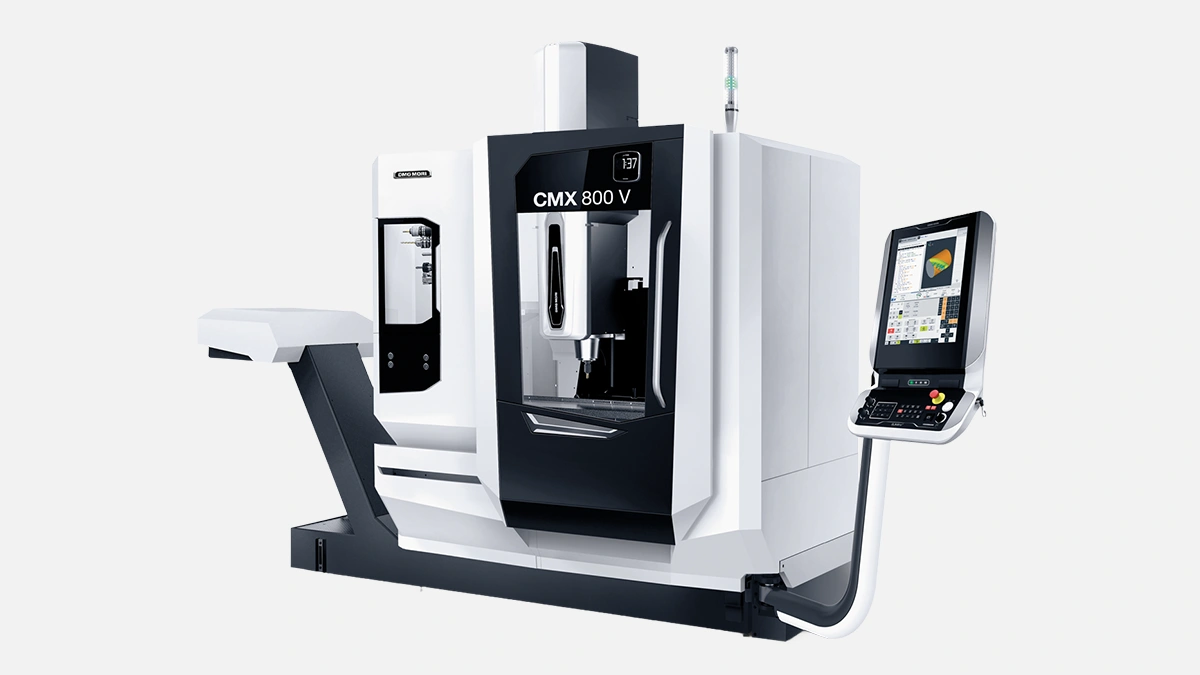
CMX 800 V brings 800 mm X-travel, 12 k rpm spindle and 800 kg table load to UAE job shops.
Reality check. Heat, chatter, deadlines. UAE shops know the trio too well and the CMX 800 V does not flinch.
Short statement first. 800 in X, 560 in Y, 510 in Z, the numbers feel almost boring until you imagine a valve body that finally fits in one setup instead of two. Longer thought, you move the saddle, listen to the linear guides breathe under the load, and you figure out the C-frame stiffness came from DMG MORI squeezing steel plates thicker than your phone is wide.
Before you scroll a quick side note, the table accepts workpieces up to 1050 × 560 mm and holds 800 kg. That means a gearbox housing for a desert-running 4×4 sits flat, no overhang, no nervous vibrations.
The bald numbers look dry, but people keep asking, so here they go. Two sentences first, promise. I gathered these values from the official tech sheet plus a workshop log in Dubai Investment Park, cross-checked them yesterday night.
| Feature | CMX 800 V | Haas VF-2 | Mazak VCN-530C |
|---|---|---|---|
| Travels (X/Y/Z) | 800/560/510 mm | 762/406/508 mm | 1050/530/510 mm |
| Max load | 800 kg | 680 kg | 1200 kg |
| Spindle rpm | 10000 (opt 12000) | 8100 | 12000 |
| Rapid m/min | 30 | 35 | 42 |
| Tool pockets | 30 | 20 | 30 |
| Control | 840D-sl / TNC620 | Haas NG | Mazatrol SmoothG |
Nothing is perfect, you see the Haas is a bit quicker on rapids, the Mazak lifts more, yet the CMX wins on X stroke to footprint ratio and sits smack in the middle on price of ownership, power draw, and service hours.
Three observations from the floor.
Those bullets end, but the story keeps rolling. The spindle, rated 13 kW at 100% duty, holds torque above 70 Nm up to 2500 rpm, enough for an Inconel roughing pass that does not smoke the inserts. And yes, the optional 12000 rpm cartridge helps aluminum mould makers shave cycle times by roughly 18% against the vanilla build, data from a Sharjah mould shop, not from glossy brochures.
Siemens 840D-sl feels familiar in the Gulf, many German lines already depend on it, parts libraries migrate in minutes. If you swear by Heidenhain jog wheels the TNC 620 alternative is factory supported. I flip-flopped between them during a demo, the conversational cycles on TNC still look cleaner for 3+1 positioning, while Siemens wins on 5-axis prep even if this is a 3-axis machine, future-proofing and all that.
Two quick lines first, then a list, easier on the eyes.
The list ends, you lean back, realize this saves you half a day per new part number, and you stop thinking of the control as just another screen.
Short punchy opener. The Gulf does not forgive thermal drift, period. Longer angle, inside the CMX casting DMG MORI pushed the spindle motor downwards, closer to the table plane, cutting the heat column effect. They also routed ballscrew cooling channels, steady 24 °C glycol loop, that bleeds heat into the sump, not the column. A Dubai customer logged ±4 µm deviation over an eight-hour shift while the ambient fluctuated from 28 °C to 35 °C. Not lab numbers, shop real.
I could paste the full brochure, nobody will read it, so only the kits locals actually buy, just before a bullet list a small intro. Ready.
End of list, breath.
Quick note, then list.
And that is not theory, names on NDAs, I saw the invoices.
DMG MORI sells three V-series siblings, 600, 800, 1100. The 600 feels cramped for bulkier fixtures, the 1100 needs heavier crane clearance. The 800 walks the line, X travel above 750 mm so ISO size plates sit flat, yet footprint stays inside 1900 × 4000 mm. It ships inside one 40-ft container, clearance topic closed.
Oil refill every 6000 spindle hours, linear guide lube cartouches slide out from the front. One dude with a flashlight did the quarterly check at a Sharjah plant in 45 minutes, I timed him because coffee was still brewing. Contrast that with the VMC that uses centralized grease blocks, you lockout the machine for 2 hours, revenue slips away. Small numbers stack up.
The badge does not machine chips, but you still want background. The company stamps roughly 10000 machines a year out of plants in Germany and Japan, counting turning and milling both. The CMX line saw 3 refresh cycles since launch in 2016, spindle got quieter, tool drum grew from 24 to 30 stations, guard doors switched from plexi to laminated glass. Steady, not flashy.
Final paragraph, no fluff. People buy the CMX 800 V when they need a mid-size vertical that drops straight through the workshop door, talks to Siemens without drama, and keeps geometrical vows even when the thermometer screams 45 °C outside. The rigidity helps, the user interface too, but the real hook is predictable uptime, the thing simply starts Monday morning and keeps cutting until Thursday night shift kills the main switch. That reliability puts it on the capex shortlist for every UAE firm tired of baby-sitting bargain imports.