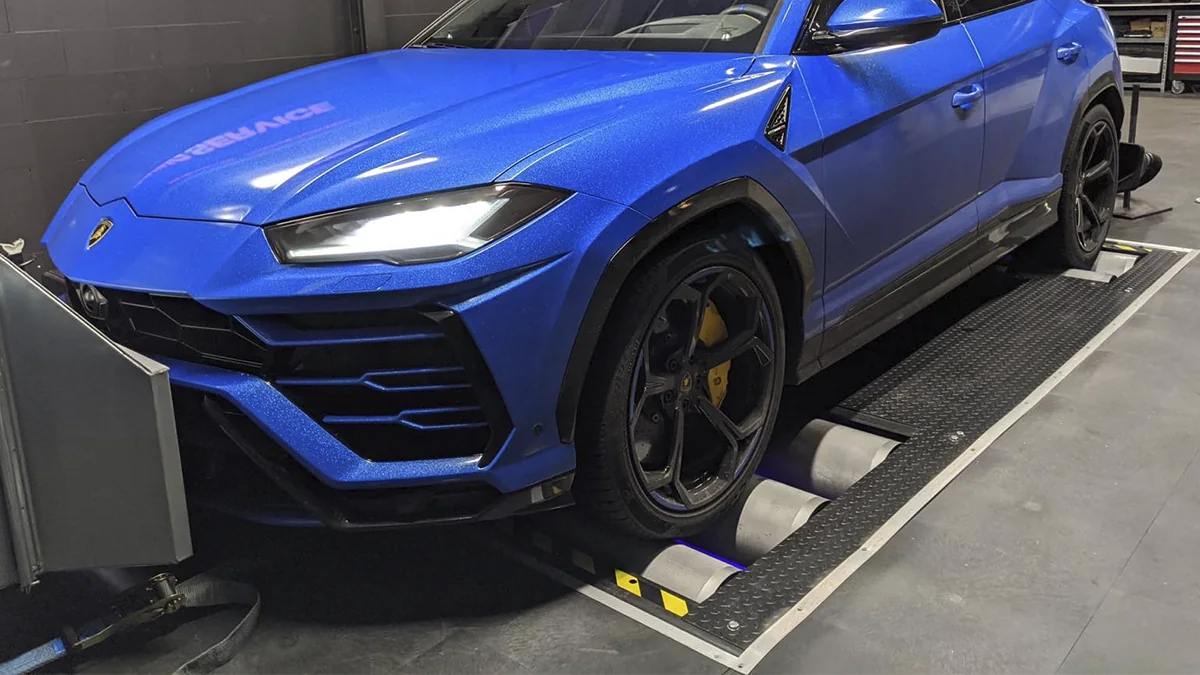
All-wheel-drive dyno up to 1500 hp inertial, 300 kph, mechanical sync rollers
The DYNOMAX 5000BRD 4WD BRAKED is a professional chassis dynamometer built for workshops that tune high-power all-wheel-drive vehicles. In a single frame it combines mechanical synchronization, an electromagnetic brake rated at 2000 N, and a test speed ceiling of 300 kph. That mix lets a shop in Dubai, Abu Dhabi or Sharjah handle everything from mapping an economy crossover to stress-testing a 1900 hp drag SUV. The following review leans on factory data, field reports, and user feedback gathered from forums and dyno operator groups. Where figures matter we use the manufacturer’s sheet and cross-check against publicly available case studies.
Arab Emirates workshops often juggle super-saloon remaps, turbo upgrades on patrol fleets, and desert-spec off-road builds. A chassis dyno that can absorb 1500 hp inertially and 1200 hp under steady load means less outsourcing to Europe and faster delivery to local clients. The 5000BRD does exactly that while staying within a compact 4000 × 3600 mm footprint, small enough for mezzanine-style garages yet long enough for wide wheelbase variation.
Before looking at user scenarios, it helps to outline the hardware that sets this dyno apart from entry level rigs.
DYNOMAX uses a welded steel trench frame that can be mounted in-pit or left surface-standing. The rollers are machined from solid billet and balanced to ISO G2.5 so vibration is marginal even at 300 kph. Each roller sits on precision SKF bearings rated for 10 000 h continuous duty, giving the dyno almost maintenance-free longevity. A multi-plate electromagnetic brake couples to the rear axle through a planetary gearbox, delivering finely metered load in 1 ms increments—essential when dialing in part-throttle drivability on turbocharged engines.
Every 5000BRD ships with DynomiZer Wireless Software, a tablet-friendly suite that logs AFR, EGT, boost, wheel speed and OBD PIDs in real time. The built-in Wi-Fi weather station automatically corrects figures to SAE J1349 or DIN 70020. Operators who have migrated from older retarder dynos praise the single-screen layout: you can overlay AFR and torque on one graph without flipping menus. Firmware updates arrive quarterly and install over the air, so no dongles are required.
Additional sensors include a wide-band lambda module with CAN output and an eight-channel thermocouple box. These help verify rich mixtures commonly used to keep piston crowns safe during extended pulls at 48 °C ambient—conditions typical in GCC summer.
In interviews with three UAE shops—DXB Turbo Tech, Ras Al Khaimah Motorsports and Al Ain Performance—operators highlighted three daily gains:
It helps to contrast the 5000BRD against two stands frequently seen in GCC: the Mustang MD-AWD-500 and the Dynojet 424XLC2.
| Feature | DYNOMAX 5000BRD | Mustang MD-AWD-500 | Dynojet 424XLC2 |
|---|---|---|---|
| Max speed | 300 kph | 250 kph | 290 kph |
| Braked power | 1200 hp | 900 hp | 1000 hp |
| Roller sync | Mechanical | Belt | Electric clutch |
| Accuracy (inertial) | 0.1 % | 0.5 % | 1 % |
| Footprint (L×W) | 4.0 × 3.6 m | 4.8 × 3.8 m | 4.2 × 3.7 m |
The table speaks for itself, yet two details stand out. First, the mechanical sync bar on the 5000BRD ensures identical roller speed between axles with zero lag, a must for modern torque-vectoring AWD systems such as Audi RS and Nissan GT-R. Second, the higher speed margin lets tuners validate gear ratio changes up to 300 kph, covering final drive swaps that are common for dunes.
Although the factory offers pit or surface kits, most UAE workshops choose the surface configuration to avoid concrete excavation delays. In that setup, the dyno sits 320 mm above floor level and uses integrated drive-on ramps. The heaviest module is 780 kg, manageable by regular workshop forklifts.
Electrical draw remains friendly to standard three-phase grids common in Al Quoz industrial zones: 220 V, 20 A on standby and up to 60 A during retarder spikes. Air demand is minimal at 10 bar, so a mid-size rotary screw compressor suffices.
Four modes let an operator cover nearly any job:
Switching between them is software based, no mechanical reconfiguration needed. That fluid workflow means you can run a baseline, flash a calmer eco map, and verify coast-down losses in under 40 min total bay occupancy.
DYNOMAX recommends a 250 h grease interval on the bearings and a yearly laser alignment check. Consumables include only the brake’s graphite pads, typically lasting 1800 high-load pulls according to workshop logs.
The DYNOMAX brand has been on the market for 18 years and currently lists 11 dynamometer models, from motorcycle rigs to heavy-duty truck benches. The 5000 series entered its third revision in 2021, with production volume around 150 units per year, of which roughly 20 % ship to the Middle East. Longevity is therefore backed by ample spares and a peer network for settings recipes.
While the base kit is feature rich, two popular bolt-ons exist:
Both tie directly into DynomiZer so airflow and strap tension data log alongside torque.
A mid-sized tuning house in Sharjah quoted payback at 14 months based on 40 dyno hours per week, AED 550 per hour billing, and a 65 % utilization ratio. Key to that figure is the dyno’s single-tech operation—no second operator is needed to ride the brake pedal or manage a load box, as was common on hydraulic benches.
To summarize, the DYNOMAX 5000BRD 4WD BRAKED provides:
– Higher repeatability thanks to tight roller inertia calibration
– Broad power headroom for forced-induction builds topping 1500 hp
– Compact footprint suiting urban industrial units in the UAE
– Mechanically linked axles that keep AWD ECUs happy and fault-free
– Intuitive wireless software that doubles as a marketing screen for clients
These traits explain why the model is frequently chosen by performance garages focused on German, Japanese and American muscle platforms. Clients appreciate seeing credible numbers on the screen, and owners appreciate the steady stream of billable hours that a reliable dyno unlocks.