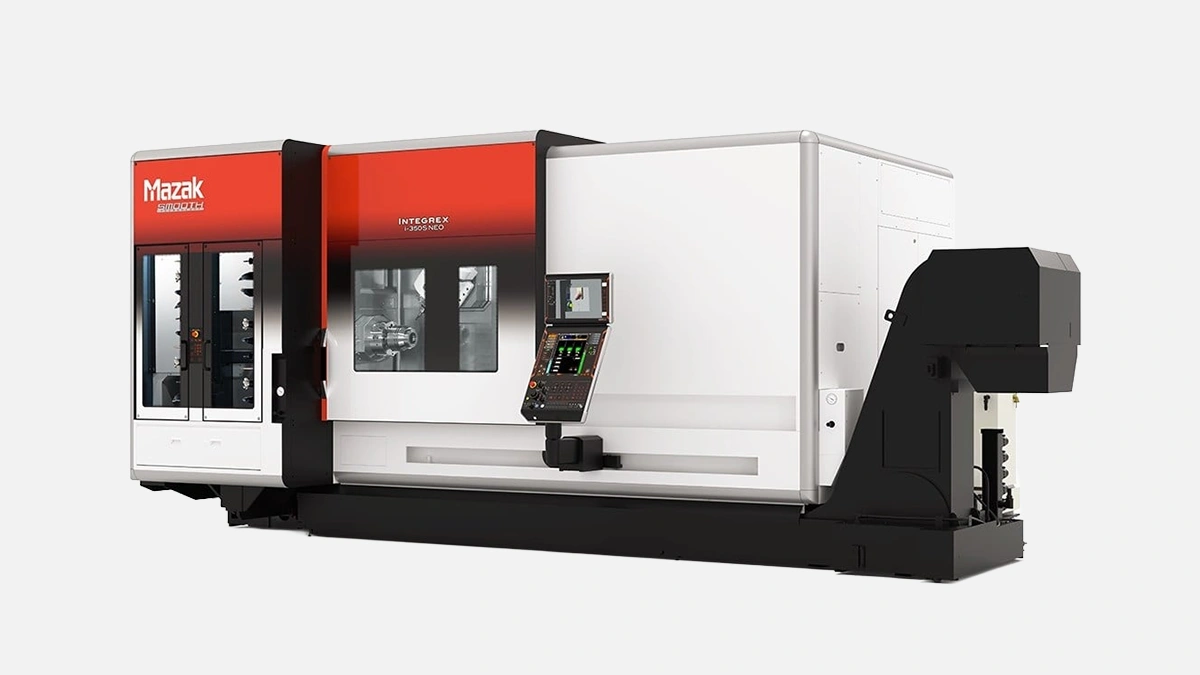
Mazak INTEGREX i-350S NEO multitasks Ø660 mm parts with 12 000 rpm milling and 102 mm bar, ideal for UAE oilfield jobs.
Short. Punchy. The name alone already hints at a multitasking beast, yet the machine does not shout about it, it just works. When you stand next to the i-350S NEO you immediately notice the wide front door, the robust cast-iron base, and the familiar smooth gray of every Mazak built over the last thirty-plus years. I had three cups of coffee when I first saw it on the demo floor in Minokamo and still remember the faint smell of cutting fluid. Anyway, let us talk numbers, because numbers never lie.
Before diving in, glance over the little comparison table below. It is there for context, nothing more. The content will make much more sense once you have a frame of reference.
| Model | Max swing (mm) | Milling spindle (rpm) | Bar capacity (mm) |
|---|---|---|---|
| INTEGREX i-250H | Ø 520 | 10 000 | Ø 76 |
| INTEGREX i-350S NEO | Ø 660 | 12 000 | Ø 102 |
| INTEGREX i-450H | Ø 760 | 10 000 | Ø 116 |
Numbers done, the story begins.
The base is a single piece of high grade Meehanite, shot-blasted, stress-relieved, and left to sit for months before final finish machining. Why so much drama around the base, you ask. Because heat. Because vibration. Because a shop in Abu Dhabi cutting Inconel 718 at 200 m min surface speed cannot afford chatter or thermal drift. The i-350S NEO soaks up that heat, keeps geometry tight, and does not complain.
Those three bullet points sum up why many operators call it boring in the best possible way. It just holds tolerance day after day, no fireworks, no drama.
The next paragraph normally would be a dry recital of stiffness coefficients, yet let me switch gears. I once watched an operator crash the lower turret of a different brand into the chuck, ten seconds of metallic horror. Same job shifted to an i-350 and the part count went back up in half a shift. No magic, only rigidity.
Travel numbers look ordinary on paper, until you picture a B-axis head swinging over 250 mm of Y travel while the second spindle sneaks up for simultaneous pinch turning. The result feels like dancing with two partners who never step on each other’s toes.
Notice the absence of a W axis, Mazak keeps it simple, the second spindle moves on Z only, less to service.
Every axis rides linear scales from Heidenhain, standard, no surcharge. A friend running aerospace housings in Sharjah told me his monthly CPK reports sit above 1.33 without extra compensation. Good enough for NADCAP auditors, good enough for most of us.
Let us throw more data on the table because spindles define cycle time.
| Type | Power (kW) | Torque (Nm) | Max speed (rpm) |
|---|---|---|---|
| Main turning spindle | 30 | 420 | 4 000 |
| Second turning spindle | 22 | 380 | 4 000 |
| Milling spindle | 37 | 119 | 12 000 |
Mazak lists these as S1 continuous ratings, not peak, so you actually get them, not a marketing spike. Milling spindle is oil-cooled, uses HSK-T63, and swaps tools in under 3.5 seconds chip-to-chip. Someone is going to say, yeah but there are machines with 15 000 rpm. True. Those tend to give up torque below 3 000 rpm. The i-350S holds flat torque up to 4 000, handy when drilling Ø 50 mm holes in 316 stainless.
Base spec is 36 tools, most UAE buyers tick the 72 pocket chain. I have only seen one shop push the optional 120 pocket drum, mostly for oil and gas valve bodies where tool redundancy matters. The magazine sits at the back left, service crew can pull it without removing guarding, nice touch.
Before the list, note the magazine does not need an external air dryer, the built-in membrane dryer keeps pressure at 5.5 bar and dew point below 5 °C.
After tooling comes chips, always chips. Standard hinge conveyor with rear exit, you may order a drum-type if running cast iron, your call.
Mazatrol SmoothAi. Love it or hate it, you cannot ignore it. The panel boots in 45 seconds, supports STEP import right at the control, and offers AI assisted cycle time estimator. I tried to trick it with a horrible STL once, the thing still parsed it, though the estimate was off by 7 percent. Close enough for quoting.
Fanuc lovers, relax. You can still program in EIA, full macro B, background editing, the whole lot. There is even an OPC-UA server for MES link, which many factories in Jebel Ali free zone use for live dashboards.
No fancy adjectives, just field notes.
All above share solid reputations, none ruin your day, yet the i-350S NEO gives that extra capacity without forcing a much larger footprint.
Mazak sells the i series since 2011 and produced more than 8 000 units across six frame sizes. The i-350 came out in 2018, the NEO refresh added better spindles and the SmoothAi control in 2023. There is also the i-350H with a different lower turret layout, and the i-350ST which deletes the second spindle in favor of a tailstock for shaft work. Buyers pick what fits parts, the core castings stay common, meaning spare parts travel faster through the supply chain.
Walk into a job shop in Musaffah and you will likely see one. Typical parts
Local operators rave about the stable cutting on sand-laden castings imported from India, apparently the wipers on the linear guides last longer than on some other brands. A maintenance manager told me his yearly consumable cost dropped by 18 percent after switching to Mazak wipers, anecdotal but worth noting.
Mazak keeps an in-region spare part hub in Dubai with roughly 9 000 SKUs, covering bearings, card assemblies, and sheet metal. Typical lead time for a spindle cartridge sits at 3 days if stock is in Japan, 24 hours if local. Compare that to some European builders where shipping alone takes a week and you see why downtime risk goes down.
No grand finale, just practical reality. The i-350S NEO is not trying to be everything, it focuses on medium to large diameter multitasking, keeps the floor space around 7.8 m², and refuses to drift in temperature. Shops buying it tend to chase high mix low volume work, oil field service, aerospace fixtures, or medical implants beyond Ø 100 mm. They pick it because it eats roughing passes, finishes with one setup, and moves on.
In short, faster part out the door, fewer bottlenecks. That is the whole point.