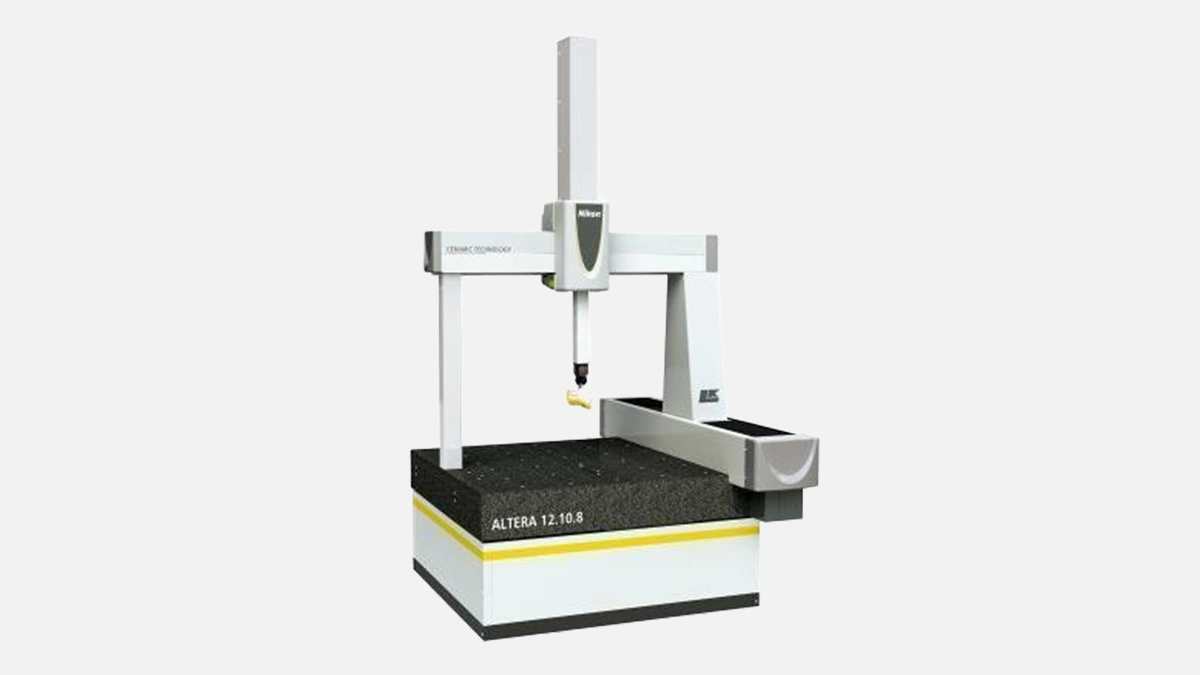
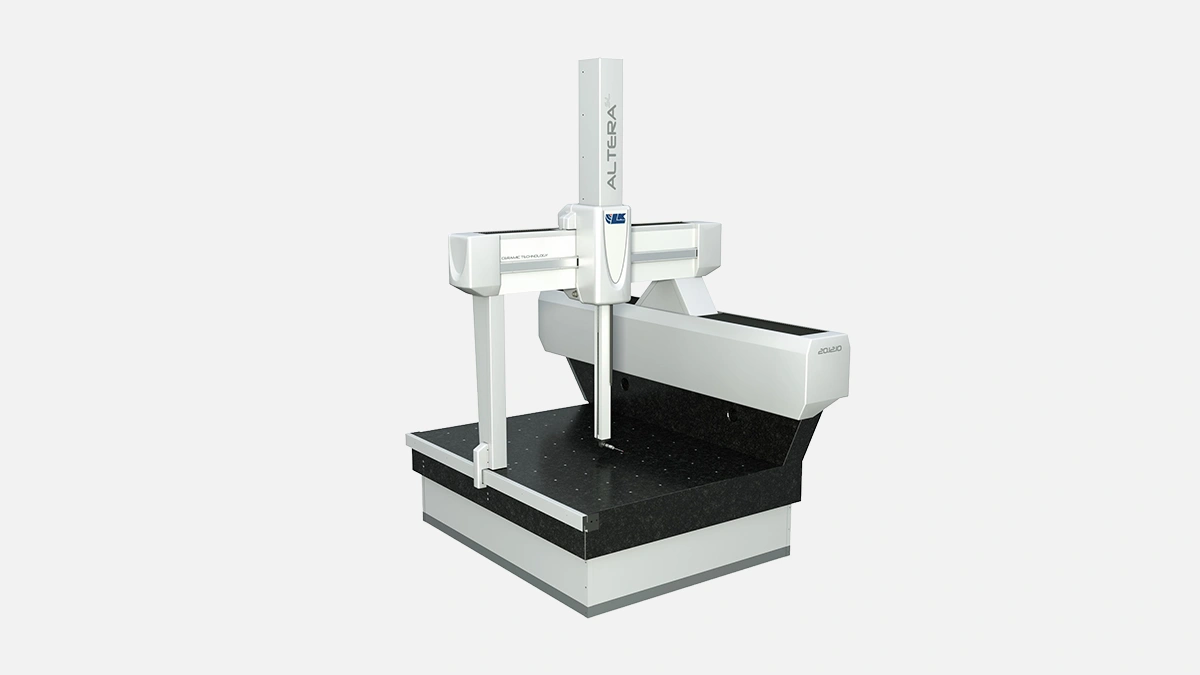
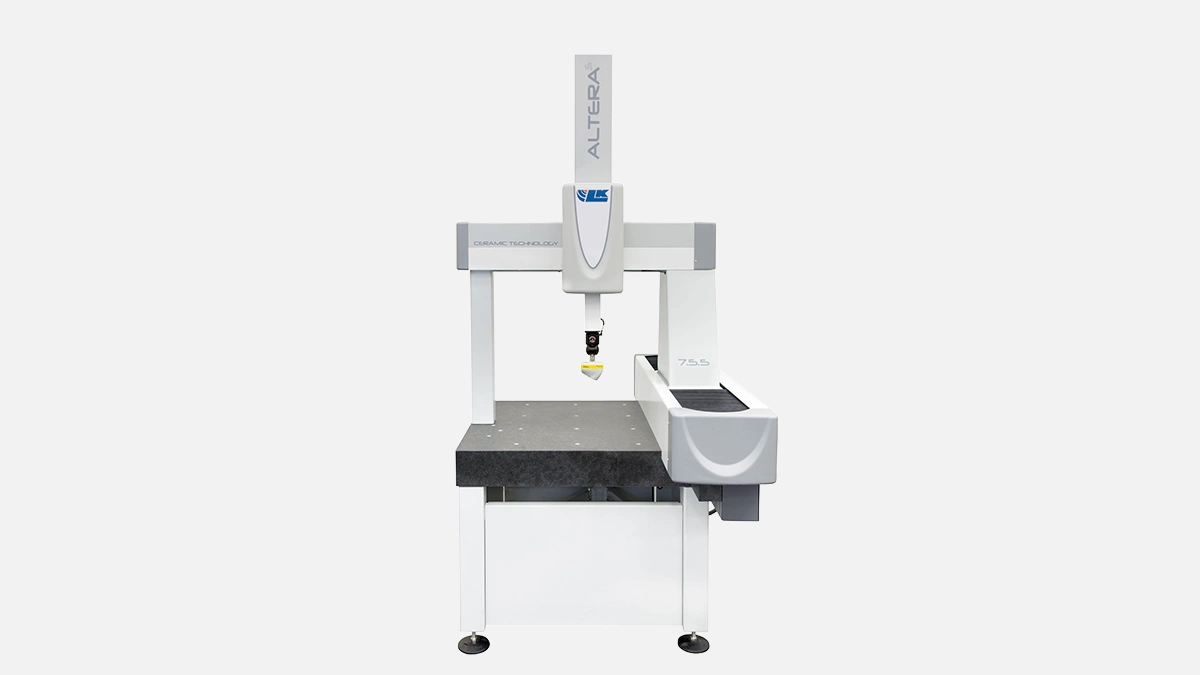
ALTERA 20.10.8 CMM delivers 2000×1000×800 mm volume and 2.2 µm+L/300 accuracy for UAE workshops.
Short intro, almost abrupt. Big granite, steel rails, the usual CMM vibe. Then the eye catches the model badge – ALTERA 20.10.8 – and suddenly the numbers start to matter. 2000 on X, 1000 on Y, 800 on Z, that volume swallows a diesel engine block and still leaves elbow room. I stand close, hear the low hiss of air bearings, wonder if anyone in the shop ever notices how quietly it floats.
Now a longer riff, because context is vital. Nikon Metrology bought the legendary LK factory back in 2012, kept the English plant running, and to date they ship roughly 400 bridge-type frames a year. ALTERA sits in the middle of the family, not the baby, not the heavy gantry, just the sturdy workhorse. Four revisions so far, each one shaving microns off the error budget and adding more probing toys. The current revision – rolled out end of 2022 – finally ditched the old DC drives, went full linear glass scales with 0.05 µm resolution. Nice step.
A machine is more than numbers, yet numbers give comfort. See the mini-table hiding below, it captures what matters during a purchase call.
| Item | ALTERA 20.10.8 |
|---|---|
| Measurement volume | 2 000 × 1 000 × 800 mm |
| Accuracy (ISO 10360) | 2.2 + L/300 µm |
| Max speed (vector) | 520 mm/s |
| Max accel | 1 730 mm/s² |
| Granite base mass | 3 900 kg |
| Overall mass | ≈ 7 100 kg |
Two sentences before the table, two after, check. Those who have lifted a machine this size know the floor drama: you want 300 mm thick reinforced concrete, nothing fancy, just flat. The UAE shops near Sharjah Industrial Area typically pour only 200 mm, so plan extra pads or steel sub-frame.
Climate hurts metrology. Daytime swings from 24 to 40 °C inside a semi-conditioned hall mess up alloy frames. Nikon answers with full-body thermal mapping, nineteen sensors talking to the Camio kernel, dynamic scaling every 5 s. I saw it live in Abu Dhabi, room at 28 °C, still hitting 3 µm on a 600 mm step gauge. Not Zeiss-level bragging but plenty tight for gearbox housings. Operators like that they can wheel a workpiece straight from the machining center, wipe off emulsion, clamp, probe. No obligatory one-hour soak.
Feels ordinary until you remember an older DEA Global needed * five * minutes to requalify after every swap.
Another break. Let us ramble about software. Camio 2023 looks like any CAD-based inspection suite, icons everywhere, but the trick sits in the vector logic. Click an edge, it auto-generates 80 % of paths, including approach moves, safe planes, even that goofy retraction by 15 mm to avoid studs. Saves cycles, also saves juniors from crashing styli.
A friend at Al Ain Precision castings logged data for a month. They run three batches: hydraulic manifolds, aluminum impeller housings, and stainless positioning plates. On the old Mitutoyo Crysta the average measurement cycle across those parts was 18 min. Switched the recipe to ALTERA, kept tolerance maps identical, cycle dropped to 11 min flat. Mostly because of higher acceleration and fewer stylus changes. Multiply by 40 parts a shift, that is an hour and a half gained, enough to squeeze an extra job before night.
Nobody buys blind, so I lined up competitors. Short bullets first.
Table for clarity.
| Model | Accuracy µm | Vector speed mm/s | Y travel mm |
|---|---|---|---|
| ALTERA 20.10.8 | 2.2 + L/300 | 520 | 1 000 |
| Global S 20.12.8 | 2.3 + L/250 | 500 | 1 200 |
| Contura 20/10/8 | 1.8 + L/250 | 480 | 1 000 |
| Crysta Apex S 2000 | 2.3 + L/300 | 430 | 1 000 |
Forget the raw grid for a second. What sells ALTERA in Emirates is service proximity. Nikon keeps a parts hub in Jebel Ali Free Zone, courier runs take half a day to Abu Dhabi, less to Dubai. Hexagon ships from Germany, Mitutoyo from Singapore, both slower. Downtime costs more than the extra tenth of a micron, period.
The bridge rides on air bearings, four per axis, gap 7 µm nominal. Rails are ceramic-coated steel, hardness 64 HRC, corrosion no issue even with that salty Gulf moisture. Drive is toothed belt on X, inline DC servos on Y and Z, glass scales anchored to granite. The scales have thermal expansion of 0.6 µm/m-K, Camio corrects that live. All cabling runs through energy chains, rated 10 million cycles. Small note, the Y motor used to sit on top, raising the height, the new batch moved it below table level, easier craning.
Operators hate recalibrating every ruby after a crash. Nikon added CrashGuard, a torque clutch that kicks out at 0.2 Nm, enough to save the stylus. Tried it myself, pushed, the head yielded, alarm beeped, axis locked. Zero damage.
Air bearings drink roughly 300 l/min at 6 bar, translates to 3 kW compressor load if you run stand-alone. Electricity for servos negligible, under 1 kW peak. Filters need swap twice a year, 50 USD each. Software subscription optional, but without updates you miss new CAD importers, not fun when a customer sends NX 2206 files.
ALTERA line spans eight volumes. The baby 7.7.5 is cute, table top vibes. Middle sibling 15.9.7 fits most gearboxes. This 20.10.8 feels like the sweet spot for automotive and oilfield blocks. If you really need a monster, 25.15.12 gives 2 500 × 1 500 × 1 200 mm, yet weight jumps to 12 t. Geometry spec stays the same ratio, so pick size by part envelope, not accuracy fantasy.
Before you call Nikon Dubai, tick these boxes, trust me.
Finish the bullet, breathe.
Honestly, if you chase sub-micron glory, grab a Zeiss PRISMO Ultra, pay double, live happy. If you need a reliable metrology bridge that survives Gulf heat, accepts big blocks, and does not eat an operator alive, ALTERA wins. The combination of active thermal maps and five-axis scanning is still rare in this size band. Also resale value holds, saw a 2017 unit auctioned last month for 68 % of book.
Strong spec sheet, manageable running cost, responsive service in UAE, that is why hydraulic shops, aerospace MRO cells, and even jewelry mold houses pick the 20.10.8. It simply measures, day shift after night shift, with little fuss. That makes money, and that is the only metric that sticks.