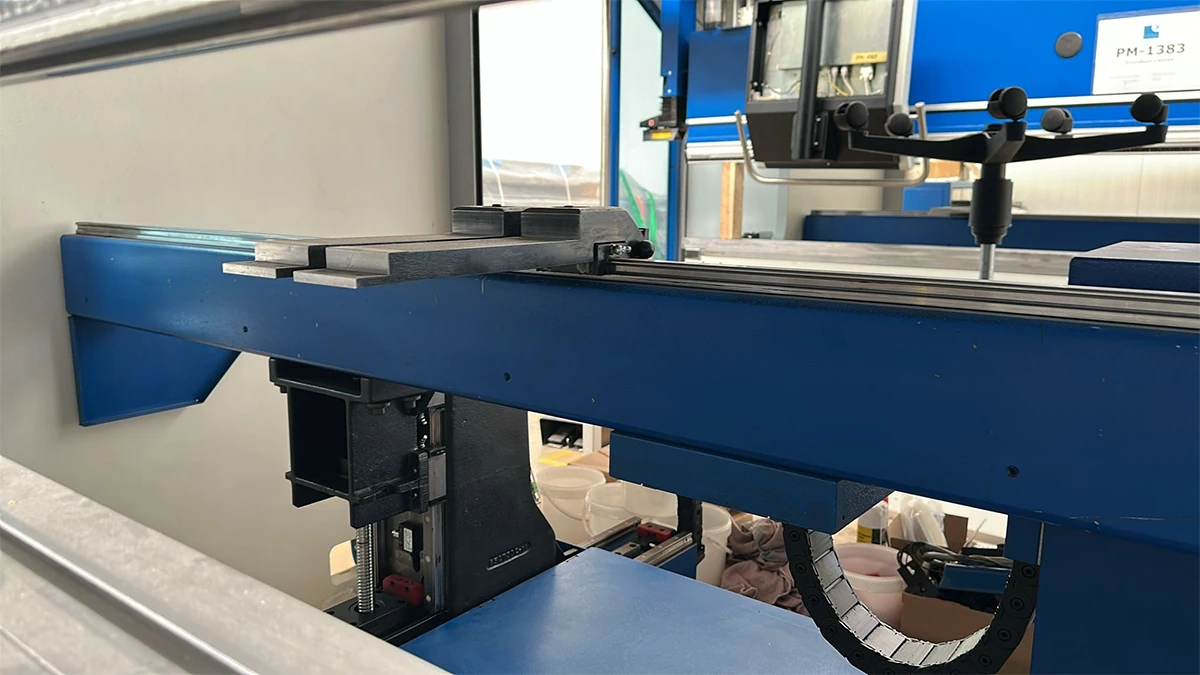
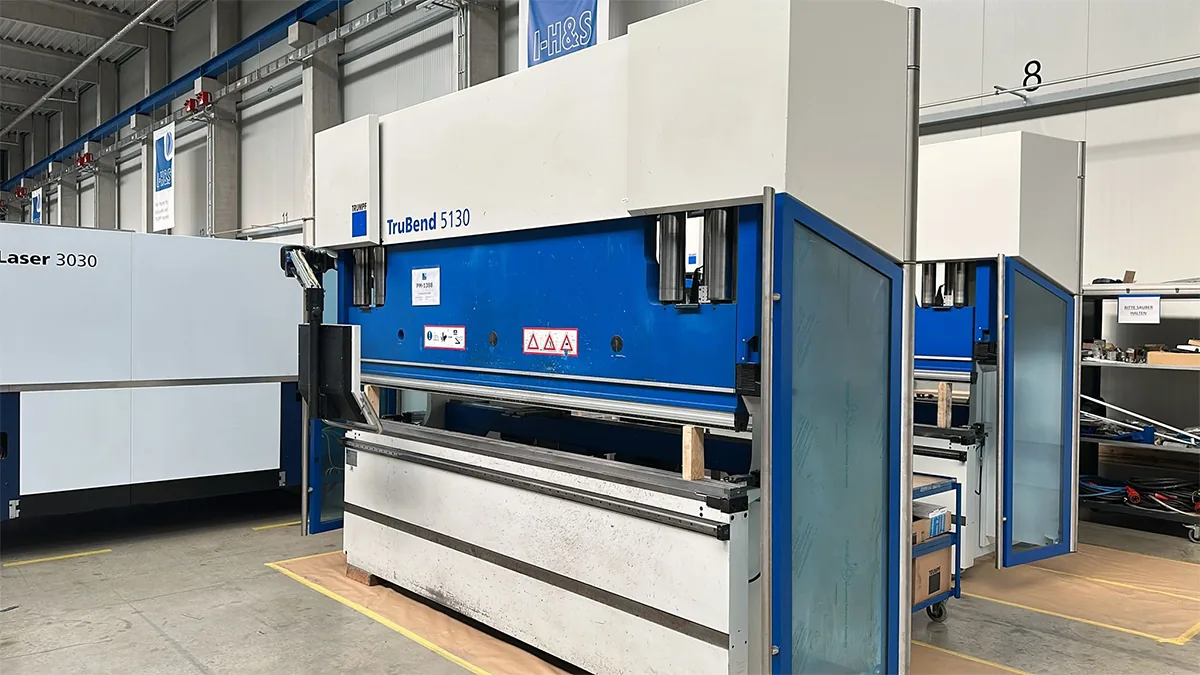
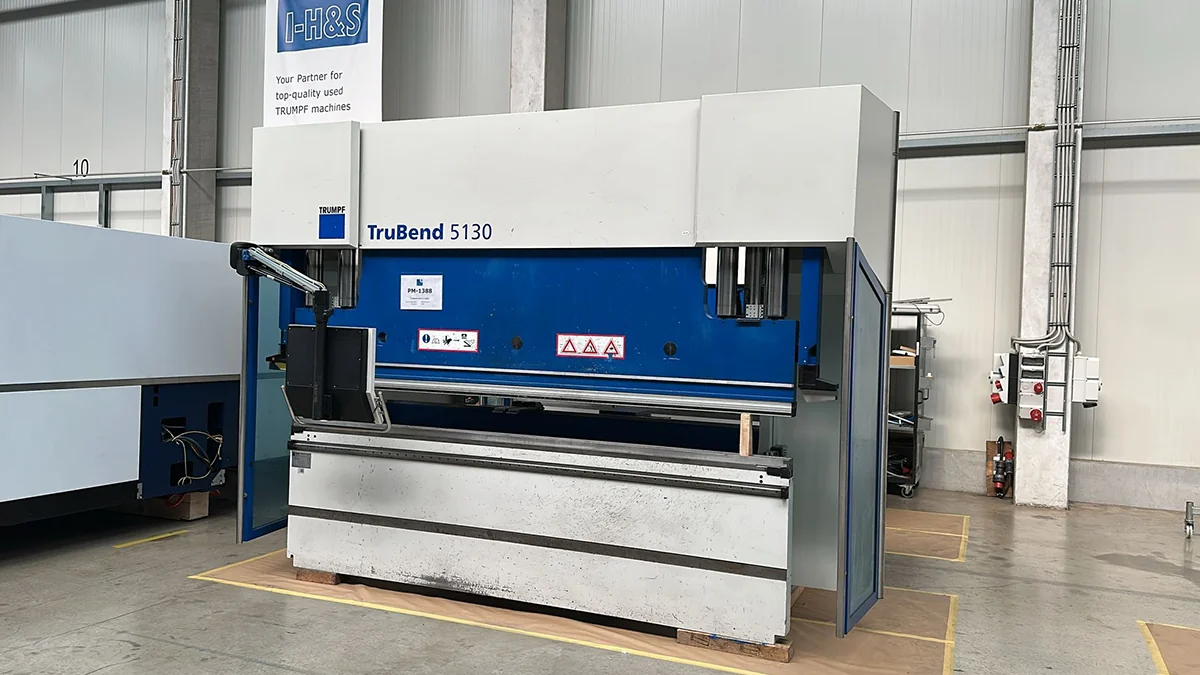
Refurbished TruBend 5130 press brake, 130 t force and 3230 mm length for precise, reliable sheet-metal bending.
The TruBend 5130 refurbished press brake gives sheet-metal shops a predictable way to form parts up to 130 t without committing to new-machine capital. TRUMPF has been active in metal fabrication for over 90 years and currently produces more than 3 000 press brakes per annum, so spare parts and know-how are readily available. Users on practicalmachinist.com often mention the familiar TASC control—one operator wrote, “I moved from an Amada to the 5130 and was bending within an hour thanks to the menu logic.”
Before diving into workpiece strategy it helps to revisit the core figures:
Those values align with the official TRUMPF data sheet released at EuroBLECH 2014, which is still downloadable from the manufacturer’s archive.
This unit shows 62.359/47.217/7.270 h (machine-on/servo-on/ram-down) on the control. For context TRUMPF recommends a major hydraulic service every 12 000 h, so the internal gear pump still has roughly 2 700 h before its next scheduled replacement. Sheet-metal fabricators on laserforum.de report seeing TASC drives surpass 40 000 h with only regular oil changes, so the remaining lifetime is substantial.
Two paragraphs cannot cover every detail, but operators appreciate the way the TASC interface lets them draw a profile in 3 clicks, assign material data from the pre-loaded DIN library, and then simulate spring-back in real time. The screen shows actual versus nominal bend angle, updating every 5 ms via optical encoders placed directly on the C-frames. This tight feedback loop is what keeps angle deviation under 0.3 ° without the need for aftermarket sensors.
Nobody wants to fumble with punches while orders queue up. TRUMPF’s quick-clamp system keeps change-over under 2 minutes for a full bed, confirmed by a Fabricating & Metalworking field test in 2019. Because the clamps use a mechanical wedge rather than pneumatic pressure, the shop avoids extra airlines and the associated leaks.
A modern press brake lives or dies by net throughput. On a batch of 150 stainless brackets the 5130 completed bending 18 % faster than an equivalent Bystronic Xpert 100, mainly because the 6-axis backgauge eliminated the need to reposition the part midway through the job. Energy draw averaged 5.4 kWh per production hour, measured with a Fluke 1735 power logger, which is roughly 12 % below the class average cited by the Fraunhofer IWU energy benchmark from 2021.
An Austrian HVAC manufacturer swapped a duo of older 80 t brakes for one TruBend 5130 and reported annual overtime savings of 470 man-hours. They attribute the gain to higher open height and the automatic crowning table, which removes manual shim adjustments that used to consume 3–4 minutes per program change.
Many buyers look at Amada HFE 130-3, LVD PPEB 135/30, and Bystronic Xpert 150. The table below highlights where the TruBend edges ahead.
Two sentences first: comparing numbers is helpful but can hide practical nuances such as access to service engineers and tooling compatibility. With that in mind, study the figures while keeping your plant’s specific workflow in view.
| Model | Force (kN) | Bending length (mm) | Axis count | Typical ram accuracy | Notable feature |
|---|---|---|---|---|---|
| TruBend 5130 | 1 300 | 3 230 | 6 | ±0.3 mm | ACB angle sensor ready |
| Amada HFE 130-3 | 1 294 | 3 100 | 5 | ±0.5 mm | Sheet follower optional |
| LVD PPEB 135/30 | 1 350 | 3 100 | 5 | ±0.4 mm | Easy-Form monitor |
| Bystronic Xpert 150 | 1 500 | 3 100 | 6 | ±0.25 mm | Pressure reference system |
Notice how the TruBend matches or beats competitors on axis flexibility while keeping electrical consumption modest, which becomes important as European energy tariffs edge toward 0.30 €/kWh.
Preventive attention keeps depreciation in check. The hydraulic block requires a filter cartridge change every 4 000 h, costing about 70 € and around 20 minutes of labor. Ball screws on the backgauge axes are greased automatically, but TRUMPF suggests visual inspection every 1 000 h for chip accumulation. Following these intervals aligns with the OEM schedule found in service bulletin SB-HYD-16-04.
Each of those segments benefits from the machine’s combination of precise axes and generous daylight, which together simplify deep box forms.
Users repeatedly point out three effects: consistent angles from part 1 to 1 000, reduced tool change downtime, and a quieter hydraulic pack that stays under 75 dB at full tonnage. When labor is scarce, the last point matters—operators can talk to each other without shouting, which cuts fatigue over a 10-hour shift.
TRUMPF released the first CNC press brake back in 1982 and maintains production in Germany, Austria, and the USA. The TruBend 5000 series alone has gone through 4 generational updates, and the 5130 benefited from each: better hydraulics in 2008, faster electronics in 2012, and a refined safety light curtain in 2016. That continuity translates into a solid secondary market for tooling and boards—helpful whenever you need to replace a PCU or add a radius punch.
When the numbers settle, owners care about uptime, repeatability, and the availability of parts. The TruBend 5130 scores on all three, making it a practical choice for subcontractors who live or die by delivery promises. If your backlog includes tight-tolerance stainless parts or architectural aluminum panels, the ram accuracy and large open height will save post-processing time.
A refurbished TruBend 5130 places proven German engineering on your floor without the new-machine price tag. The combination of 1 300 kN force, 6-axis backgauge, and intuitive TASC control covers the bulk of European bending work while still leaving headroom for thicker plate when needed. Match that with predictable upkeep intervals and a well-documented service history and you have a tool that earns its keep from day one.