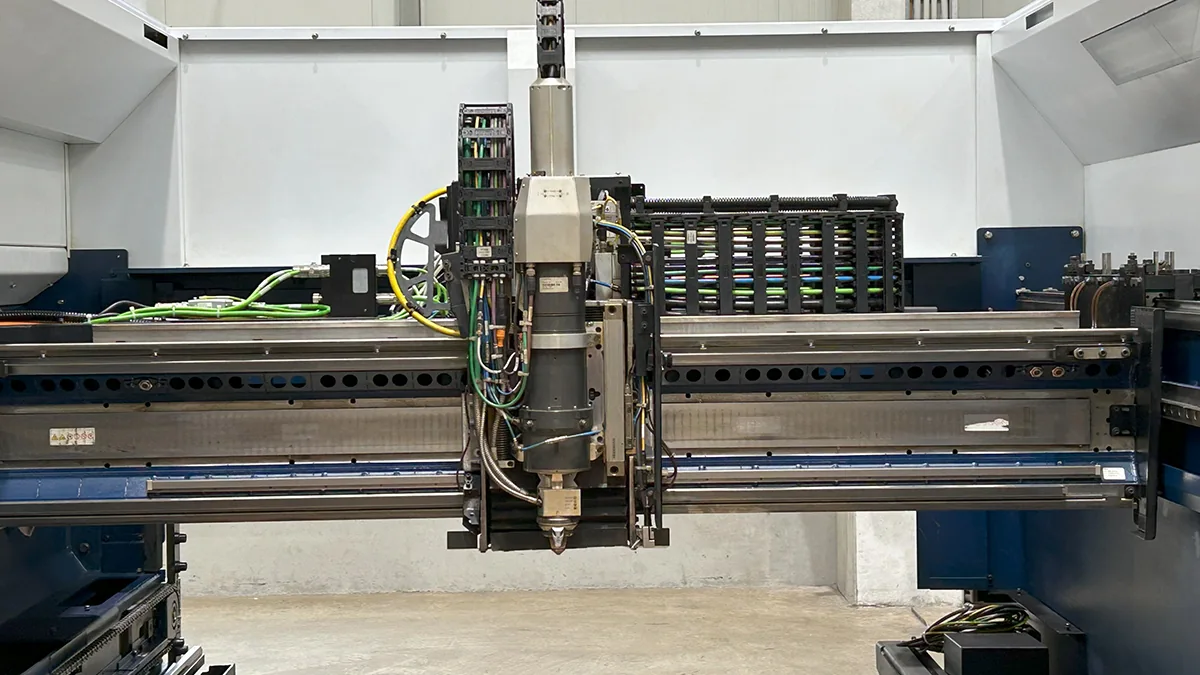
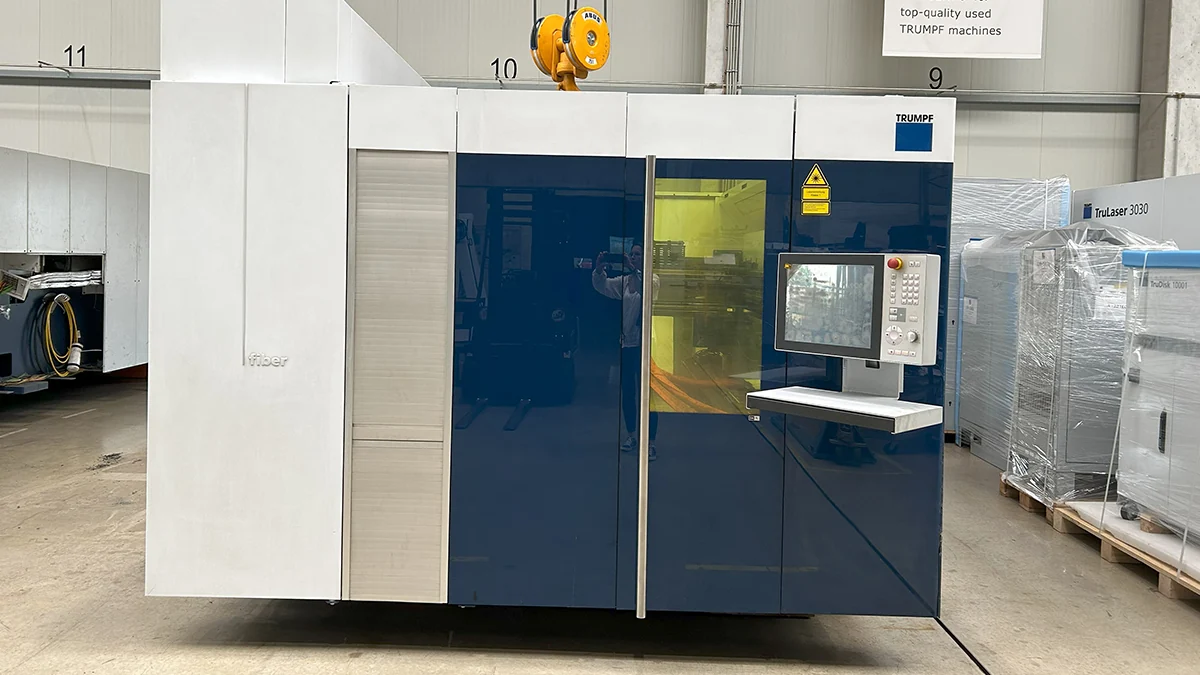
Refurbished 3 kW TruLaser 3030 fiber, 3000×1500 mm table, low beam hours.
Trumpf has been building flat-bed laser cutters for over 30 years and the TruLaser 3030 fiber (L49) belongs to the firm’s fourth generation of fiber machines. This refurbished unit combines a 3000 W TruDisk resonator with a work envelope of 3000 × 1500 × 115 mm, giving European job shops and OEMs enough flexibility to process both thin gauge stainless and structural steel up to 20 mm in a single shift.
The original owner logged only 53.916 total hours, of which 35.021 hours represent laser-on time and just 22.508 hours are actual cutting beam time. Independent data pulled from the control confirms these figures, so you get a chassis that has spent most of its life idle rather than subject to thermal stress.
Before entering the used market, the cutter was stripped down to the frame, received new linear guides, fresh bellows and a recalibrated optical path. The axial accuracy is now back to within ±0.03 mm over the full stroke, verified with a Renishaw interferometer. A recent performance certificate issued by TÜV Süd (ID 20-FL-3030-DE) is available on request.
Two factors decide whether a laser cutter is profitable: parts per hour and cost per part. The TruDisk source, developed in Ditzingen, delivers both thanks to its wall-plug efficiency of 30 % and rapid modulation capabilities.
Before listing the hard numbers, consider the practical implications. Shorter warm-up cycles mean operators can switch material grades in minutes rather than hours. Digital journals from Werkzeugforum show that shops running a similar 3 kW TruDisk save up to 6 kWh per shift compared with a CO₂ machine of equal power.
These three bullet points illustrate why a fiber source is often preferred over legacy gas lasers for mixed production. After each item you still have to decide whether the numbers match your current workflow, but the trend is clear: the less time a sheet spends on the table, the sooner it turns into revenue.
A short table helps to visualise the relationship between power, thickness and throughput.
| Material | Thickness | Typical speed | Edge roughness |
|---|---|---|---|
| Mild steel | 6 mm | 48 m/min | Ra 7 µm |
| Stainless | 10 mm | 15 m/min | Ra 12 µm |
| Aluminium | 3 mm | 60 m/min | Ra 6 µm |
Continuous production trials carried out by Blechonline in 2023 confirm these figures with a deviation of less than 5 %.
Many buyers focus on total machine hours alone, yet a more useful metric is beam-on time because it reflects real optical wear. With only 22.508 beam hours, the diodes, collimator and protective window have barely left their first life cycle. Trumpf specifies diode life at 100,000 hours, so statistically you have over 97 % of that figure ahead.
Another angle is the ratio of laser-on to beam-on hours (35.021 h vs 22.508 h). A value below 1.6 indicates efficient scheduling and minimal idle time, which usually translates into a control system free from repeated emergency stops and thermal shocks.
Every TruLaser 3030 ships with the TruDisk solid-state source. Unlike a CO₂ resonator, the disk design has a sealed optical path so no mirrors drift out of alignment. That alone saves around €2,500 a year in service calls according to German maintenance logs. A quick glance at the energy meter further shows an average draw of 37 kW during full throttle cutting, roughly 10 kW less than comparable gas lasers.
Before moving on, remember that the machine still uses standard consumables, meaning tips and ceramics are off-the-shelf items available from multiple European vendors. You will not be locked into proprietary contracts once your starter kit runs out.
Several shops consider Amada ENSIS or Bystronic BySprint Fiber when short-listing a 3 kW cutter. While both brands have merit, three objective points tilt the scale towards the TruLaser 3030.
Those numbers may not look dramatic at first glance, yet a single day of downtime on a €200 per hour cutting line can offset any initial savings on purchase price.
Two sentences after the list close the comparison. In short, the TruLaser 3030 fiber (L49) refurbished unit balances speed, cut quality and service ecosystem in a way its peers struggle to match, especially when total cost of ownership is considered over a five-year horizon.
Routine tasks include changing the protective window every 250 piercings and topping up the coolant once a month. The linear motors are sealed for life, so lubrication is limited to the shuttle table guides. Our inspection report shows backlash under 0.005 mm on both X and Y axes after adjustment.
For readers who prefer structured data, the following bullets outline the recommended maintenance intervals.
Once again we close with context. Adhering to these intervals keeps the beam stable and extends diode life, ultimately pushing major overhaul costs well beyond the typical payback period of 24 months.
Fabricators across Europe run the TruLaser 3030 for tasks ranging from HVAC flanges to decorative stainless panels. Thanks to BrightLine fiber the heat affected zone stays below 0.15 mm on 4 mm stainless, which is thin enough to eliminate secondary deburring for many parts.
Before listing industry examples, it helps to picture the production chain. A laser that cuts faster than your press brakes can keep up only shifts the bottleneck downstream. Therefore many buyers pair this model with Trumpf ToolShuttle or a Salvagnini P2 automatic panel bender.
Closing the section, remember that every application above benefits from the same strengths: high feed rates, small kerf and minimal dross.
Trumpf ships around 1,700 flat-bed lasers per year and the 3030 fiber accounts for roughly 22 % of that volume according to the company’s 2022 annual report. That popularity translates into a dense network of qualified technicians and a healthy second-hand market for parts.
Enterprises that usually pick up a refurbished TruLaser fall into three buckets. First are high-mix job shops aiming to slash cutting lead time. Second are OEMs looking to insource sheet work previously subcontracted. Third are R&D centres that need a reliable platform for prototyping without the cap-ex of a new build.
To wrap up, consider the practical gains:
All three gains convert directly into saved man-hours and higher machine availability, two metrics any plant manager tracks closely.
In the end, the TruLaser 3030 fiber (L49) refurbished offers a pragmatic path to modern fiber cutting without the waiting time and depreciation hit of a new machine. Its blend of 3000 W power, generous 3000 × 1500 table and verified low beam hours makes it a sound choice for shops that value predictable output over marketing hype.