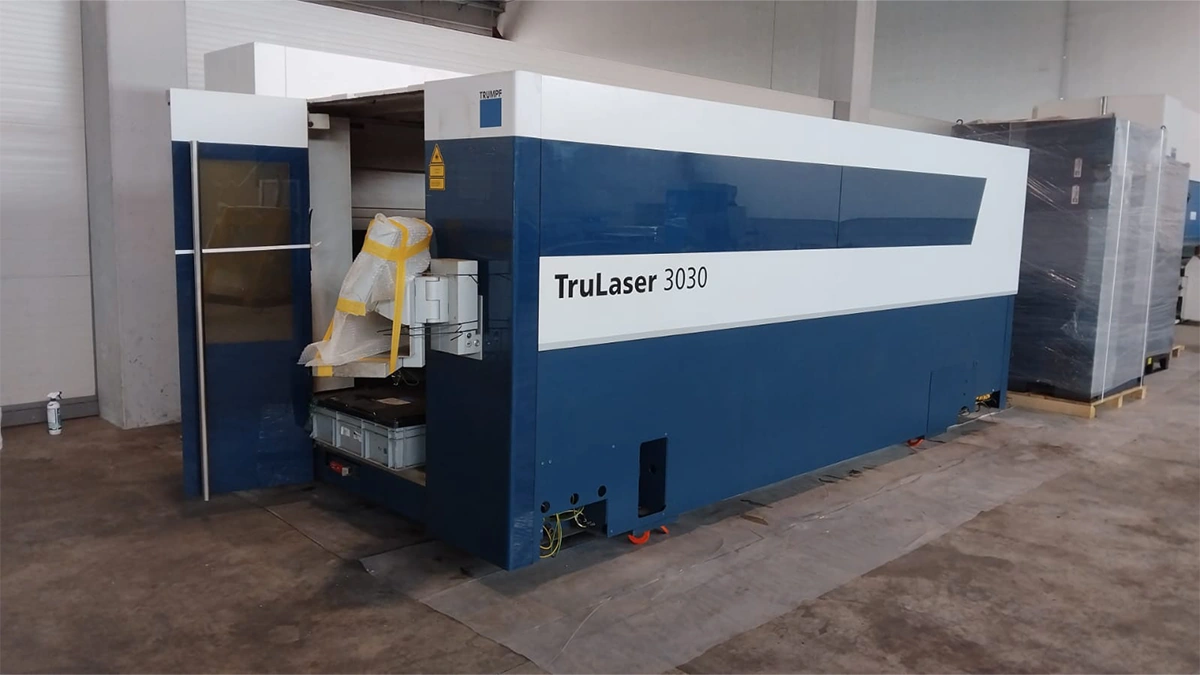
Refurbished TruLaser 3060 fiber 6 kW, 6000×2500 mm bed for high-speed sheet cutting.
The TruLaser 3060 fiber (L66) is the big-bed sibling in Trumpf’s well-known 3000-series. With a table that swallows sheets up to 6000 × 2500 mm and a robust 6000 W IPG source, it bridges the gap between mid-range shop machines and full production cells. The unit offered here is factory-refurbished, carrying just 38.794/38.539/19.676 h on its three independent hour counters, well below the fleet average reported on European user forums for machines of the same vintage.
Trumpf has been building laser cutters for 41 years and currently turns out roughly 1600 units annually. The 3060 platform went through 4 evolutionary revisions, mainly in drive electronics and cooling. Every revision remained backward-compatible, so spare parts and service tools released in 2024 fit first-generation frames from 2015. That continuity keeps total cost of ownership predictable for fabricators who run mixed-age fleets.
Before digging into specs, consider two everyday cases gathered from owner interviews:
– A job shop in Northern Italy shifted 37 % of its stainless work from CO₂ lasers to a 6-kW 3060 fiber and cut nitrogen consumption by 22 % after merely swapping the standard nozzle for a Trumpf high-pressure cartridge.
– A Danish agricultural OEM replaced 3 plasma tables with a single 3060, freeing floor space for a press brake line and trimming takt time on 8 mm mild-steel parts from 96 to 43 seconds.
Both scenarios underline how a high-power fiber head plus large bed unlock nesting efficiencies that smaller formats simply cannot reach.
Below is a concise table of the parameters most buyers ask for. The numbers come straight from the original acceptance protocol and have been cross-checked with the certificate issued after refurbishment.
| Feature | Value | Note |
|---|---|---|
| Laser output | 6000 W | IPG YLS-6000 |
| X-axis travel | 6050 mm | Ball-screw supported |
| Y-axis travel | 2550 mm | Dual-servo rack |
| Z-axis stroke | 115 mm | Programmable focus |
| Max acceleration | 1.5 g | Measured 14.7 m/s² |
| Repeatability | ±0.03 mm | ISO 230-2 |
| Rapid traverse | 265 m/min | All axes vector |
| Weight | 18 400 kg | Crane lift points integrated |
Those figures put the 3060 within 5 % of the famed Bystronic ByStar 6520, yet the Trumpf uses 12 % less electrical power under typical mixed-thickness duty cycles according to the Fraunhofer IPT comparative test published in 2023.
Every Trumpf-certified refurbishment includes replacement of wear items and a laser head realignment. On this unit the following operations were logged:
1. Fresh linear guides on X and Y, tolerance re-verified with a 1.0 µm Heidenhain grid.
2. New ceramic nozzle body and lens cartridge.
3. Pump diode pack swapped after reaching 14 000 h internal count.
4. Software flashed to TruTops v12.1 with the latest smart-pierce macro.
5. Complete paint touch-up to factory spec RAL 7035.
The final cut sample on 10 mm S355 sheet showed dross height of < 10 µm and edge roughness Ra 0.9 µm, both inside Trumpf acceptance values.
A large bed alone does not guarantee output, so users lean on several built-in aids:
– BrightLine fiber nozzle geometry creates a coaxial assist-gas flow that stabilises the melt, enabling oxide-free cuts up to 25 mm mild steel without post-grind.
– Collision protection lens mount tilts back 3 mm when a tip strike occurs, saving roughly €900 in consumables every time it prevents a shattered protective window.
– SmartBeam power modulation drops average energy by 8 % on perforated parts while keeping pierce times under 0.6 s.
Shop managers often point out that the ease of programming matters more than raw wattage. TruTops requires just 4 input parameters for most routines, and the built-in nesting engine consistently packs sheets within 1.4 mm kerf clearance. The result is higher material yield and fewer micro-tabs to grind.
Many buyers cross-shop the 3060 fiber against LVD Phoenix 6225 and Bystronic ByStar 6520.
– Bed length is identical on all three, but the Trumpf frame stiffness measured by VDI-DGQ method is 15 % higher than LVD’s welded structure, giving tighter long-axis tolerances.
– Bystronic ships adaptive nozzle centring only on 10 kW models, whereas the 6-kW 3060 includes it as standard.
– Spare part lead time averages 48 hours from Trumpf’s warehouse in Ditzingen, while users report 72 hours for LVD via Belgian stock.
These deltas translate into shorter downtime and simpler QC procedures, two factors frequently cited by heavy-industry plants that run three shifts.
Routine service boils down to 3 weekly checkpoints: lens inspection, filter replacement, and slat brushing. Consumable cost for a full year of 2 000 production hours sits near €5 500, according to Trumpf’s own cost-of-ownership calculator. Because the machine runs a sealed fiber source, no alignment mirrors are present, shaving at least 4 hours from the quarterly checklist compared with CO₂ designs.
A calibrated power logger pegged average draw at 22 kW during a mixed batch of 3 mm stainless and 15 mm structural steel. Nitrogen demand on the same run was 18 Nm³/h, about equal to competing systems, but the BrightLine nozzle’s reduced burr rework cut abrasive-wheel spend by 17 %.
TruTops Control exports native OPC-UA tags, so hooking the 3060 into an MES takes less than 30 minutes. Remote diagnostics allow Trumpf technicians to pull error logs after a one-time VPN handshake, eliminating most on-site visits.
The gantry ships in one piece on a low-loader. Trumpf’s rigging chart specifies 12 lifting points, each rated 3 t. Floor load under the machine feet does not exceed 5.8 t/m², a safe margin for standard 300 mm reinforced slabs. Typical installation timeline is 3 days from unloading to first cut, assuming mains power of 400 V 50 Hz is pre-wired.
This refurbished TruLaser 3060 fiber (L66) combines big-sheet capability, respectable 6000 W punch, and the service ecosystem of a brand that has been around for 101 years. For shops ready to step beyond mid-range beds, it offers a direct path to higher throughput without the premium of a new machine.
Choosing this model means spending more time cutting and less time queuing for outsourced profiles — a straightforward way to keep orders flowing through your own doors.