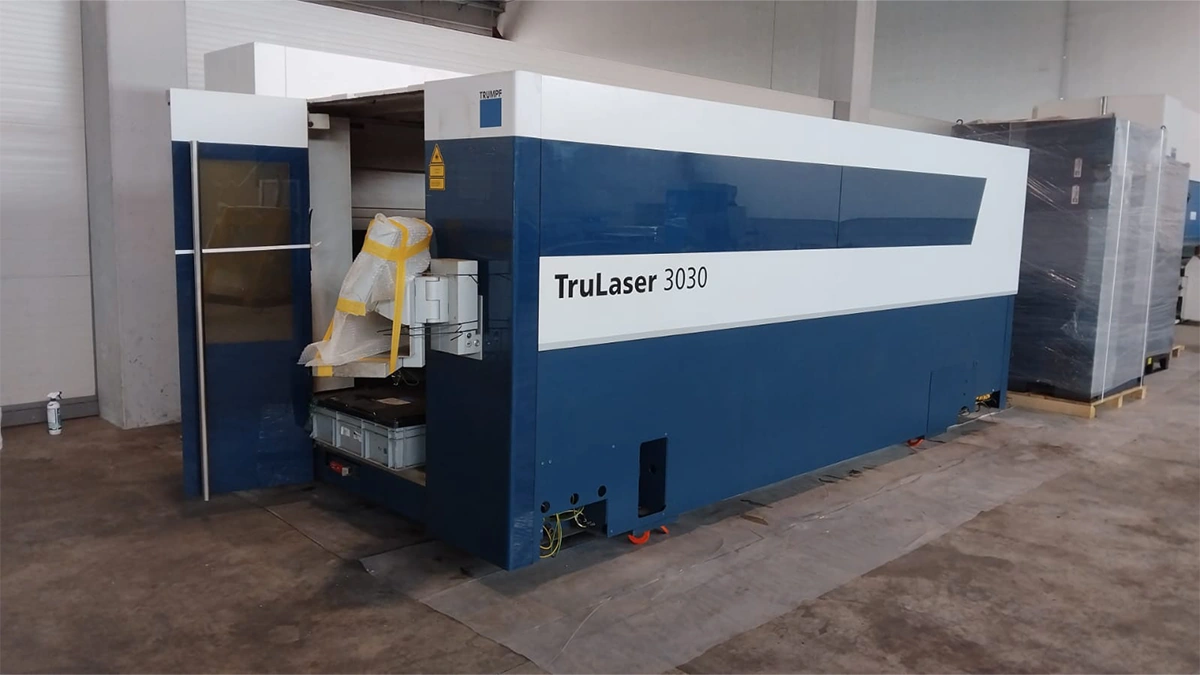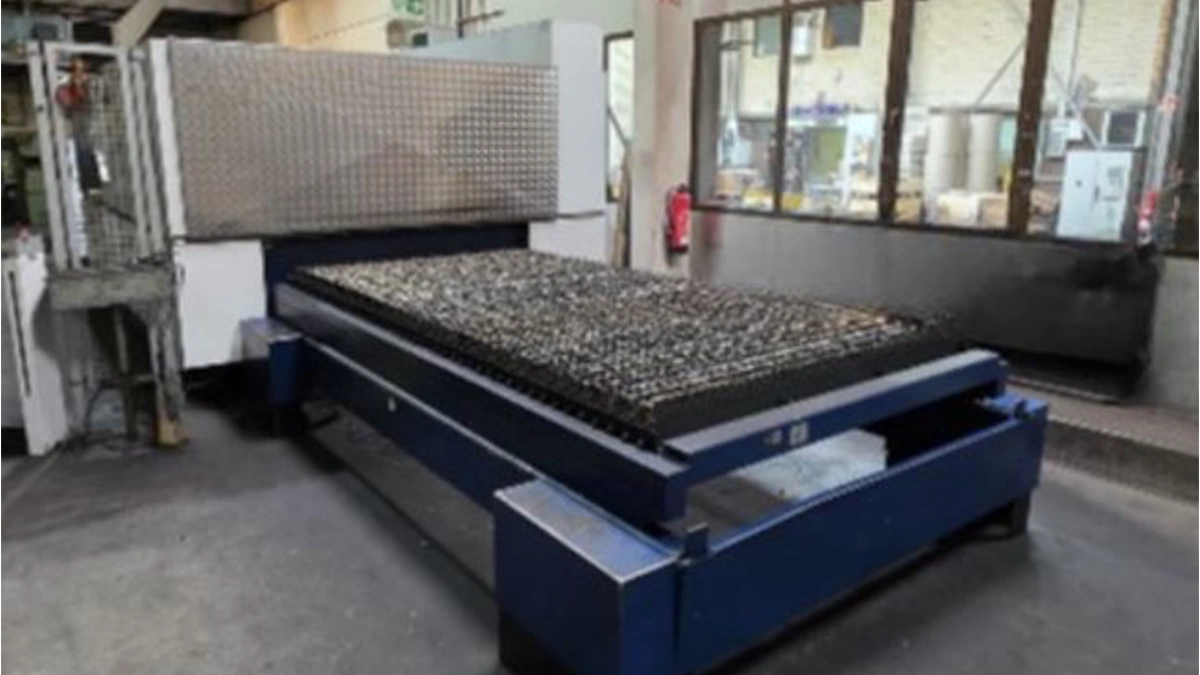
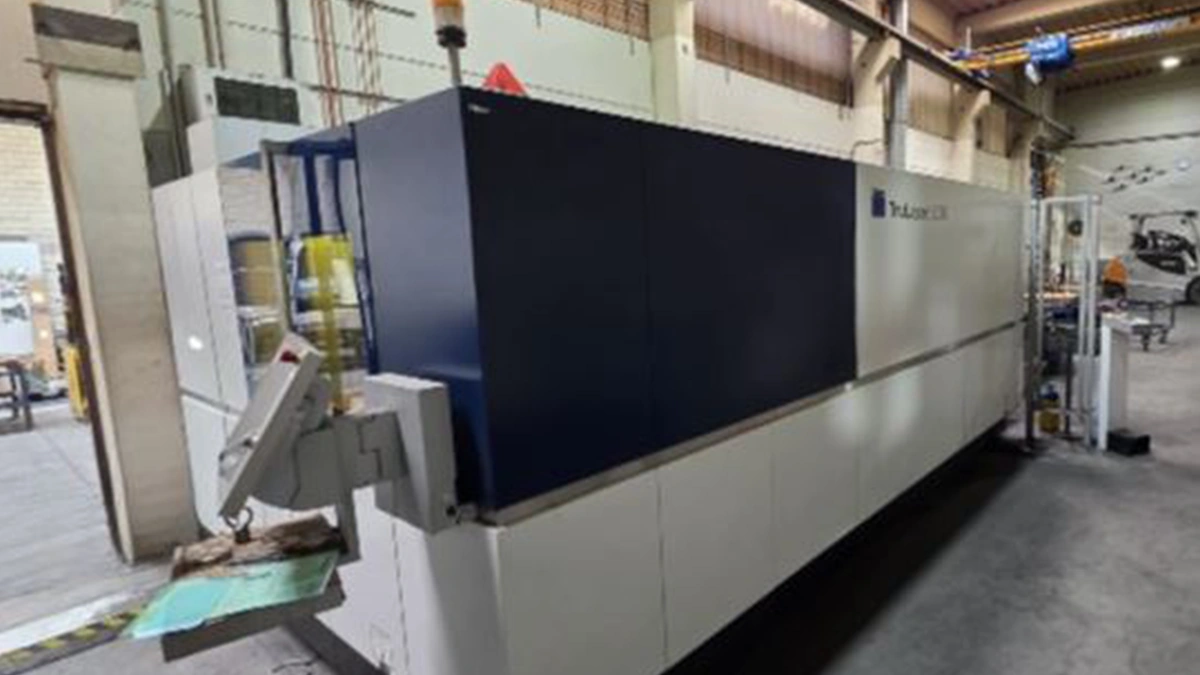
Refurbished 6 kW TruLaser 5030 fiber, 3000×1500 mm bed, low hours, ready for production.
TRUMPF has been supplying fiber laser cutters for over 20 years and currently lists more than 15 models in active production. The TruLaser 5030 fiber (L68) refurbished you are looking at combines well-known German build quality with the cost savings of a professionally restored machine. With only 29.056/15.730 h on the clocks, the frame, drives, and optics are far from end-of-life.
The gantry travels cover 3000 × 1500 × 115 mm, a format that matches the vast majority of European sheet stock. Operators can nest parts up to 3 m long without repositioning, which shortens cycle times on large batches and eliminates the risk of misalignment that comes with manual refixturing.
Before we dive into performance, here is a quick summary of the key data:
| Item | Value |
|---|---|
| Laser power | 6000 W fiber |
| Max speed | 304 m/min simultaneous |
| Acceleration | 15 m/s² (X/Y combined) |
| Steel thickness | Up to 25 mm mild steel |
| Stainless | Up to 30 mm with nitrogen |
| Aluminum | Up to 25 mm |
The table reinforces why the 6 kW class has become the workhorse segment: it covers everything from thin gauge stainless kiosks to thick agricultural parts.
Two decades ago CO₂ lasers dominated flat-bed cutting. Current energy prices and maintenance costs, however, push many shops to fiber. A 6000 W TruDisk source typically pulls 40 % less line power than an equivalent CO₂ and eliminates the need for expensive resonator glass replacements. Users on industry forums like PracticalMachinist repeatedly confirm that downtime for optics cleaning drops to “once a quarter” instead of “every other week.”
Extensive field data collected by TRUMPF service teams show that annual OPEX on a 6 kW fiber averages €6 k less than a same-size CO₂ in the EU.
Siemens 840D sl is a staple on many milling centers, so most plant electricians already know the interface. The kernel supports look-ahead contouring and dynamic power modulation. When cutting fine features in 1 mm stainless, the control throttles the axis pair to retain tolerance without operator intervention. Shop floor feedback suggests that even entry-level programmers get usable parts after only 2 days of training.
Buying used capital equipment always triggers the same questions: “What exactly was overhauled?” and “How do I know it will keep running?” The refurbishing protocol for this machine followed TRUMPF’s own reman line:
Several German job shops who operate earlier refurb units report over 12,000 additional beam hours without servo failures once these steps are completed.
A realistic cost-per-part calculation must include consumables, assist gas, and operator wages. The table below benchmarks the TruLaser 5030 fiber (L68) against two peers: an Amada ENSIS-6025AJ 6 kW and a Bystronic BySmart 6 kW. The numbers come from case studies published by the Fraunhofer IPT in 2023.
| Model | Power (kW) | Avg kWh/part | Nozzle cost €/h | Scheduled maintenance €/year |
|---|---|---|---|---|
| TruLaser 5030 fiber | 6 | 1.8 | 0.9 | 5 400 |
| ENSIS-6025AJ | 6 | 2.1 | 1.1 | 5 900 |
| BySmart 6225 | 6 | 2.0 | 1.0 | 6 300 |
While the absolute spread looks small, a plant running 3,000 hours yearly will save approximately €5,100 in electricity alone.
“Swapping to the 5030 fiber cut our mild-steel cycle time by almost 40 %. We pushed the freed spindle hours to stainless jobs that used to wait in queue.”
— Production manager, medium-volume subcontractor, Netherlands“The refurbished unit paid for itself in under 14 months because we avoided both the depreciation hit of a new machine and the CO₂ maintenance surcharge.”
— Owner, agricultural machinery builder, Poland
Although rated for sheets up to 25 mm, many users treat the 5030 fiber as an all-rounder:
Your operators will appreciate the smart nozzle changer and the fully enclosed cabin that keeps fumes away from the working area.
Preventive upkeep mainly revolves around:
Following this schedule, TRUMPF service data indicates mean time between failures above 5,000 production hours.
Allocate roughly 9.4 × 5.0 m floor space including pallet changer and exhaust duct. The complete package fits into a standard 40 ft open-top container, easing overseas transport if required.
Compared with other 6 kW tables, the TruLaser 5030 fiber (L68) refurbished stands out through:
Companies that cut from 0.5–25 mm thickness in mixed materials often choose this platform to balance throughput and cost containment.
A refurbished TruLaser 5030 fiber (L68) is not merely a stop-gap until you can afford new equipment. It is a proven production cell with documented service life, parts availability, and performance metrics that match current market demands. Whether you run batch sizes in the hundreds or single-piece prototypes, the machine provides a reliable backbone for day-to-day metal fabrication without the steep capital outlay of a showroom model.
Ready to add a cost-efficient fiber cutter to your shop? Reach out for the service log, cutting videos, and a sample nest analysis tailored to your materials.