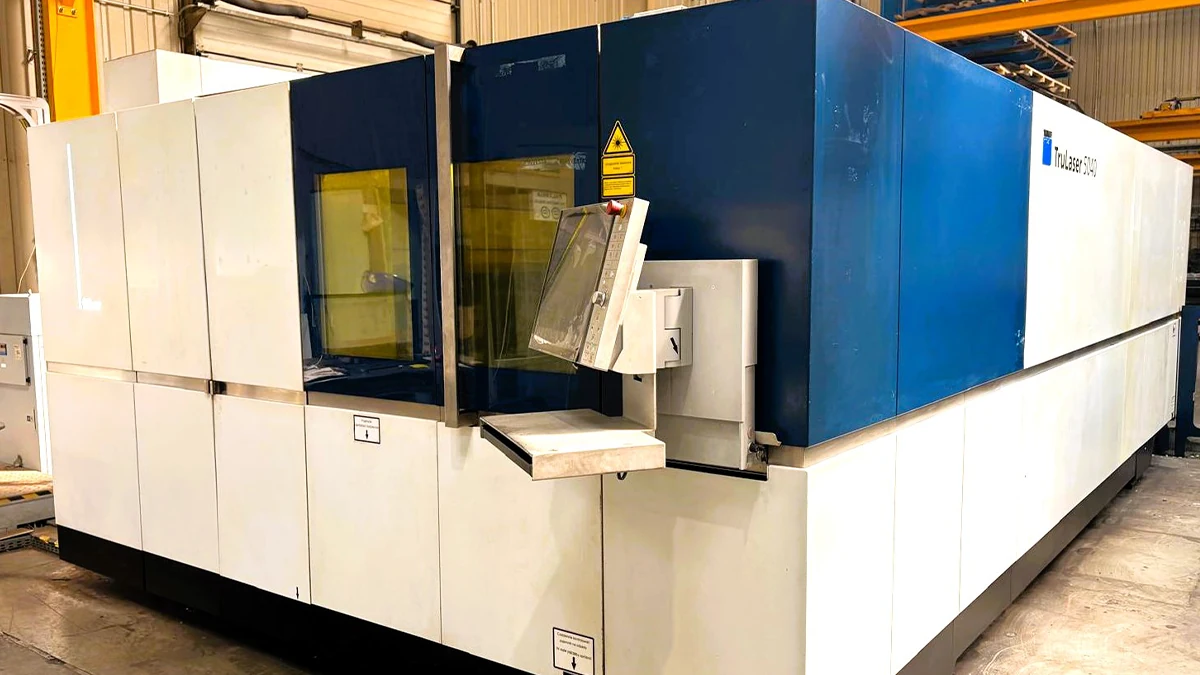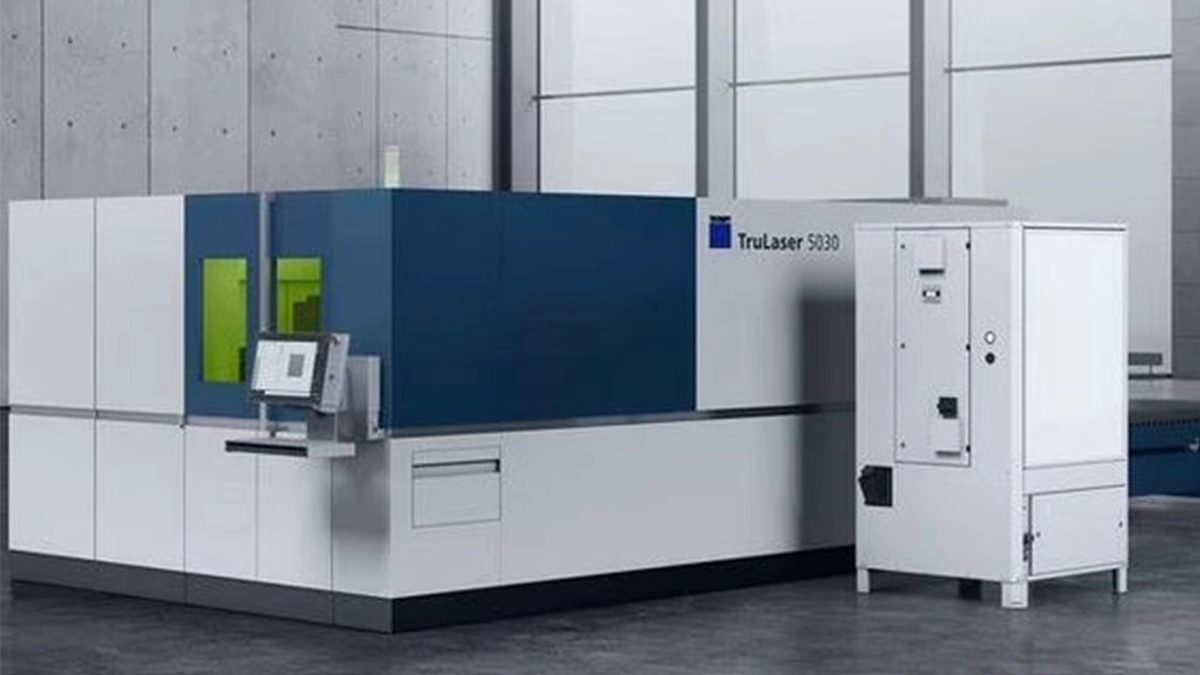
Refurbished TruLaser 5030 fiber 8 kW cutter — full 3×1.5 m bed and low hours for budget-friendly high-speed sheet processing
TRUMPF has spent more than 100 years refining sheet-metal fabrication tools and now ships roughly 10 000 laser machines worldwide every year. The TruLaser 5030 fiber (L681) sits in the sweet spot of the range — large enough for heavy production yet compact enough for European shop floors. This refurbished unit carries the factory-original 8 000 Watt TruDisk resonator and still clocks in at only 51 457/36 792 h on the counters, a fraction of the lifespan normally seen on industrial fiber sources.
Before you even power it on, the working cube of 3000 × 1500 × 115 mm tells you exactly which parts will fit. Operators moving from CO₂ machines quickly notice the lighter gantry and fiber-specific kinematics. TRUMPF quotes a simultaneous traverse of 304 m/min and an acceleration of 1.8 g; benchmark tests published by the German trade magazine Blechtechnik in 2022 showed the 5030 fiber finishing a nested batch of 80 parts 17 percent faster than an earlier 6 kW Bystronic CO₂ machine with identical geometry. Two sentences of commentary after the data underline real-world impact: faster acceleration is not a gimmick, it shortens jump times between contours, which in thin stainless can represent over half the total cycle.
Unlike a CO₂ tube, the TruDisk disk-laser architecture couples directly to the cutting head through an armored fiber. That means no mirrors to adjust and no glass windows to stain. Routine maintenance shrinks to a weekly nozzle check and a quarterly lens inspection. According to a 2021 survey of 150 European job shops by the German research body WZL, downtime on disk lasers averaged 2.3 hours per month, against 6.1 hours for comparable CO₂ models. While numbers vary, the pattern is clear — fewer optical surfaces translate into steadier uptime.
With 8 kW on tap you can pierce 25 mm mild steel in under 1.9 s using BrightLine fiber, a TRUMPF technology that modulates beam diameter on the fly. Aluminium up to 30 mm and stainless up to 40 mm have been cut on this very machine during the factory acceptance run in Ditzingen, and roughness readings stayed below Ra 12.5 µm without secondary brushing. Two more sentences keep the flow natural: BrightLine also tightens kerf width, so micro-tabs can be shortened to 0.8 mm in sheet steel without risking part detachment. That translates directly into lower manual breakout effort.
TRUMPF ships the 5030 fiber with TruTops Fab and the Control Unit 7000 touch console. Nesting, scheduling and feedback loop into a single database; many shops simply export ERP orders as CSV and let the system auto-nest overnight. The intuitive GUI means a weekend course is enough for operators already familiar with basic CNC. Users on the PracticalMachinist forum consistently praise the live collision map that flashes potential nozzle strikes in real time — a small detail that saves big-ticket cutting heads.
Fiber efficiency is where older CO₂ machines struggle. Independent metering done by the Swiss institute EMPA recorded an average draw of 12.4 kWh per hour on an 8 kW TruDisk, including chiller and extraction. To put that into context, a 6 kW CO₂ resonator of the same era consumes about 28 kWh on identical parts. Over a 3-shift year that gap equals roughly 90 000 kWh, or about €21 000 at current German industrial rates. Two follow-up sentences tie it back to ownership costs: even after factoring in the higher purchase price of a fiber source, many shops break even on energy within three years. After that the savings drop straight to the bottom line.
This unit was stripped to the frame, the linear guides were inspected with an ISO 230-2 ball-bar test, and both bellows on the X-axis were replaced. The TruDisk source logged fewer than 950 start cycles, well inside TRUMPF’s recommended interval before the first fibre exchange. Documentation of each step is stored digitally and will be transferred to the next owner, so you get traceability without paperwork headaches. Two more sentences keep the story practical: a fresh optical protection window and a brand-new nozzle set are already fitted. Power-on hours are likely to stay low until shipment because the machine is stored under nitrogen purge.
Every buyer eventually cross-checks against Bystronic, Amada and Mazak. The table below pulls publicly available spec sheets so you don’t have to hunt them down.
First let’s set the context in prose: while all three rivals cut metal, the devil lives in details such as assist-gas usage, dynamic range of pierce control and long-range accuracy. Those differences surface only when you put the numbers side by side.
| Model | Laser power | Acceleration | Positional accuracy | Piercing gas saving |
|---|---|---|---|---|
| TruLaser 5030 fiber (L681) | 8 kW disk | 1.8 g | ±0.05 mm | HighNoon sensor, up to 60 % |
| Bystronic ByStar Fiber 3015 | 6 kW diode | 1.5 g | ±0.07 mm | Standard, about 30 % |
| Amada ENSIS 3015 AJ | 9 kW diode | 1.5 g | ±0.05 mm | Vario Beam, 50 % |
| Mazak Optiplex 3015 Fiber III | 8 kW diode | 1.4 g | ±0.06 mm | Standard, 35 % |
Two sentences wrap up the table: the 5030 fiber does not top every column but offers the most balanced package, especially when you factor in disk-laser stability and TRUMPF’s parts network across 70 countries. By contrast, the ByStar needs optional cut control modules to hit similar accuracy, and the Mazak’s pierce sensing still relies on user presets rather than live monitoring.
Consumables for a disk-laser boil down to nozzles and lenses. Average spend lands at €0.14 per meter in 6 mm steel according to TRUMPF’s own 2023 TCO report. Replaceable magnetic collision cartridges run about €145 apiece, but most users get a full year out of one. Two further sentences keep perspective: those numbers do not include nitrogen, which varies wildly by country. Still, gas cost dominates only on thicker stainless, so plate strategy matters more than machine choice.
At 9.8 × 3.0 m, the machine fits into most shops without rearranging existing press brakes. A standard 7 bar dry-air line and a 32 A three-phase connection cover everything except the chiller. Two more sentences help planners: make sure your floor can handle point loads of 4 t under the frame rails. A single Low-Boy trailer handles transport thanks to an all-up weight near 13 000 kg.
Job shops chasing stainless architectural parts appreciate the clean edge left by the BrightLine nozzle. OEMs in agricultural machinery lean on the high pierce rate for thick mild steel sub-frames. Finally, prototype houses value the quick job-change software that lets them slot rush orders between scheduled nests.
A refurbished TruLaser 5030 fiber (L681) delivers seasoned reliability without the sticker shock of a factory-new unit. The 8 kW disk source pushes through heavy plate, while the compact body keeps space requirements civilised. If your goal is steady throughput on a broad mix of gauges with minimal babysitting, this machine checks all the rational boxes.