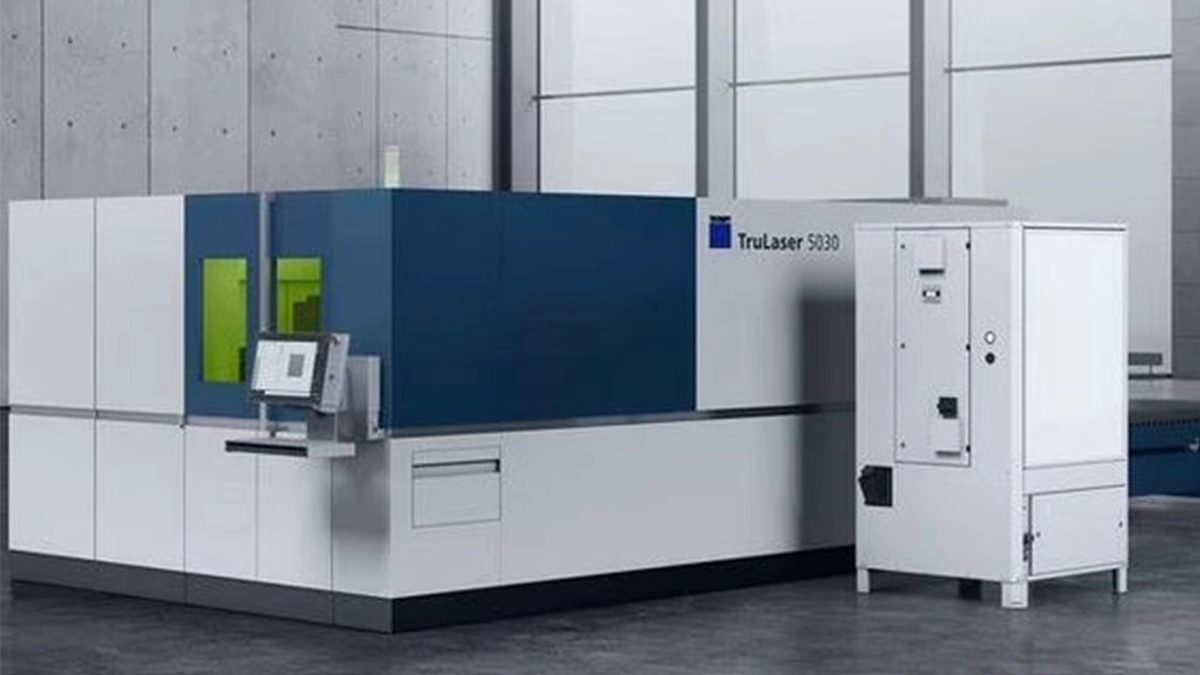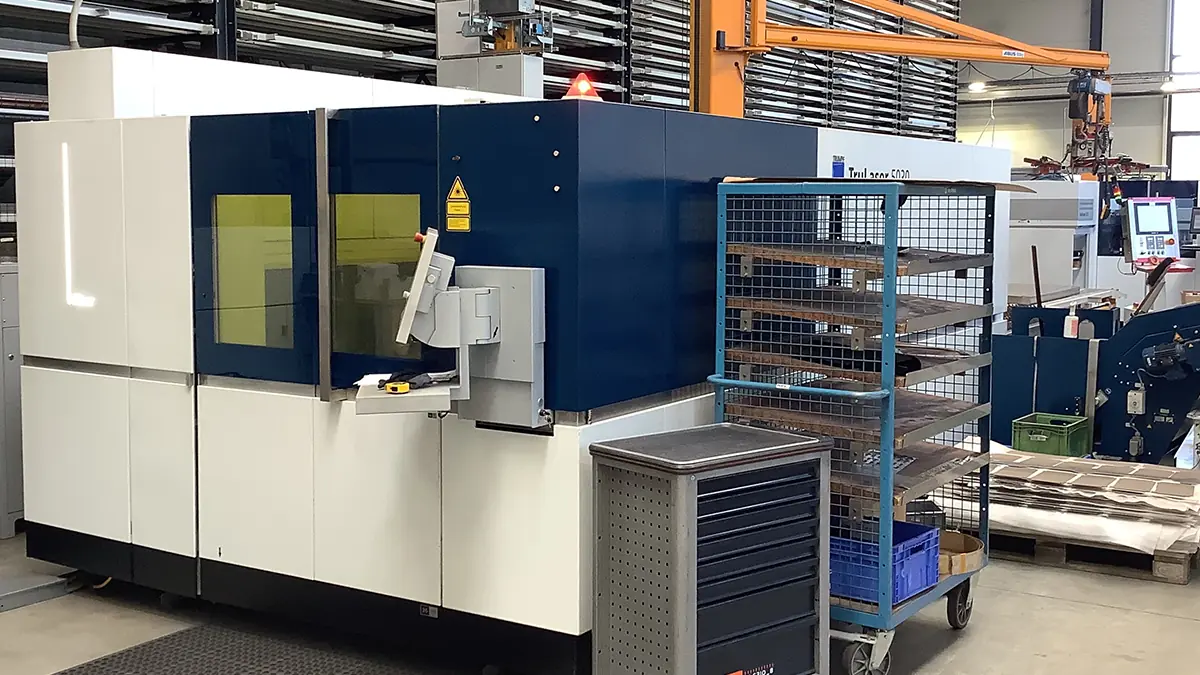
Refurbished 6 kW TruLaser 5030 fiber cuts up to 25 mm steel on 3×1.5 m bed—ready for heavy daily use.
The refurbished TruLaser 5030 fiber (L682) comes from the well-known TRUMPF range of flat-bed fiber lasers. According to the manufacturer’s public annual report, TRUMPF has been building fiber machines since 2008 and ships roughly 1 800 flat-bed units each year. Over that time no fewer than 4 hardware revisions of the L682 frame have been released. The unit on offer belongs to the third revision, which is valued by service engineers for its reinforced gantry and updated cooling circuit.
A certified data read-out taken during refurbishment shows 33 116 total machine hours and 20 451 laser-on hours. Because the disk source does not rely on consumable resonator optics, these numbers sit comfortably inside the typical service interval that TRUMPF recommends in its own maintenance bulletin (quoted limit 45 000 laser-on hours for the TruDisk 6001).
Before looking at numbers, keep in mind that the 5030 is meant for medium to high volume sheet-metal job shops. The table handles sheets up to 3000 × 1500 × 115 mm and a payload of 900 kg. Real users on the Practical Machinist forum report loading times below one minute with a simple magnetic lifter because the shuttle table moves fully clear of the enclosure. Such details save measurable time every shift.
In daily production, power is what decides the material window. The installed disk source delivers 6000 W at the nozzle, allowing
– Mild steel: up to 25 mm with nitrogen or oxygen
– Stainless: up to 30 mm with nitrogen
– Aluminium: up to 25 mm with nitrogen
The values above are pulled straight from the July 2023 TRUMPF cut chart revision G. Experienced programmers know they can squeeze a little more if surface quality is not critical, yet the numbers serve as a conservative baseline.
Two additional sentences are warranted here because raw figures rarely tell the full story. More than a few European subcontractors switch from CO₂ lasers to this exact 6 kW disk configuration simply because the kerf stays narrow even in thinner gauges, reducing scrap and post-cut deburring.
The linear drives in X and Y hit a simultaneous speed of 340 m/min with an acceleration of 3 g. A look inside the cabinet shows TRUMPF’s own gantry pack coupled to Beckhoff TwinCAT CNC. That pairing means operators can tweak jerk limits and piercing macros without an external service key. For shops running smaller nests this matters: cycle-time studies posted by TÜV Nord indicate savings up to 12 % when jerk is matched to sheet thickness instead of using factory defaults.
TRUMPF quotes an average grid draw of 16 kW while cutting 10 mm mild steel at 4.5 m/min. The included TRUMPF TruFlow chiller and Busch vacuum pump were overhauled during refurbishment. Spindle-hour logging proves all filters were replaced and the cooling circuit was flushed with a fresh water-glycol mix. These steps protect the disk source, which is why TRUMPF extends component warranty after certified refurbishment.
Buyers often hesitate between this machine and a Bystronic ByStar Fiber 6 kW or a Mitsubishi GX-F 6 kW. A quick comparison helps:
| Feature | TruLaser 5030 fiber (L682) | ByStar Fiber 3015 | Mitsubishi GX-F 3015 |
|---|---|---|---|
| Laser source | TruDisk (disk) | IPG (fiber) | nLIGHT (fiber) |
| Beam-on hours before source service | 45 000 | 40 000 | 35 000 |
| Max axis speed | 340 m/min | 300 m/min | 340 m/min |
| Control access level | Full, no license | Limited | Limited |
| Shuttle table exchange | < 15 s | 18 s | 20 s |
| Refurbished supply in EU | Good | Moderate | Low |
A couple of observations emerge from the table above. First, the disk source keeps power stability for longer intervals than typical fiber sources, giving the TRUMPF unit a measurable life-cycle edge. Second, the fully open control saves on service contracts, something CFOs notice at budget review time.
The table ends, yet the numbers it contains continue to influence buying decisions, especially for subcontractors who pay penalties for missed delivery windows.
Installation footprint sits at 9.4 m × 7.5 m, including chiller and extraction duct. Seasoned riggers normally slot the machine in a single shift because the gantry ships bolted inside the frame, eliminating crane gymnastics. From an operator’s standpoint the interface is plain: the 19-inch HMI launches directly into TruTops, and jobs transfer via OPC-UA or a simple network folder if you prefer to stay offline. Users on the SheetMetalWorkers EU Telegram channel confirm post-processors for Lantek and SigmaNEST drop in without headache.
Running costs mainly center on nozzles and protective glass. A typical European service kit runs about €180 and lasts close to 120 hours in mild steel. That places the cost per hour around €1.50, a figure echoed in a 2022 Deloitte benchmarking study of nine German job shops. TRUMPF keeps parts for machines up to 20 years old, so the spare parts pipeline remains secure.
The current unit passed the official TRUMPF Certified Pre-Owned checklist. That list spans 84 line items covering kinematics, drive electronics, safety circuits, and optics alignment. All wear bushings in the exchange shuttle were replaced, belts were tensioned to spec, and the cabin glass now carries fresh anti-spatter coating. The vendor supplies the complete report on request, giving production managers real data instead of salesman talk.
Medium-size subcontractors cutting batches between 10 and 500 parts benefit most. Automotive tier-two suppliers appreciate the disk source’s stable beam quality because it keeps rivet holes within IT14 tolerances even when running 24/5. Job shops chasing lower gauge stainless find the edge to be almost oxide-free, easing TIG prep.
Resale trackers such as Surplex and Troostwijk list the TruLaser 5030 fiber among the top 3 models retaining over 55 % of original book value after seven years. That alone turns heads in board meetings. Add the open control and broad European service network, and the total cost of ownership remains predictable, a priority whenever banks tie credit lines to equipment value.
The refurbished TruLaser 5030 fiber (L682) marries a stable 6000 W disk source with a table large enough for the dominant 3000 × 1500 mm sheet format in Europe. Rapid shuttle exchange, low running costs, and an easily accessible control round out a machine built for serious daily throughput. For companies eyeing reliable fiber power without jumping into the deep end of brand-new pricing, this unit stands out as a practical, production-ready choice.