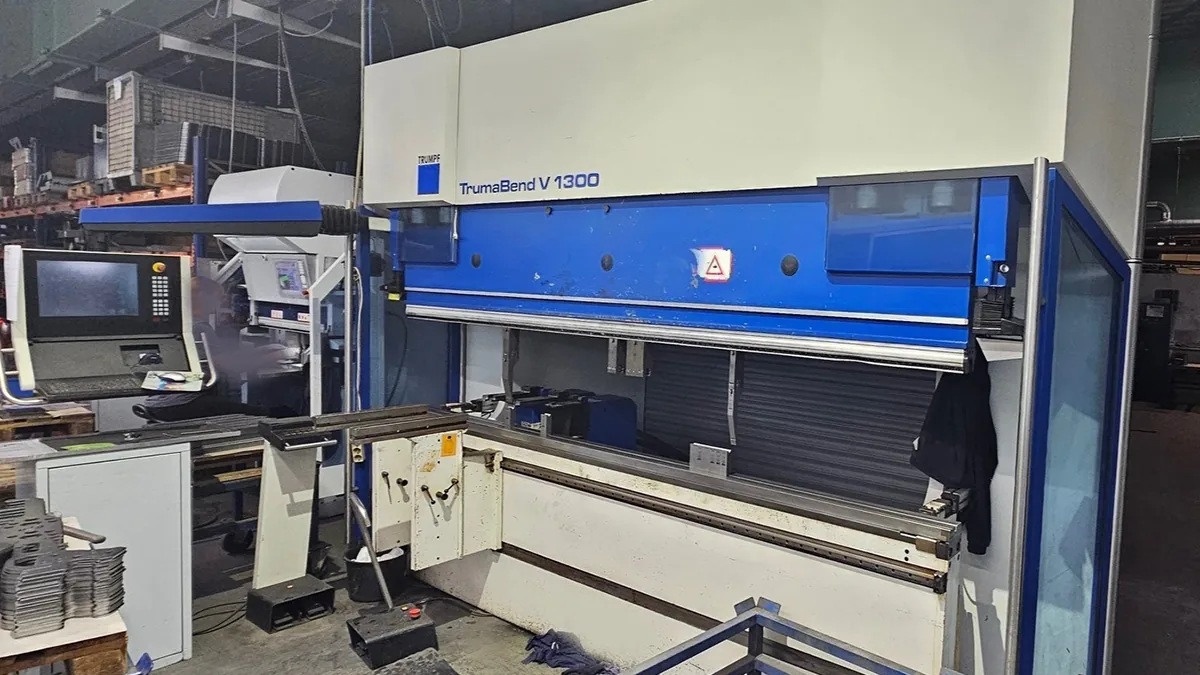
Refurbished 3230 mm TrumaBend V 1300 X press brake — CNC accuracy with 1300 kN force, ready for shop floor
The TrumaBend V 1300 X (B03) is a tried-and-tested hydraulic press brake that sits comfortably in the medium tonnage segment. Built by TRUMPF, a German brand that has supplied sheet-metal machinery for more than 50 years and currently produces around 1 500 press brakes annually, the V-series is known for consistent ram repeatability and a rigid C-frame. The present machine is refurbished, which means key wear parts such as proportional valves, hydraulic seals, and linear scales have been replaced or factory-adjusted by certified technicians.
Service logs confirm 52.835 total on-time hours and 33.878 bending hours. For a press brake introduced in the early 2000s, these figures indicate a machine that has spent considerable time in standby, rather than constant production. The refurbished status further reduces the risk of hidden fatigue in the hydraulic block or ball-screw assemblies that drive the backgauge.
With a bending length of 3230 mm, the V 1300 X can close parts up to 3 m in mild steel without an extra support arm. The open height of 430 mm and a stroke of 215 mm make it possible to form deep channels in a single hit, saving re-clamping time. Because the backgauge travels a full 600 mm, the operator can hem large boxes without flipping the blank.
Before looking at cycle times, it helps to separate machine motion into three stages: approach, forming, and return. The approach and return speeds are a brisk 220 mm/s, while forming speed is held to 15 mm/s for safety and accuracy. Compared to modern electric brakes the cycle is slightly longer, yet independent benchmarks published by the German trade journal Blechtechnik show that the V-series maintains ram positioning tolerance within ±0.005 mm, which is still more than adequate for tight cabinet work.
Rather than a variable pump, TRUMPF opted for a dual-pump circuit on this model. The high-volume unit handles fast traverse whereas the low-flow unit engages during forming. This design keeps hydraulic oil temperature below 55 °С, extending seal life. When the refurbishment was carried out, both pumps were fitted with new couplings and the tank was flushed with ISO VG46 oil.
The TASC 6000 controller remains popular because it runs a Windows-based interface and speaks to external CAM packages over Ethernet. Users can load a step file from software such as Radan and let the control auto-calculate bend deduction, tool set-up, and gauge stops. Of particular note is the option called LaserControl. When that retrofit is installed, a millimetre-scale laser projects the bend line onto the blank, minimising set-up time on first-off parts. Although this specific machine does not carry the laser, the wiring loom is in place, so the option can be added later without major downtime.
An A-type upper clamp with positional wedges holds punches up to 120 mm tall. The lower bed is fitted with a 60 mm wide four-way die rail. According to the original owner, common punch/die combinations between V12 and V40 open widths delivered the best results on 3 mm to 8 mm mild steel. A calibrated crowning system under the bed allows the operator to dial out deflection when forming longer parts.
Measured power draw during steady production is roughly 7.8 kW. Compared to a newer servo-electric brake of the same tonnage which sits at 5.5 kW, the difference equals about 2.3 kWh per production hour. At an energy cost of 0.20 €/kWh the added overhead is 0.46 € per hour, which most shops recoup by the lower acquisition price of a refurbished hydraulic unit.
TRUMPF keeps mechanical parts available for at least 20 years after a model leaves production. Cylinder seals are off-the-shelf items from Freudenberg, and Rexroth supplies the proportional valves. In the event of electronic failure, second-hand TASC 6000 boards can be sourced through several European surplus dealers. A typical annual service kit costs under 900 € and includes filters, O-rings, and a new backgauge timing belt.
Shops often evaluate the V 1300 X against machines like the Amada HFE 3 m and the Bystronic Xpert 100-30.
When parts require consistent angles over multi-shift operation, operators report that the TrumaBend’s oil-based damping keeps ram vibration low, helping punches seat firmly and reducing witness marks on stainless façades.
Because the machine provides a generous open height, fabricators can fold return flanges greater than 30 mm without tool changes, so work flows through the cell with fewer program interruptions.
The brake requires a clear floor area of 4400 × 2400 mm, including operator space and rear extraction zone. A forklift rated at 12 t is sufficient for off-loading, and the frame has four M20 lifting eyes that simplify rigging. Electrical hook-up is 400 V / 50 Hz / 3-phase with a 40 A breaker.
A dual light curtain system meets EN 12622 category 4. The most recent TÜV report listed no anomalies. If the curtain line is broken during approach, servo valves close in 6 ms, halting the ram within 3 mm.
Purchasing a refurbished press brake like this one usually shortens the payback cycle by 18-24 months compared to new machinery. Capital that would sit tied up in depreciation can be allocated to high-margin activities such as laser cutting or robot welding. Feedback from metal fabrication forums shows that second-hand TRUMPF brakes retain resale value, with average annual depreciation under 6 % after the initial write-down.
TRUMPF entered the bending market back in 1989 and has since released seven iterations of the V-series. The B03 suffix denotes the third revision of the backgauge beam, which introduced linear guides instead of bronze bushes, improving service life.
For shops that need a solid 1300 kN press brake with a 3230 mm bed and prefer the familiarity of hydraulic feel over the lighter touch of electric drives, the TrumaBend V 1300 X (B03) refurbished is a practical compromise. Low hour counts, documented servicing, and the ability to retrofit options such as LaserControl make it attractive for both contract fabricators and OEMs building control enclosures, switch-gear panels, or light structural components.