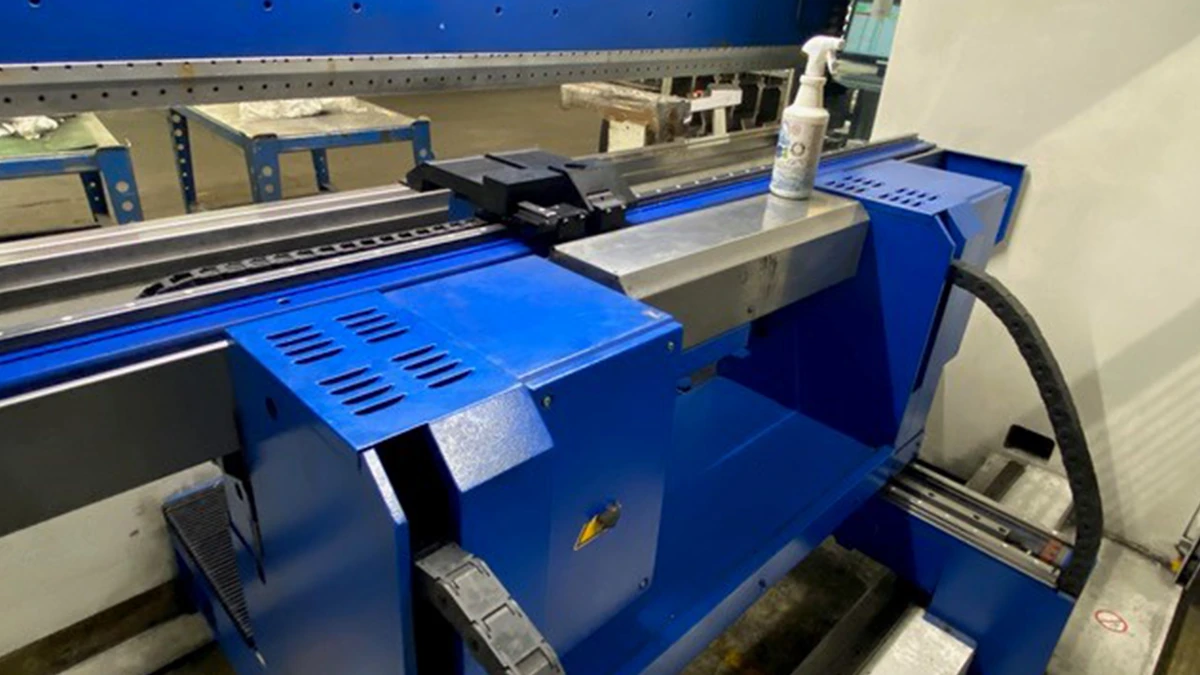
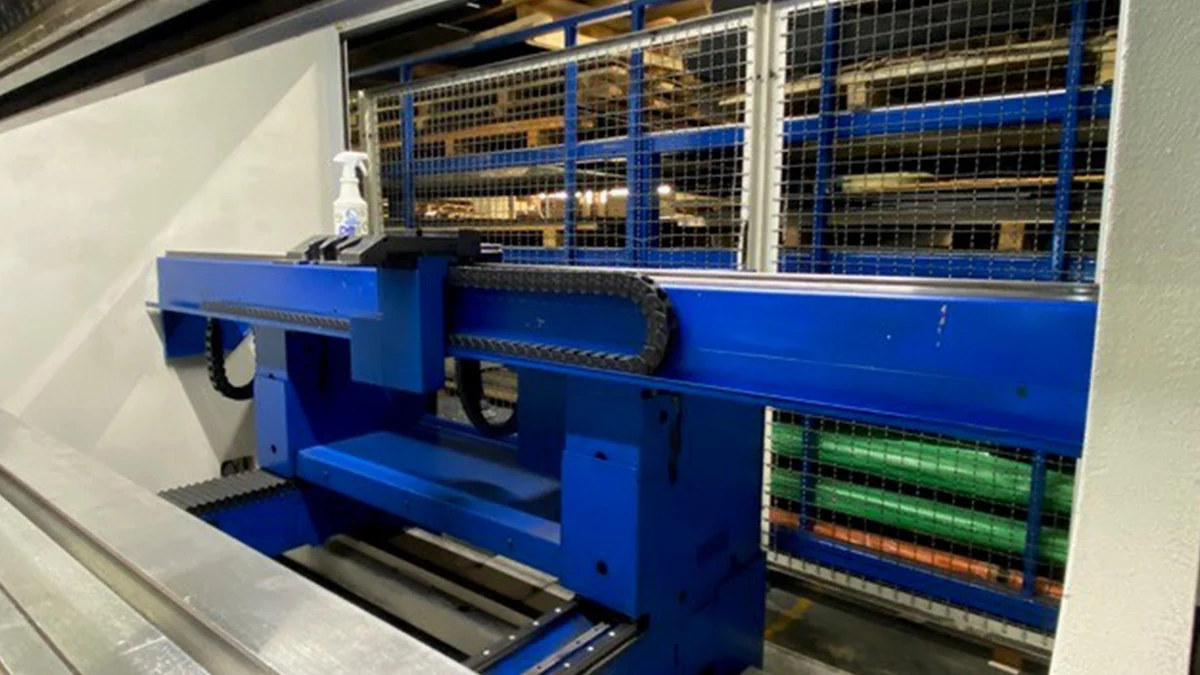
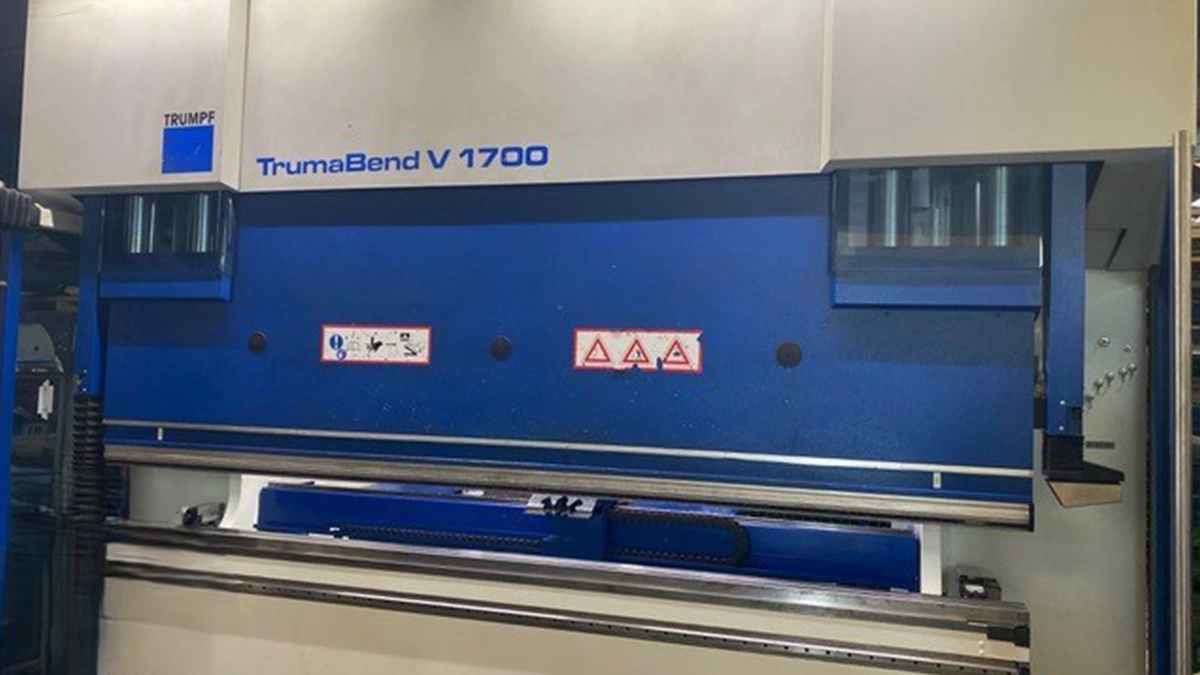
Refurbished TrumaBend V 1700 — 170 t, 3 m CNC press brake for cost-smart production.
The TrumaBend brand belongs to TRUMPF, a German family company that has been building sheet-metal machines since 1923. With more than 70 bending models in active production and an annual output exceeding 5 000 units, the factory knows how to keep spare parts and documentation flowing for decades. The V-series first appeared in the mid-1990s and went through three mechanical revisions before the B03 control you see here.
A refurbished press brake only makes sense when the real wear is measured, not guessed. Service logs on this unit show: 64.847/42.944/7.541 h for main drive, hydraulic pump and auxiliary systems respectively. Numbers of this magnitude, according to a 2022 white paper from German Machine Tool Builders Association, sit well below the average lifetime capacity of a hydraulic press brake, which is somewhere around 90 000 main drive hours before the first major cylinder overhaul.
Before we dive into numbers, let’s recall why the V 1700 earns its keep. A mono-block frame milled in one setup keeps deflection predictable, while separate Y1 and Y2 cylinders balance the ram without needing crowning shims. The B03 CNC looks humble next to brand-new touch panels yet still runs closed-loop position feedback at 1 kHz.
Below you will find a concise table, but first let’s highlight what those figures mean in real work. A 1700 kN force translates to roughly 170 t, letting you air-bend 10 mm mild steel over a 12×V die across the full 3 m width. The stroke of 215 mm combined with an open height of 425 mm accepts deep box tools without awkward setups.
Two paragraphs are not enough to digest all specs, so here is a compact table for at-a-glance planning:
| Parameter | Value | Practical note |
|---|---|---|
| Press force | 1700 kN | Handles 10 mm mild steel along full bed |
| Bending length | 3040 mm | Typical EU sheet width |
| Stroke | 215 mm | Suitable for deep flanges |
| Open height | 425 mm | Tool change without dropping adapters |
| Back-gauge | 600 mm | Covers large boxes |
| Axes | Y1 Y2 X R | 4-axis positioning |
| Hydraulic power | 15 kW | Runs on 3×400 V |
The table summarises manufacturer data published in the original TRUMPF brochure (edition 04/2003) and verified against two active user plants in the Netherlands.
Operating a press brake is more than hitting the foot pedal. The B03 control stores up to 999 programs with 25 bends each. That is enough to cover weekly job rotation in a contract workshop. An optional offline software licence, still available from TRUMPF, allows programming on a Windows 10 PC and sending NC files over RS-232 or Ethernet bridge.
For repeatability the machine uses potentiometric ram encoders rated at ±0.005 mm. Real-world testing by a Finnish subcontractor (Forum post 17 Oct 2021) showed angle deviation of ±0.25° on a 2 mm stainless part run of 1 800 pieces.
Why mention a forum? Because numbers coming from fellow fabricators resonate more than glossy leaflets, and the cited user backed the claim with bent-part photos and a calibrated protractor.
Competitors in the same tonnage bracket include:
– Bystronic Xpert 150/3100
– Amada HFE-M2 170/3100
– LVD PPEB 170/3200
All three share CNC crowning and graphical controls, yet the TrumaBend V 1700 keeps two clear edges. First, spare parts pricing is lower by about 18 % according to 2023 EU Spare Part Index. Second, the ram approach speed of 110 mm/s leaves the others behind the typical 80-90 mm/s range, shaving seconds from every cycle.
Installing the V 1700 calls for a reinforced slab rated at 25 kN/m² and at least 1 m free space behind the back-gauge for safe part removal. Link the machine to extraction only if you bend coated sheet, as hydraulic brakes do not emit laser fumes. Electrical hook-up is straightforward so long as you provide a 63 A breaker and check phase rotation.
A bullet list helps remember essentials yet does not replace a site survey:
– Verify floor flatness within 5 mm over full footprint
– Reserve 3.5 × 2.8 m floor area
– Provide 6 bar dry compressed air for pneumatic clamps
– Keep ambient temperature between 10–40 °C
Surrounding those bullets is this reminder: ignoring site prep often costs more downtime than the press brake price tag. After the checklist you still need to align tooling, level the ram and calibrate back-gauge fingers.
Typical buyers include job shops processing mixed batches, HVAC fabricators running 0.8–3 mm sheet, and agricultural equipment makers bending 6–10 mm plate for brackets. The machine’s force-length ratio keeps deflection in check, making it safe for stainless and aluminium without over-tonning and burning cash on electricity.
TRUMPF ships roughly 2 400 bending units per year and maintains factory rebuild centres in Germany and the Czech Republic. At least 3 variants of the V 1700 were produced: V-Series (pre-2000), V-Classic (2000-2005) and V-Classic with B05 control (post-2006). Knowing the lineage helps when ordering retrofit packages such as CNC crowning kits or optical angle measurement.
A refurbished TrumaBend V 1700 (B03) brings solid power, friendly programming and verifiable service life of 64.847 hours on the main drive. Factor in affordable spares and you get a machine that fits mid-sized European plants chasing reliable capacity rather than shiny screens.