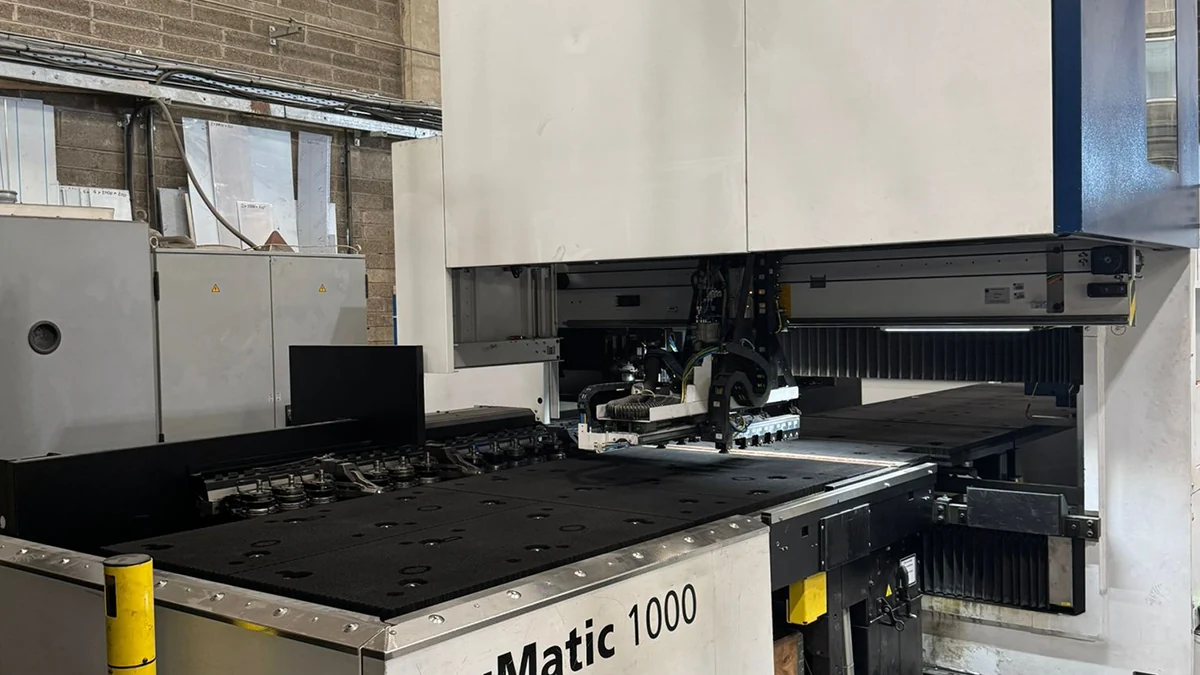
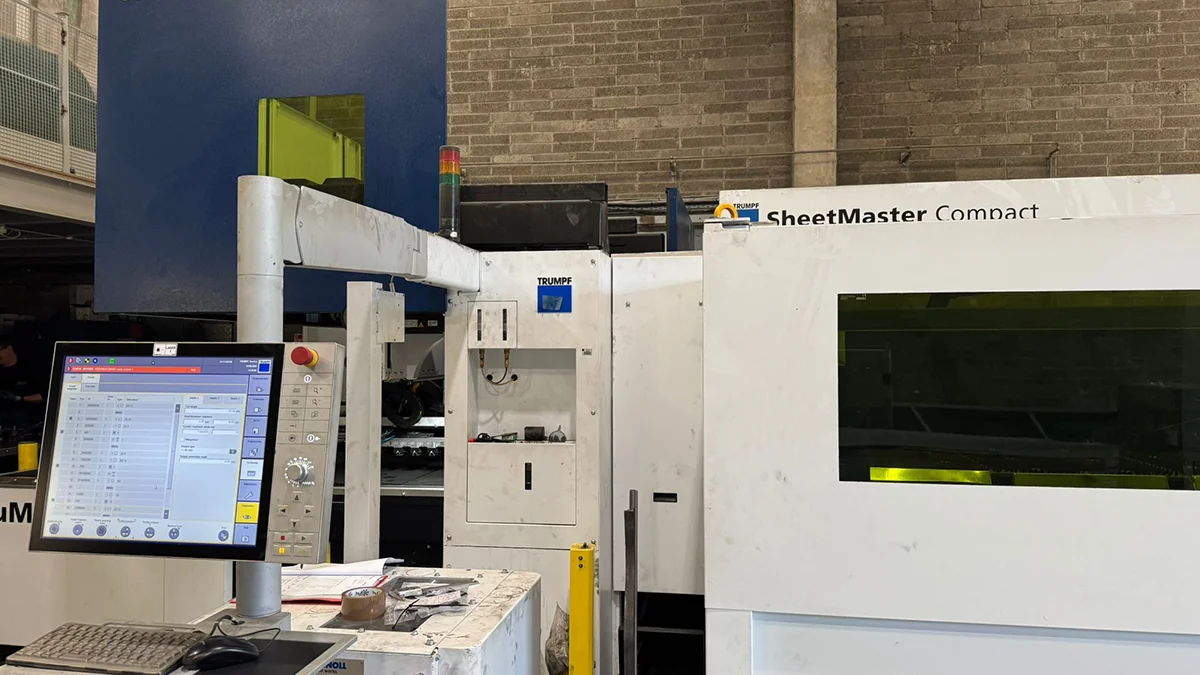
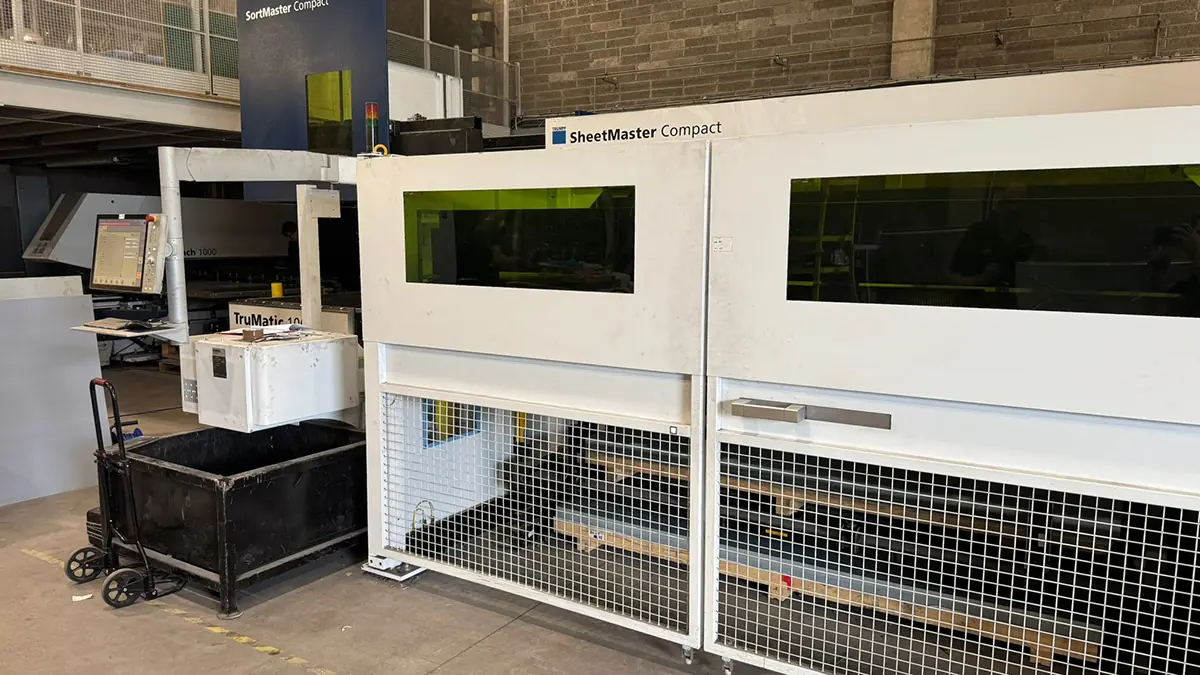
Refurbished TruMatic 1000-1300 fiber — 3000 W laser plus 165 kN punch in a compact 2500×1250 mm footprint.
When TRUMPF introduced the TruMatic 1000-1300 fiber series, the idea was simple — merge the speed of a fiber laser with the flexibility of a punching head in a single compact frame. More than 3 000 units of this family have left the production floor in Ditzingen since 2013. The refurbished unit on offer still keeps the original German build quality while giving you a dramatic reduction in capital expenditure compared with a factory-new model.
Machine uptime often tells the real story. This TruMatic shows 19 109 hours on the laser counter and 15 442 hours on the general counter, both taken directly from the control logbook. Several EU sheet-metal shops on industry forums regard anything below 25 000 laser hours as the sweet spot for a pre-owned hybrid — past initial teething issues yet far from end-of-life.
The frame is a welded steel gantry, stress-relieved and machined in one clamping to keep torsion low. A rack-and-pinion drive on X and a precision ball-screw on Y lets the carriage cover the full 2500 × 1250 mm table size without backlash. Linear guides are sealed against dust, a design taken verbatim from larger TruMatic 7000 units.
Before listing the core assemblies, let’s briefly touch on why TRUMPF still uses separate linear axes for laser cutting and punching: mechanical decoupling reduces vibration, so the fiber source can hold a ±0.1 mm contour tolerance even when the punching ram fires at 800 strokes per minute. Users on the Practical Machinist board confirm that small holes stay round when both processes run back-to-back.
The table below shows how the unit compares to two competitors.
| Feature | TruMatic 1000-1300 | Prima Power Combi Genius | Salvagnini S1 |
|---|---|---|---|
| Laser power | 3000 W fiber | 4000 W fiber | 3000 W fiber |
| Punch force | 165 kN | 230 kN | 200 kN |
| Max sheet | 2500 × 1250 mm | 3000 × 1500 mm | 3000 × 1500 mm |
| Positioning accuracy | ±0.1 mm | ±0.15 mm | ±0.12 mm |
| Footprint | 7.2 m² | 11 m² | 10 m² |
| Average power draw | 9 kW | 12 kW | 11 kW |
As the numbers show, the TruMatic trades raw power for a smaller footprint and lower energy use. Shops with limited floor space often value those two factors above an extra kilowatt of laser output.
The heart of the machine is a TRUMPF TruDisk fiber resonator rated at 3000 W. According to factory literature, wall-plug efficiency hits 28 %, twice that of vintage CO₂ sources. The sealed optical path eliminates mirrors, so real-world users report uptime over 99 % between scheduled cleanings.
TRUMPF ships the machine with a quick-change cartridge system. Three lens cassettes — 1.8 in, 3.75 in, and 5 in focal length — cover everything from thin gauge stainless to 6.4 mm mild steel. Nozzle centering is handled by a proprietary CCD routine already stored in the Sinumerik macro library.
The hydraulic ram delivers 165 kN via an all-steel C-frame. A 21-position linear magazine feeds standard Thick Turret tools, while a double-station index holds forming inserts or a multi-tool cassette. Two owners interviewed at EuroBLECH 2022 both praised the servo-controlled rotation: setups that once took an hour are down to ten minutes because tools auto-index under CNC.
Even in the entry-level configuration this unit carries the FMC label — Flexible Manufacturing Cell. That tag means the pallet changer, load/unload tower, and scrap skeleton conveyor are tied into the core CNC. Music to any production manager who hates stop-and-go workflows.
Two paragraphs later many potential buyers ask about interface compatibility. The short answer: the FMC stack speaks Profinet, OPC-UA, and TRUMPF’s own OPC DataChannel, so tying the machine into an ERP dashboard is a matter of one Ethernet drop.
The Sinumerik 840D slotted into TRUMPF TruTops is standard. Post processors exist for SolidEdge, Inventor, and the open-source FreeCAD Path WB. Offline nesting can squeeze parts to 5 mm web width before common-edge cutting, proven by a Case IH subcontractor who posted screenshots on SheetMetalHub.com.
“We switched from a Prima E6 to the TruMatic fiber mainly for the control — less babysitting, more green light,” — Production manager, Denmark, May 2023 interview.
Serviced every 2000 operating hours by an authorised TRUMPF technician. Major items replaced:
All invoices are included in the documentation pack. A vibration baseline recorded after the last guide replacement shows 1.2 mm/s RMS on the X-axis, comfortably below TRUMPF’s own limit of 2.0 mm/s.
Fiber technology means no laser gas mix, only cutting assist gas. Shops usually run nitrogen at 15 bar for stainless and oxygen at 1.6 bar for mild steel. Average electrical draw sits around 9 kW, measured with a Fluke 1738 over a mixed production week.
Because the resonator emits at 1.07 µm, eye safety is stricter than for CO₂. The enclosure meets EN 60825-4, and door interlocks are hard-wired to a Pilz safety relay, not just software.
Prima Power and Salvagnini deliver larger punching forces but rely on proprietary tool cartridges. TRUMPF sticks to open Thick Turret standards, so consumables cost roughly 30 % less according to Metalix price sheets. Additionally, TRUMPF publishes firmware updates quarterly — the December 2023 patch added MQTT status tags that older Salvagnini firmware still lacks.
Metal furniture makers appreciate the forming ability for louvres and countersinks. HVAC shops like that one machine can laser-cut complex flanges and then emboss stiffening ribs in a single clamp. Job shops in Scandinavia often debate whether to separate laser and punch operations; this hybrid cuts the argument short, freeing up floor space for a press brake or powder-coat booth.
The machine breaks down into three major units under 4 t each, fitting onto standard curtain-side trailers. A TRUMPF-approved rigging plan is available. Cold commissioning usually takes 3 days including level checks and the first part run.
The TruMatic 1000-1300 fiber (K07) (FMC) refurbished unit combines a power-efficient 3000 W fiber source, a reliable 165 kN punch head, and full FMC automation into a footprint that smaller European shops can actually accommodate. TRUMPF’s decades-long presence — 1923 foundation, 2000+ employees, 140 machines per week output across all lines — ensures spare parts and technical support remain on tap. All these factors explain why contract manufacturers from Portugal to Poland keep choosing this hybrid over single-process alternatives.
That balance of affordability, proven German engineering, and software openness makes the TruMatic 1000-1300 fiber a practical pick for any plant aiming to expand sheet-metal capability without gambling on untested technology.