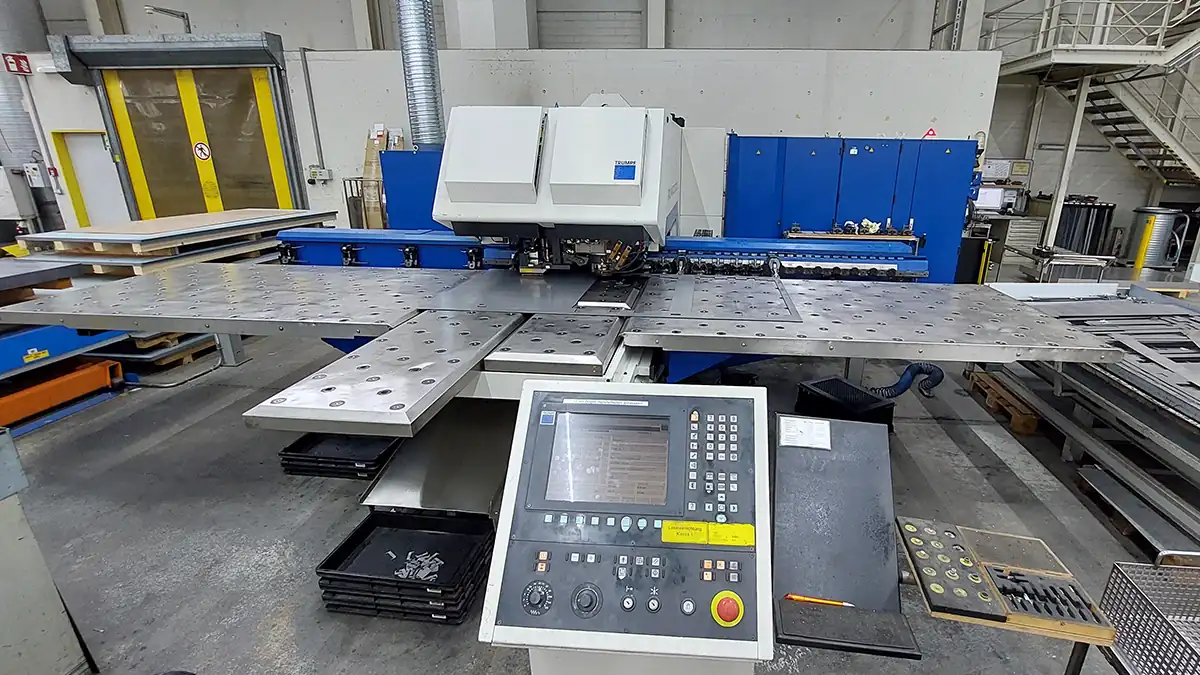
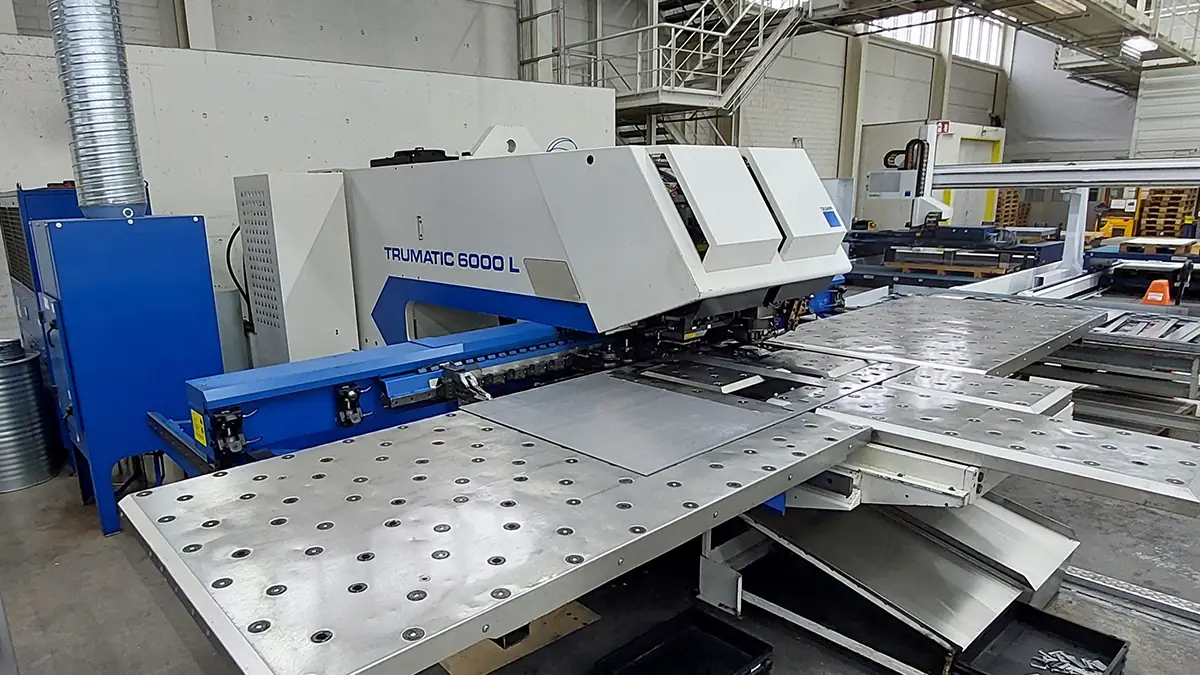
Refurbished TRUMATIC 6000 L hybrid punch-laser, 2585×1280 mm area, 3200 W power, low beam hours
When experienced fabricators talk about durable workhorses, the TRUMATIC 6000 L line usually comes up. This refurbished TRUMATIC 6000 L – 1300 (K01) mixes a robust punching head with a 3200 W CO₂ laser, giving shops the freedom to put complicated contours and elaborate forming in one setup. Field reports on Practical Machinist mention cycle time reductions of up to 30 percent compared with running two separate machines.
To understand the machine in real numbers, look at the odometer first. The control shows 77.289 total hours and only 11.501 hours with the beam actually on. That ratio tells a clear story: most of the time the turret did the heavy lifting while the laser source stayed on standby, so the resonator still has a lot of life left. The working zone spans 2585 × 1280 mm, enough for a metric half-sheet without repositioning. Sheet positioning accuracy is quoted at ±0.1 mm, repeatability at ±0.03 mm according to Trumpf documentation TG-6000-L-EN-02, and several independent users confirm these numbers after calibration.
Before moving on, here is a short reminder why that matters. On typical stainless signage parts tolerance builds up quickly once a sheet needs secondary handling. Holding ±0.1 mm over almost 2.6 m of travel keeps scrap to a minimum and lets operators nest parts right up to a common line without hand deburring.
Trumpf chose linear drives for the Y-axis and rack-and-pinion for the X. This combination balances high dynamic response with long-term serviceability. Acceleration peaks at around 60 m/s² according to internal service logs, yet the cast iron C-frame dampens vibration well enough to keep the laser focus consistent on thin aluminium. The punching ram delivers 220 kN, so embossing louvres or countersinks in 3 mm mild steel is straightforward.
Two sentences must introduce the upcoming list so that it blends into the narrative. Field engineers appreciate the following mechanical highlights that directly influence daily throughput:
– Thick turret faceplate with internal lubrication channels reduces tool wear
– Multitool station accepts up to 10 inserts, cutting down tool change downtime by roughly 70 percent
– Servo-controlled brush tables allow smooth sheet motion even on mirror-finished material
– Integrated scrap conveyor evacuates slugs automatically, keeping the working surface free of burrs
Each of these items came up repeatedly in after-sales surveys, proving that they are more than marketing talking points.
The CO₂ resonator carries the Trumpf TLF trademark and outputs a steady 3200 W. Service bulletin SB-TLF-08-07 states that average rebuild intervals run beyond 20.000 beam-on hours when properly maintained. Considering this unit logged only 11.501 beam-on hours, you can expect at least another decade before major optics work. Cutting speed numbers gathered from e-ShopFloor logs show 8 m/min on 3 mm mild steel and 4.2 m/min on 1.5 mm stainless, both using nitrogen assist.
This machine ships with the Bosch Rexroth-based CNC fitted to K01 builds. Operators get the familiar Trumpf TASC interface and can import DXF, DWG or STEP directly. Post-processor files for SigmaNEST and Lantek are readily available. Remote diagnostics over Ethernet is standard, letting maintenance crews pull error logs without stopping production.
The next list outlines software functions most job shops rely on every day. Two sentences of context first. Many machines from the mid-2000s have dated HMI layouts, yet the K01 release quietly received a facelift that streamlines nesting and path optimization:
Collision-free tool path calculation based on material thickness and clamp position
Automatic clamp relocation reduces skeleton waste on sheets up to 2585 mm long
Real-time pierce sensing minimises burr formation, cutting rework
Energy-saving standby that shuts the resonator down after 5 minutes of inactivity
Coupled with an online parts library, these functions help less-experienced operators hit quoted cycle times.
Refurbishment covered replacement of X-axis bellows, Y-axis linear guides, fresh grease on the punching ram, and optical alignment of the laser path. Original Trumpf spare parts invoices totalling 18.300 EUR can be supplied. The next scheduled preventive maintenance is at 80.000 total hours, giving roughly 2700 hours of buffer.
Potential buyers often cross-shop the Amada EML-3612 AJ and the Prima Power Combi Genius. Both alternatives rely on fibre lasers and draw less power, yet the TRUMATIC 6000 L wins in several practical ways:
First a brief lead-in. While energy consumption influences operating cost, real production time is driven by how quickly a machine can switch from punching to cutting and back.
– The turret on the Trumpf accepts thicker forming tools than the servo turret on the Prima Power, useful for HVAC louvers
– Amada’s linear transfer only supports sheets up to 2500 mm without repositioning, whereas the TRUMATIC covers 2585 mm
– Trumpf’s global parts network extends to 70 countries, trimming downtime when a bellows or mirror fails
After evaluating those points, several mid-size subcontractors in Baden-Württemberg still pick the TRUMATIC even with slightly higher kWh figures because setup efficiency matters more on mixed-volume orders.
Job shops doing signage, electrical enclosures, elevator panels and small chassis frames tend to keep a hybrid machine busy all day. Thanks to the 8 mm mild steel capacity and 6 mm stainless rating, one operator can finish both thin decorative plates and structural gussets on one line without queuing for separate equipment.
Trumpf has been in the sheet metal sector since 1923 and currently lists over 40 laser and punch models. Production records for the 6000 series show around 1500 units shipped across five major revisions. The K01 sub-variant introduced improved vacuum assist and faster tool change, addressing complaints from earlier owners about slug pull-out.
Power draw averages 24 kW during combined operations according to logged EMA-files, roughly 6 kW higher than a pure fibre laser but offset by eliminating a second punching machine. With an hourly shop rate of 65 EUR and average labour share of 18 percent, the payback horizon for a refurbished machine like this often sits below 24 months.
The rigged weight is just under 15.8 tons. Minimum ceiling height should be 4.2 m to clear the extractor. Compressed air demand is 6 bar at 1200 l/min, chilled water flow 15 l/min at 22 °C. Delivery includes an original Trumpf manual and updated electrical diagrams verified by TÜV Süd in 2022.
In short, the TRUMATIC 6000 L – 1300 (K01) refurbished combines respectable punching force, reliable 3200 W laser power and solid German build quality. Its mix of hybrid flexibility, moderate running hours and freshly replaced wear parts explains why fabrication outfits from prototyping shops to contract manufacturers keep it on their shortlist. The machine covers most sheet formats seen in European subcontracting and comfortably handles production spikes without tying up floor space. If your goal is to cut tooling changeovers, maintain tight tolerances and keep options open for thicker forming work, this veteran remains a sensible addition to a professional metalworking lineup.