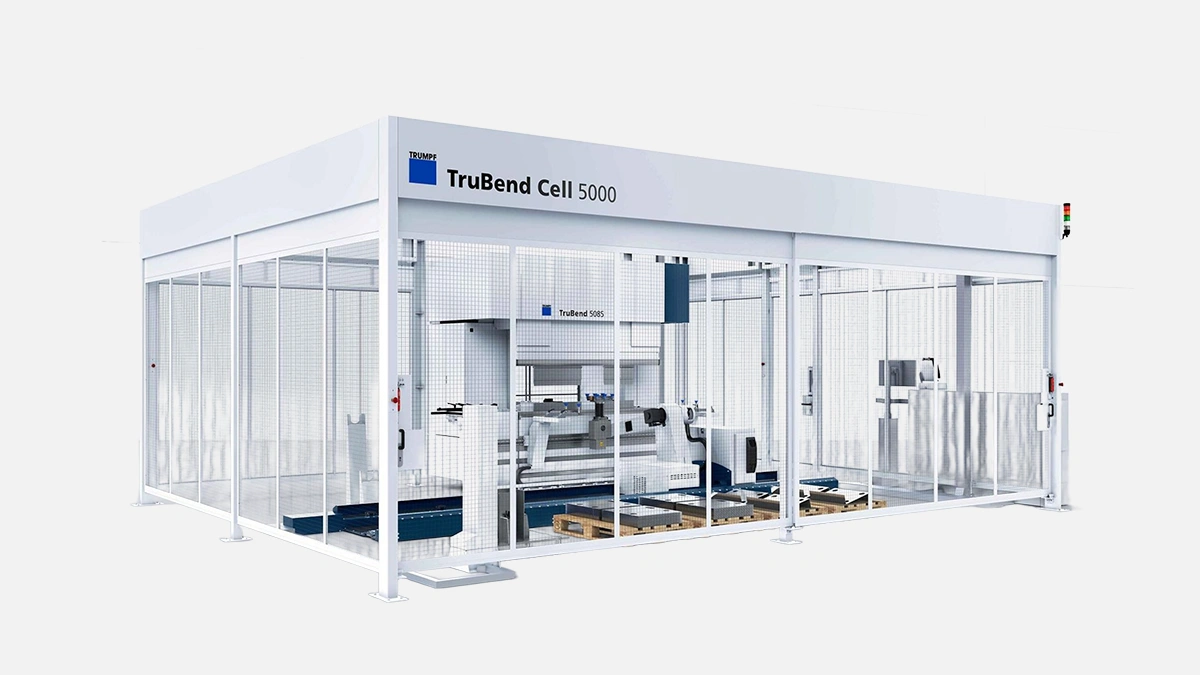
TruBend Cell 5000 bends parts robotically, 1700 kN force, 150 kg payload, fast setups for UAE fab shops.
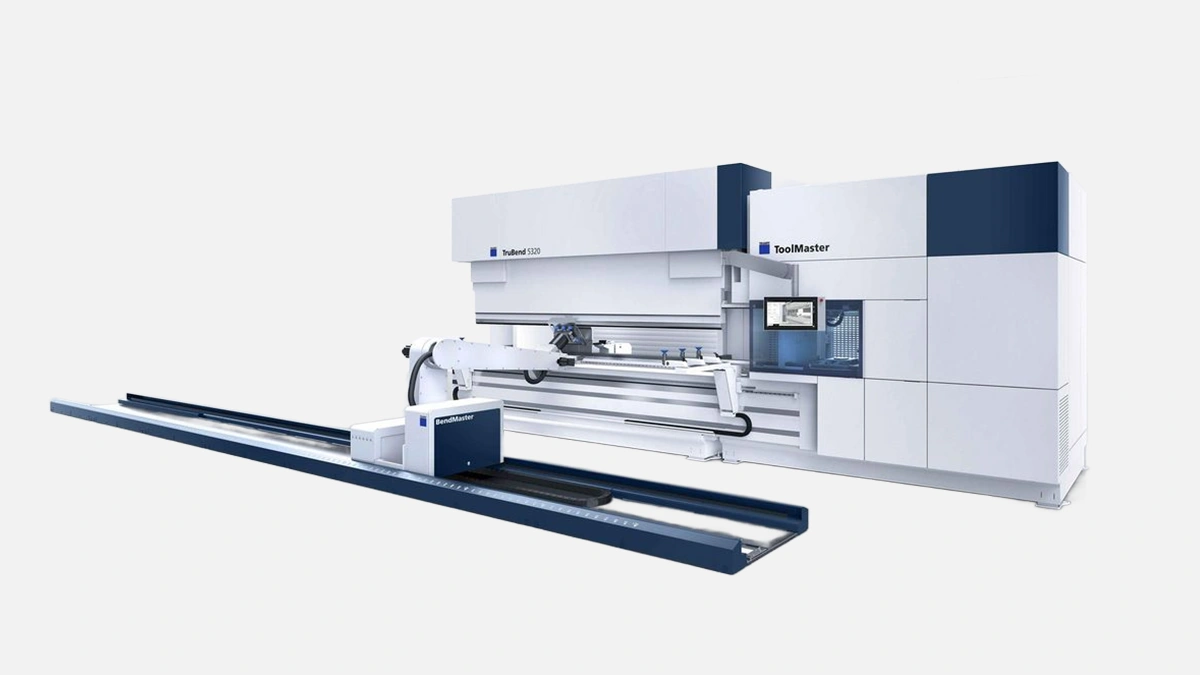
Short, sharp, right to the point. 5000 in the name is not pure marketing fireworks, it hints at a generation that already swallowed four whole iterations before it. The cell blends a TruBend 5170 press brake with the BendMaster robot plus a conveyor island that looks almost casual, until you watch the arms swing and notice the blank is already bent while you are still looking for your coffee mug.
Heat, dust, tight production schedules, and a culture that dislikes babysitting machines. The cell handles that cocktail. I spoke with two shop managers in Sharjah, both run mixed batches, stainless in the morning, coated mild steel after noon. They claim the press brake ram keeps its ±0.3 mm repeatability even when the air temp hits 42 °C. Quoting one of them, “the thing never sweats, only we do.”
Before listing the numbers, let us stop on three daily pains the cell quietly removes.
– Drift in angle after lunch break
– Operator hunting for wedges to fix crowning
– Robot dropping slim parts once every hundred cycles
You still get the odd burr on bad laser blanks, obviously, yet the rest is gone. That twist alone explains why many local fabricators keep pushing their accountants toward Trumpf.
A table is easier than another windy paragraph, check it, breathe, move on.
| Spec | Value | Note |
|---|---|---|
| Ram force | 1700 kN | Same as TruBend 5170 stand-alone |
| Bending length | 3230 mm | Full length at nominal load |
| Robot payload | 150 kg | With BendMaster 150/300 arm |
| Max blank size | 3000 × 1500 mm | Fits common Gulf sheet stock |
| Repeatability | ±0.3 mm | Tested over eight hours |
| Tool change | 6 s average | Using automatic magazine |
| Cell footprint | 10 × 8 m | Robot fenced in |
Numbers on paper do not bend parts, yet without them we would all be guessing. Notice that the robot payload stays solid even when handling wide sheets, something cheaper cells quietly gloss over.
The real magic hides in the mundane sequence nobody bothers to film.
First, the loader grabs a raw sheet, slips it under a camera, barcode gets read, program snaps in. Second, a shuttle plate hands the blank to the BendMaster fingers, suction cups hold the far edge, hooks catch the near one. Third, the robot glides to the ram, positions the part, backgauges whisper into place, the brake fires. Fourth, the arm flips the piece for the next leg, the brake fires again. Finally, a tiny conveyor dumps finished parts into a tote that rolls to welding. Five stages, no yelling across the hall.
When operators were asked what they notice first, answers repeated over and over.
Fast angle feedback via ACB sensor, live correction within 1 press
Thin parts stay flat because the gripper follows curvature dynamically
* Offline programming from TruTops Bend keeps the cell moving while the programmer is at home eating shawarma
That trio does not show on glossy brochures, but shop floor guys keep pointing at it. And rightly so.
Time to put the machine next to rivals, nothing abstract.
– Bystronic Xpert Cell: similar ram force, robot payload tops at 100 kg, switch-over from gripper to suction head is manual, which costs roughly 3 minutes every style change
– Amada EG-4010 with Robot: compact, brilliant for small brackets, yet the 1 m bending length simply cannot hit chassis parts for electrical cabinets you see everywhere in Dubai parks
– Salvagnini B3-ATA with manipulator: automatic tool adjustment is sweet, still, the cell footprint blows past 12 m in length, that murders many urban plants where rent eats margins
Trumpf slips through those gaps, offers the longer bed, keeps the footprint sensible, and holds a bigger robot. Not perfect, nothing is, but the edge is clear.
You might ask, what about TruBend Cell 7000 or 3000. Fair. The 7000 targets light gauge up to 4 mm, lightning fast, max blank under 500 mm, ideal for HVAC louvers, yet dead in the water when you throw 6 mm stainless. The 3000 is the budget gateway, ram force at 1250 kN, tooling manual, no automatic magazine. The 5000 sits in the middle, sweet spot, uses the same controller code as the bigger 8000 presses, but you do not mortgage the warehouse to get it.
Two months back I spent an afternoon at a plant in Abu Dhabi. Their metric is simple, how many rejected bends per shift. With the old hydraulic brake they dumped roughly 2 % scrap, with the cell they log 0.4 %. Do the math, on 2000 parts that is 32 instead of 40 kilos of metal in the bin, week by week, metal prices where they are, it matters.
The operator joked that his new stress comes from picking playlists, not from chasing tolerances. Joking aside, less stress means lower staff churn, which in the Gulf is almost as important as power cost.
We have already hinted, but let us drill them into one glance.
– Robot payload keeps flat across work envelope, no weird derating curves
– ACB angle sensor requires zero calibration blocks, saves real shift minutes
– Magazine holds 1200 mm long punches and dies mixed, so you rarely unload
– Touchpoint interface runs on a tablet-like screen, you swipe, pinch, done
No smoke, no mirrors, just items people tell each other over WhatsApp groups.
Rental forklift cages, power distribution boxes, stainless kitchen furniture, name any mid-size batch made from sheet and you will bump into a TruBend Cell 5000 somewhere in the supply chain. The brand behind it, Trumpf, turns 14 000 machines a year across laser, punching, bending, additive and software. Five generations of TruBend press brakes spawned this cell, the robot part alone already sits at revision 4. Companies in UAE swing between quick ROI and staff availability, the cell ticks both boxes.
At the end of the day, the headline benefit sounds boring but pays the bills: consistent angle, shift after shift, without a human glued to the foot pedal. That is why the purchase orders keep landing on desks.