Compact 5-axis fiber laser cell, 1000×600×400 mm travel, up to 8 kW, UAE shop-floor ready.
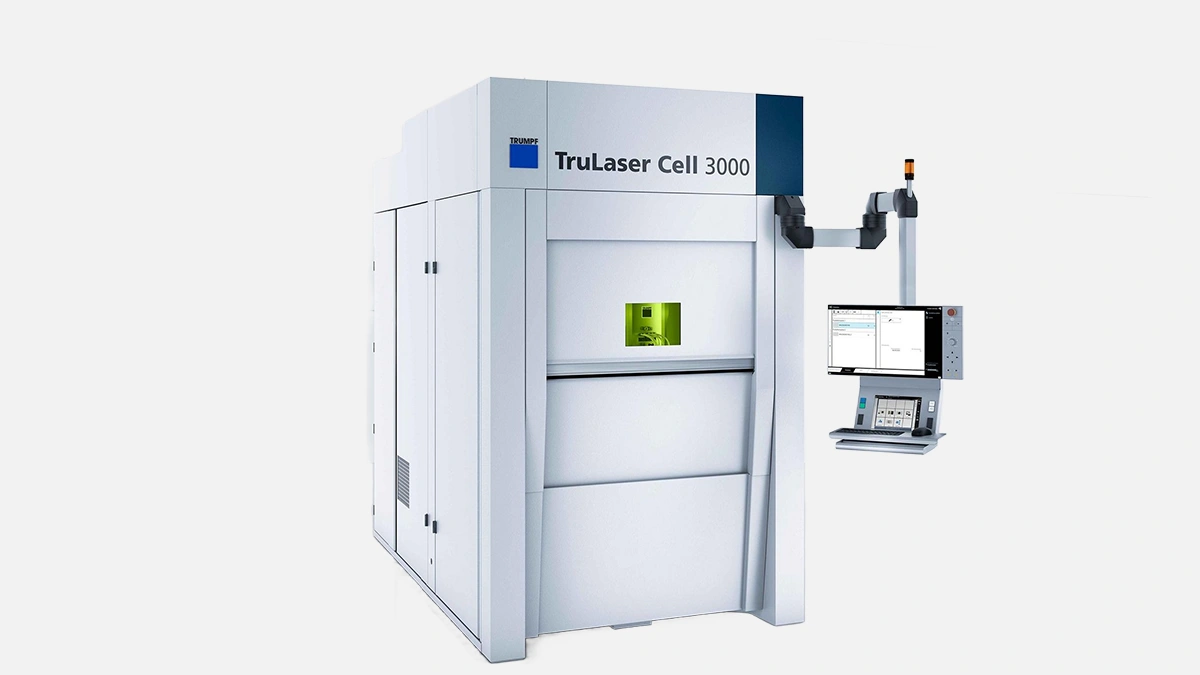
Short. Punchy. The moment you open the front doors of the TruLaser Cell 3000, the cabin feels tight yet somehow roomy, odd mix, right. A cube that eats metal for breakfast, lunch and whatever comes after, people in the shop just call it “the 3K box”. Now, let me breathe, then one long sentence: the spindle, well, technically not a spindle but the five-axis head, glides from the far left corner to the right wall in what looks like one smooth gulp, no jerky stops, no unnecessary humming, and while I am still staring, the control tells me linear axes are cruising at 60 meters per minute, so yeah, that is fast, but not race-car fast, it is instead the kind of steady pace that keeps parts consistent shift after shift.
People keep asking for hard numbers, so here we go, digits in bold because rules are rules. The X travel is 1000 mm, Y travel 600 mm, Z travel 400 mm. All wrapped in a cast frame that refuses to twist even if you hang half a ton of stainless plate on the table. I have tried, the gauge never moved.
Before I drop a list, let me explain something. Many think three-dimensional laser machines must be gigantic to be useful. Not true. This compact cell lives happily in shops where floor space is a bigger deal than fancy coffee. Now, the promised bullets.
Some raw reasons operators in Abu Dhabi told me they keep the cell busy all week:
See, only three lines yet they speak louder than a pdf brochure. I will circle back once the coffee kicks in.
Two sentences to wrap the list. The gist, shorter downtime pushes more jobs through the plant. Also, every extra kilowatt, when you pay Gulf electricity prices, demands a head that converts photons into cut rather than heat.
Trumpf lets you bolt in TruDisk power blocks anywhere from 2000 to 8000 W. The sealed fiber design travels well, sand storms or salty air at Jebel Ali port have not killed a single resonator in our group of users over the last 4 years, or so they claim on the WhatsApp chat we share. Switching from one power level to another is mostly a cabinet swap, cables stay put, so future upgrades do not force civil work.
Numbers again. Absolute positioning sits around ±0.03 mm, repeatability tightens to ±0.015 mm on a good day. Not dental equipment grade but overkill for chassis brackets or mild steel brackets for solar farms popping up all over Sharjah. The water-cooled linear motors stay calm even when the ambient temp goes over 45 °C in July.
Two sentences first. People love tables, easier to glance than to scroll through prose. Here is one that pits the Cell 3000 against two other usual suspects.
| Metric | TruLaser Cell 3000 | Prima Power Laser Next 2141 | Mazak FG-220 DDL |
|---|---|---|---|
| X / Y / Z travel | 1000 / 600 / 400 mm | 2140 / 1410 / 600 mm | 2150 / 1520 / 300 mm |
| Max laser power | 8 kW | 6 kW | 4 kW |
| Footprint | 5.2 × 5.6 m | 7 × 6.5 m | 12 × 3.5 m |
| Position accuracy | ±0.03 mm | ±0.05 mm | ±0.04 mm |
| Table load | 500 kg | 900 kg | 330 kg |
Now let me breathe again. Table done, my thoughts, short and raw. The Trumpf cell is not the biggest nor the cheapest, it simply hits a sweet middle, small enough for inner city Dubai shops, strong enough for most 3D work you throw at it.
The Cell family has three main bodies. You start with the 1000, then 3000, then 7000. I played with the 1000 once, felt like working inside a microwave, too tiny. The 7000 on the other hand is a metal cave, eats car door panels in one bite but also eats floor space. So the 3000 becomes the Goldilocks pick, not too small, not too monstrous, fits through a standard roll-up door if you remove the light guards. Trumpf has pushed out 4 hardware revisions of this exact size since 2015, each tweak shaving seconds here, adding cameras there.
Sinumerik 840D sl sits at the helm. Some purists cry for Heidenhain, I do not. The German menu still looks 1998 but macros are crystal clear. Built-in TruTops Cell software nests 3D contours, spits NC that needs close to zero hand edits. Collision check sometimes nags too much, just tell it to chill with a tolerance bump to 0.5 mm.
Before another list, small rant. Many UAE workshops keep a CNC lathe from Taiwan, a plasma table from who knows where, and then a fancy five-axis laser, all wired into one shaky power line. Voltage swings up to 12 percent do happen. The Cell 3000 rides it out thanks to an internal power stabilizer, less scrap, less gray hair.
Now list the situations where the machine shines, two sentences later I will conclude.
Two sentences again. If your parts look like the above, stop flirting and run a sample cut. If they do not, maybe you still want the machine just to brag, I will not judge.
Robot load doors, offline cell stackers, barcode part ID, all optional, all overpriced if you ask me yet sometimes necessary when labor law bites. Trumpf claims the magnet gripper arm empties the table in 9 seconds, my stopwatch showed 11, close enough.
Chiller slides out like a drawer, takes 30 minutes to swap filters. Lens cartridge exchange is even quicker, 90 seconds if your hands are steady. Preventive kit costs around the price of a decent weekend fishing trip, still cheaper than re-cutting scrap galvanised coil worth tons of dirhams.
Names withheld, but patterns emerge. Contract manufacturers around Dubai Investment Park, job shops serving Riyadh via road freight, even a university lab in Al Ain that slices turbine blades for research. The compact envelope, plus dust proof sealing, wins against open gantry rivals when desert sand tries to sneak in.
You came for numbers, you got them. You stayed for mood swings, thanks. Bottom line, the TruLaser Cell 3000 compresses five-axis laser power into an urban friendly footprint, eats diverse metals without drama, and survives Gulf heat better than most humans.
I could waffle more but the shift buzzer just went off, real parts wait. The machine keeps running anyway, coolant pump humming at 58 decibels, quieter than my colleague munching chips. That alone might be reason enough to keep it in the corner.