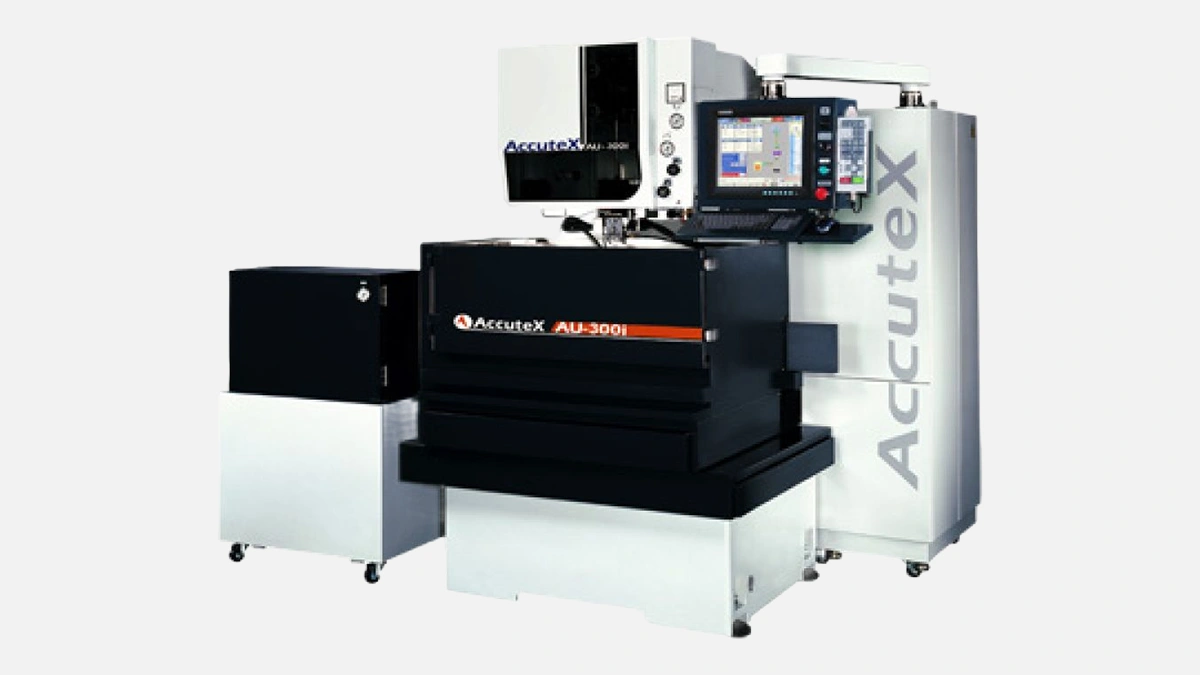
Compact AU-300i Wire EDM, 300 × 250 × 200 mm travel, fine Ra 0.25 µm.
Short. Sharp. You look at the AU-300i, blink, and suddenly realise the thing has been running while you were scrolling WhatsApp. The machine does not ask for attention, it just hums. Then, mid-shift, you notice the wire chart in the control leaping, the arc voltage settling at 65 V, the cut cruising at 280 mm²/min, and you think, wait, that is pretty athletic for a chassis hardly wider than a pallet.
Accutex sits in Taiwan since 1990, around 30 different CNC EDM models on the catalogue, yearly output somewhere near 1200 units if to trust their own booth talk in EMO Milano. The AU-series counts four revisions, and the 300i is the “sweet spot” child – not too tiny, not a floor-eater like the 750.
Before we drown in anecdotes, numbers first.
| Axis | Stroke | Ball-screw grade | Linear glass scale |
|---|---|---|---|
| X | 300 mm | C3 precision | 0.1 µm resolution |
| Y | 250 mm | C3 precision | 0.1 µm |
| Z | 200 mm | C3 precision | 0.1 µm |
| U/V | ± 60 mm | direct drive | 0.1 µm |
| Max taper | ± 30° @ 80 mm | — | — |
Those strokes might read modest, yet inside most Dubai job shops mould inserts rarely overshoot 500 mm anyway, so nobody cries.
Two things people miss in brochures: column rigidity and dielectric cover. The frame is Meehanite cast, ribbed, left in the yard for 12 months natural ageing, so geometry drift stays boringly low even when the chiller water creeps to 28 °C in August.
Long sentence warning. The i-generator pumps a discrete pulse width down to the wire, fine trims land around 0.25 µm Ra straight from the third skim, no voodoo powders, just keep conductivity at 15 µS/cm, tune servo gain, check the tiny graph on the touch panel, done.
I like that the macro list already holds subroutines for lattice vents common in oil-and-gas valve cages, you pick the template, feed heights, press Run, walk away.
Hot climate is not a joke. UAE summer pushes shop ambient to 42 °C if the AC quits for an hour. Accutex bundles a plate heat exchanger rated 4 tons, enough to pin dielectric to 20–22 °C. Cartridge filters are twin-can, 5 µm, change once every 500 hours. The gasket material is EPDM, does not go brittle from salty air blowing in from Jebel Ali.
I scribbled these lines after poking three operators in Sharjah.
Might be a honeymoon phase, yet nothing broke for a full quarter.
The AU-100i, AU-300i, AU-500i, AU-750i. Same control, different iron. Inside the family the 300i is the only one that ships on a single flat-rack container, crane capacity 5.5 t reaches, unload in 45 minutes, less paperwork at Port Rashid. The 100i loses U/V stroke, so forget fancy taper geometry, and the 500i jumps price and footprint. Many toolrooms simply pick the middle child and call it a day.
Time to throw it against the regular trio.
| Model | Max workpiece kg | Min wire mm | Rough cut mm²/min | Finish Ra µm |
|---|---|---|---|---|
| Accutex AU-300i | 400 | 0.05 | 280 | 0.25 |
| Makino U3 | 500 | 0.05 | 300 | 0.20 |
| Sodick ALC400G | 500 | 0.03 | 320 | 0.22 |
| GF CUT E 350 | 350 | 0.05 | 260 | 0.30 |
Makino edges a bit faster, Sodick wins on micro wire, yet both cost noticeably more and their service hubs in Abu Dhabi queue for weeks. Accutex keeps spare parts in a small warehouse near Ras al Khor, courier drops a new power board next day, at least that is how the mould guys claim.
Short list, no fancy marketing.
They share one pain: floor space. The AU-300i footprint is 1.8 × 2.0 m, slips near a lathe, leaves room for the forklift lane.
Let me dump the notes I keep in the phone.
Do these, the machine behaves, skip them, and you start chasing mysterious servo hunts at 2 AM.
I start happy, drift sceptical, end realistic. The Accutex AU-300i will not outrun a Makino on ultimate cycle time, but it wins the boring, day-to-day game of uptime. Brass wire, de-ionised water, a filter set every two months, and you are back making chips or rather spark dust. Three years later resale value hangs around 55 percent which is fair. Most importantly the control screen looks like a modern phone UI, operators below 30 grasp it in one afternoon.
So, why do buyers sign the PO? Because the machine fits through a 2.1 m high dock door, drinks moderate power, survives heat, and finishes parts ready for assembly. That is it, no poetry.