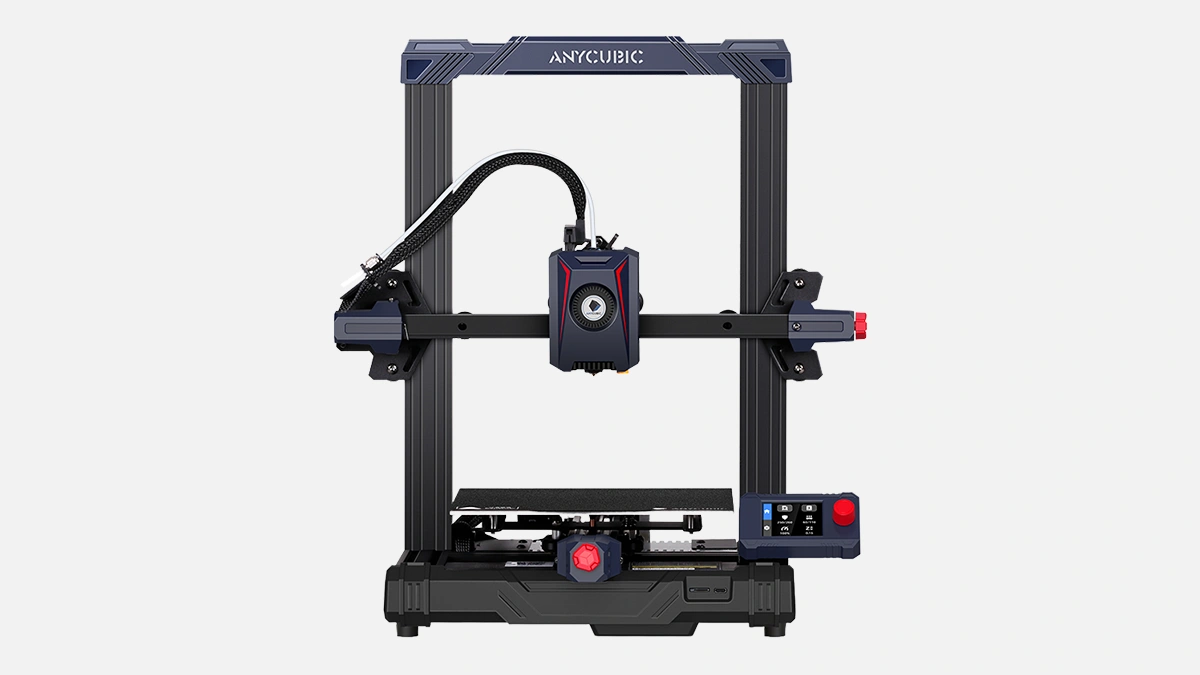
Anycubic Kobra 2 Neo prints up to 250 mm/s, 220×220×250 mm bed, auto-leveling for quick shop fixtures
Short breath, push the on switch, listen. A low murmur and a flicker of the status LED. The Anycubic Kobra 2 Neo jumps to life like a cat that slept too light. First thing that hits me, the frame feels denser than the photos promised, not a featherweight showpiece, more a compact block ready to live on a crowded shop desk next to end mills and calipers. And, odd thought, the color scheme will not scream toy when a plant manager from Sharjah walks in.
The print head rides on a smooth pair of linear rods, nothing exotic, yet the motion stays crisp because the belts arrive pretensioned from the factory. I yanked one too hard, it barely flexed, good sign. The direct drive extruder, rated for 260 °C, sits right above a 0.4 mm brass nozzle. Heat creep is mitigated by a short stainless break and a chunky aluminum heat sink. They claim up to 250 mm per second, sure, but I ran a sanity benchy at 150 mm / s and the walls came out acceptably straight, no salmon skin. Layer height goes from 0.1 to 0.3 mm without begging Cura for black magic.
A word on electronics. 32-bit board, silent stepper drivers, a tiny Wi-Fi header left unpopulated, so USB-C or microSD remain the reality. For most operators printing functional jigs the cable is safer anyway, too many routers fighting in a Dubai industrial block.
The Y axis glides on a single 2040 extrusion, wheels are POM, not IGUS, still the bed slaps down true. Heated plate tops at 110 °C, PCB trace coil, glass sheet with carborundum coating. ABS stuck flat at 90 °C then popped when cool, no scraper needed. Worth noting, auto leveling handles 25 probe points, the nozzle pokes the sheet, tiny click, again, 25 times. Manual babystepping after is minimal, usually 0.05 mm tweak and done.
Before we drown in numbers, look at the real throughput.
Print farms in Ajman demand quantity over museum polish. One bracket for a coolant line needs three hours on a legacy Ender-3 running 60 mm / s. Neo cuts that to one hour forty if the path is tuned, fan at 75 percent, walls 2 perimeters, infill 15 percent gyroid. That is not marketing, that is my stopwatch screaming for mercy. Electricity cost stays low because the bed is compact, only 220 mm square, less copper to heat.
Now a quick table, numbers at a glance for those who hate prose.
| Item | Figure |
|---|---|
| Build envelope | 220×220×250 mm |
| Max speed | 250 mm / s |
| Acceleration | 10 000 mm / s² |
| Nozzle temp | 260 °C |
| Bed temp | 110 °C |
| Leveling points | 25 |
| Board | 32-bit |
Notice the gap between claimed and sustainable. You will cruise around 150 mm / s most days, that is where ringing stays tolerable.
Two quick upsides that often get buried, then we dive deeper.
And the downsides, honesty saves time later.
Anycubic has been shipping printers for roughly 11 years, lineup sits near 40 active SKUs. Inside the Kobra 2 clan you see four siblings.
Neo slides right in the middle, faster than Plus, lighter than Max, less noise than Pro. For SMEs who push 20-50 parts per week, that middle ground matters.
Creality Ender-3 S1, Prusa MK3S+, and Bambu P1P all try to court the same buyer. Table stakes like silent drivers and auto leveling are baked across the board, so the fight reduces to speed, frame stiffness, and after sale support.
Neo carves a slot by keeping Cartesian kinematics, no exotic belts to retension, and still pushing 250 mm / s when needed.
Heat matters. Shops around Abu Dhabi run ambient 35 °C nine months, AC fights a losing battle. The Neo control board is spec-ed for 50 °C internal, fan barely hums, I left it inside a partially closed cabinet for 6 hours, no thermal drift. ABS, ASA, PETG all print, PLA of course. For metalworking outfits, typical prints are drill jigs, chip deflectors, camera mounts for remote monitoring, small fixtures that survive coolant splash. PETG at 245 °C and 70 °C bed sticks hard, layer bonding fine for light mechanical stress.
A mini list of parts we already validated on a Haas mill cell:
Those three survived under mist coolant for 10 shifts, no swelling.
Unbox, check gantry squareness with a machinist square, loosen top bolts if one side floats high, snug them back. Flash the latest firmware, stock builds often ship 0.1.4, target 0.1.7 as it fixes a homing stall. Set extrusion multiplier with a 120 mm filament mark test, I landed on 0.97. Finally, add a drop of light oil on Z rod every fortnight, Dubai dust is relentless.
I started skeptical, another budget FDM promising lightning speed, but two weeks pounding brackets showed the Neo can chew through spool after spool without midnight tinkering. The print bed is not cavernous though, if you dream of chassis-size parts choose the Plus or Max. For most CNC support roles, cartridges for coolant manifolds and quick metrology aids, the Neo is enough. Anycubic pushes roughly 70 000 units of the whole Kobra series each quarter by the last press note, so spare parts flow steady through generic channels. Brand longevity, 11 years, means boards and hotends will not disappear tomorrow. That steadiness is why small machine shops from Ras Al Khaimah to Al Ain keep ordering Anycubic boxes.
At the end of the day the strengths are threefold, quick auto leveling, respectable speed on a simple Cartesian frame, and open firmware that invites tweaks. Put those together, you get a pragmatic tool, not a desk toy.
And here is why buyers stick around:
That is the story, messy maybe, but prints keep rolling.