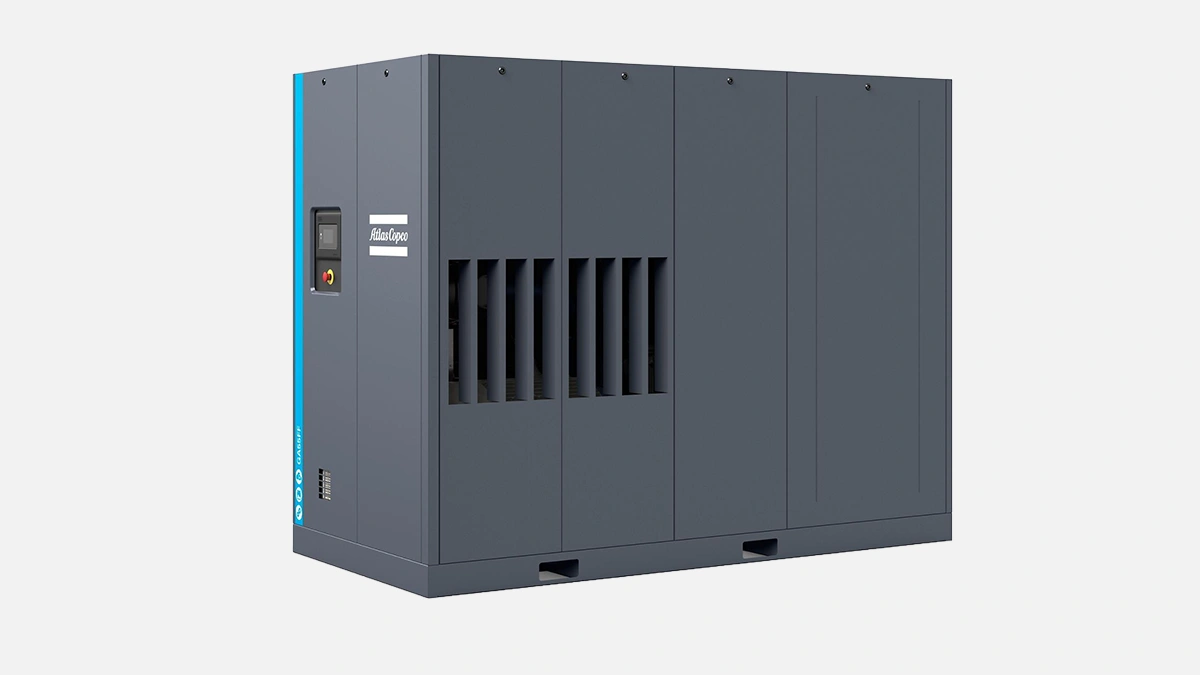
55 kW screw compressor with built-in dryer, 9.2 m³/min at 7.5 bar, fit for mid-size CNC shops in UAE.
Short. Punchy. GA 55 FF. You walk into the compressor room, the thing is just there, grey-blue cabinet, fans humming at a steady 71 dB, nothing screechy, just a dry mechanical breath. In Dubai heat, that matters.
Then I catch myself rambling. Let us dive.
Before we get poetic, numbers talk louder. I stitched the key metrics into a tiny table, glance at it then decide if you read on or swipe.
| Parameter | Value | Why you care |
|---|---|---|
| Motor power | 55 kW | Slots neatly into mid-size shop grids |
| FAD at 7.5 bar | 9.2 m³/min | Feeds four to six CNC lathes without gasping |
| Max pressure | 10 bar | Covers air chucks, mist collectors, random blow guns |
| Integrated dryer | Yes, +3 °C PDP | Cuts rust risk in humid Gulf evenings |
| Noise level | 71 dB(A) | People talk next to it without shouting |
| Footprint | 1.96 × 0.95 m | Slides between the pillar and the coolant tank |
Two lines of thought appear right after the table. First, the flow-to-power ratio looks honest, nothing hyped. Second, the built-in dryer saves floor space – in Sharjah workshops every square meter is a wrestle with forklifts and pallets.
Oil-injected rotary screw, fixed gear drive, no fancy VSD brains. Some call that old school, I call it predictable. The element itself is Atlas Copco’s fifth iteration on the GA line, bore and length tweaked for better rotor tip speed. Not marketing fluff, you can hear the smoother idle when the load signal drops to 40 percent. The air path is short. Intake filter, element, oil separator, aftercooler, dryer, out. Fewer bends, less pressure drop.
Three points, that is it for now. More later.
Humidity spikes at night by the coast. A bare compressor shoots out wet air, tools rust, valves stick, operators curse. The FF suffix fixes that with a refrigeration loop holding pressure dew point around +3 °C. In Al Ain you might get away without it, in Abu Dhabi port you will not. Energy penalty is roughly 2 percent of absorbed power, peanuts compared to scrapping corroded cylinders.
I timed a full service, filter package swap, oil change, health check. 48 minutes when you know the bolts, 75 when you do it first time. No rocket science, the rear panel drops, cartridges slide out vertical, no oil shower if you crack the drain first. Genuine filters cost a bit, skip them once and the separator delta-P crawls up, you lose 0.3 bar headroom, power bill climbs. Your choice.
See, two bullets. Enough.
You ask, why not GA 45 FF, why not some screw from Kaeser or Ingersoll. Table time again.
| Model | Power kW | FAD m³/min at 7 bar | Noise dB(A) | Integrated dryer | Noted quirk |
|---|---|---|---|---|---|
| GA 45 FF | 45 | 7.4 | 70 | Yes | May struggle with four big sand-blasters |
| GA 55 FF | 55 | 9.2 | 71 | Yes | Sweet spot for multi-machine shop |
| Kaeser SK 45 | 45 | 8.1 | 68 | Optional | Dryer extra footprint |
| Ingersoll R55i | 55 | 9.0 | 73 | Optional | Touch panel menu nested deep |
Look at the middle row. Slightly louder than Kaeser, but dryer inside, wiring tidy, price delta negligible according to market chatter, though we do not list numbers here.
Atlas Copco pumps out roughly 110 000 oil-injected screws each year, the GA line alone holds more than 15 sizes. GA 55 FF sits right between GA 45 and GA 75. Same frame, same fan, different rotor cut. Means spare panels fit across the trio. If your plant grows, swapping to GA 75 needs no new concrete pad.
Elektronikon Touch can talk Modbus, Profibus, simple dry contacts, pick whatever the old PLC in the corner digests. No cloud mandate. You get basic load-unload trend, weekly schedule, remote start. If you insist on Wi-Fi, a smart box plugs in and pushes data to SmartLink. I left it off in one factory, manager did not care, in another they loved seeing kWh per part on a dashboard. The point, freedom.
Every machine has them. Door hinges feel light, I have seen two bend after a forklift wing mirror smack. Electronic drain solenoid costs half the price of a Chinese standalone valve, keep a spare. And the white paint inside the panel chips if you use harsh degreaser. Cosmetic, yet still.
Datasheet says 71 dB(A). My phone meter read 72.4 at one meter height, full load, filter clean. Acceptable. Workers in Ras Al Khaimah rolled carts next to it and did not flinch. Put it on rubber pads to kill vibration bleeding into mezzanine offices.
Mid-volume CNC job shops – think 5–7 spindles running cuts and purge cycles nonstop.
Fabrication yards – plasma tables sip air, sand-blasters gulp, GA 55 FF feeds both if sequenced smart.
Petrochemical maintenance bays – paint booths love the dry air, instruments stay clean.
I slapped that list on a whiteboard last week. Saved an hour of back-and-forth.
Fixed speed means full load or idle. Duty cycle in most metal shops is 80 percent plus, so variable speed adds peanuts. What matters is pressure band. Set system at 7.5 bar, trim drops, cut idle time. Each 1 bar reduction chops roughly 7 percent power draw. GA 55 FF holds pressure within 0.1 bar when piping is sized sane. That is where the real savings hide, not in marketing badges.
Atlas Copco has been around since 1873, builds screws since the seventies, the GA badge itself went through at least 5 major revamps. The current GA 55 FF blends a proven rotor, a dryer that does not leak freon every year, and a control that even my stubborn uncle can read. It is not the cheapest box on the floor, yet shops across UAE keep ordering it because downtime stings more than procurement price. Dry air, steady flow, moderate noise, done.
That trio sums up why the machine ends up on so many RFQs from Ajman to Abu Dhabi.