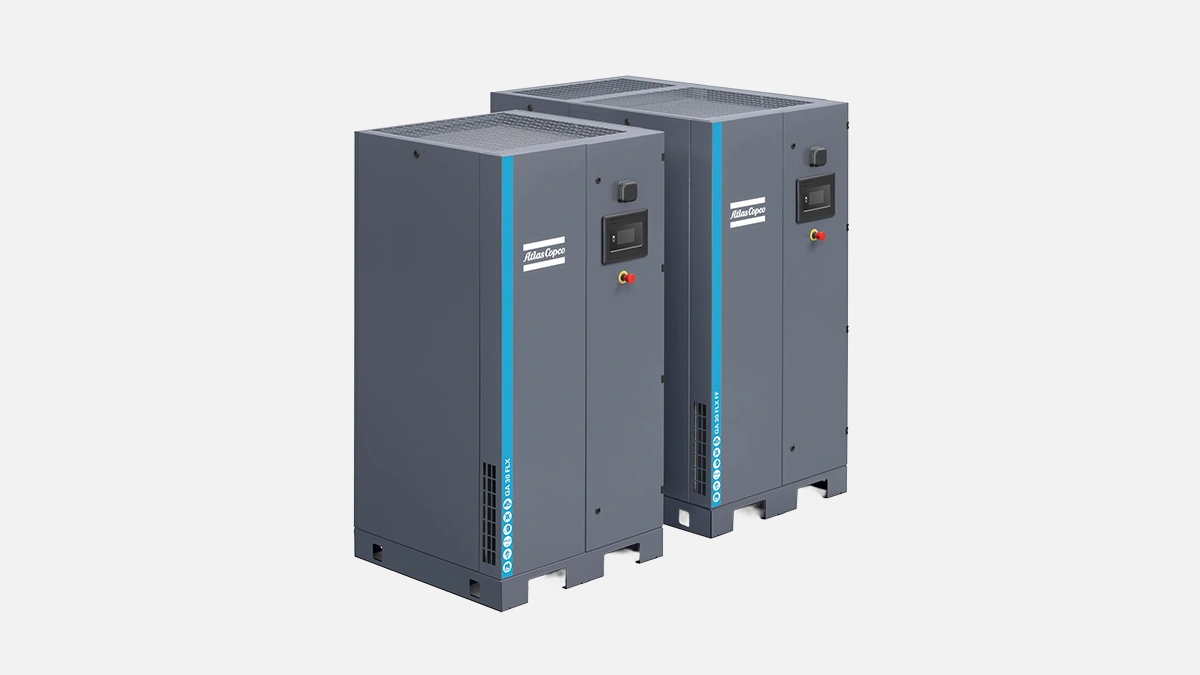
Dual-speed GA FLX delivers 3.2–6.1 m³/min at 5–13 bar with only 65–70 dB(A) noise, ideal for hot UAE workshops.
Short breath, metal smell, overhead crane screeches, you step closer. GA FLX sits there, no drama, boxy housing, subtle Atlas Copco blue. One switch, two speeds, that is the whole deal, or so it looks. Then you listen more carefully, the low-rpm mode whispers, the high-rpm mode barks just enough, both stay below 70 dB(A) which is basically conversation level if the rest of the workshop did not shout over grinders.
Everybody repeats the variable frequency story, great stuff, but a lot of shops in Sharjah or Abu Dhabi still run on rigid power budgets. VFD drives cost, VFD boards fry in the desert heat, and the local electrician curses because spare parts fly in from Belgium once a month. Dual speed feels like a middle path. One fixed pole set for base demand, a second for peak shifts. Nothing else. Fewer sensors, fewer excuses.
Before digging deeper, a fast recap of numbers to keep in your pocket because managers will ask.
| Item | Low speed | High speed |
|---|---|---|
| Motor rpm | 1 500 rpm | 2 975 rpm |
| FAD | 3.2 m³/min | 6.1 m³/min |
| Specific power | 5.1 kW per m³/min | 4.9 kW per m³/min |
| Full load amps | 32 A | 58 A |
Tables never tell the sweat story, still they shut down most arguments in the meeting room.
Two quick bullet lists are coming, hold on.
Before the list, note this, GA series exists since 1993, more than 120 000 units shipped globally, that means parts and second-hand advice are everywhere.
Enough intro, below bullet list shows what sits under the sheet metal.
That is list one. Now breathe, sip water, carry on. Dual-speed does not do magic yet the simplicity keeps maintenance people calm. I witnessed an operator in Ajman swap the separator in 18 minutes flat, no jokes, he timed it for TikTok.
A list again, but first a detour. UAE workshops run hot, dusty, voltage fluctuates when everyone fires the plasma tables at once. The GA FLX brochure quietly states “ambient up to 46 °C.” Reality check, Ras Al Khaimah hits 50 in mid-July. Still the machine copes if you respect clearance around the cool air intake and avoid placing it under the mezzanine full of welding fumes. Ok, list time.
Now we move on, no more bullets for a while.
Atlas Copco is 150 years old, Swedish legal HQ, production for GA family in Belgium and China, around 70 compressor models today. They roll out roughly 35 000 oil-injected screw units each year across all plants. GA FLX itself has gone through 3 internal revisions since first reveal in 2019. Version A had a smaller cooler, version B switched to Nano controller, current C revision adds the larger 18-liter oil sump you see now. Names on the rating plate expose revision so buy parts accordingly.
Comparing gear helps board members sign the PO. Here is the quick talk over coffee. Ingersoll Rand R-Series 30 kW runs VSD, nice energy numbers, yet its Smart Control module refuses to boot when line voltage dips below 355 V, common in Sharjah industrial sheds. Kaeser BSD 65 offers stout German castings, good, but noise hovers at 74 dB(A). GA FLX hits a middle ground, quieter than Kaeser, more tolerant than IR, price tag lands closer to fixed-speed which still makes accountants smile.
Not just this exact frame exists, you also spot GA FLX 18, GA FLX 22 and GA FLX 30. Same housing, motor swapped, pulley ratio tweaked. The 18 kW unit feeds two small laser cutters nicely. The 30 kW beast covers an entire cluster of six CNC lathes. Spares, controllers, firmware all interchange so your storekeeper needs one shelf.
First 4 000-hour kit bundles oil, separator, filters. Change belts every second kit even if they look fine. The dual speed starter uses two sets of contactors, carry a spare because sand dust pits the silver faces in a year. Cleaning the after-cooler with compressed nitrogen once a quarter keeps delta-T low, energy meter proves it. And yes, the Elastollan hoses turn brittle after 5 seasons under desert UV, lazy to cover them, your problem not the factory’s.
Math time, quick but useful. A typical metal fab in Dubai runs compressors at 75 % load profile. Old star-delta 30 kW screw eats around 160 000 kWh per year on that profile. Swap to GA FLX dual speed and you move down to 105 000 kWh, saving 55 000 kWh, roughly 22 000 AED at the current DEWA industrial tariff. Not billionaire money, still enough to buy coolant filters or a Friday team BBQ.
One guy alias “FalconCNC” wrote, “been running GA FLX for 18 months, only alarm we got was dirty sensor, blower cleaned it, done.” Another post from “LatheBoss” complained the Nano controller lacks Modbus, he hacked a dry contact relay, now logs runtime into his SCADA. Mixed bag, but none reported rotor scuffing or oil carryover spikes.
We are closing in, last structured thing. But first a sentence so the list does not sit naked. Walk through the checklist below with your maintenance chief, do it before you wire money.
Enough lists for today.
GA FLX will not win tech awards, yet it simply works, day after day, in heat, dust, voltage sag. Shops that cut aluminium profiles, bend mild steel ducts, or run medium CNC cells pick it for that reason. Large rigs with fancy VSD still exist but they scare small maintenance crews. GA FLX keeps them relaxed, and relaxed people hit production targets, end of story.