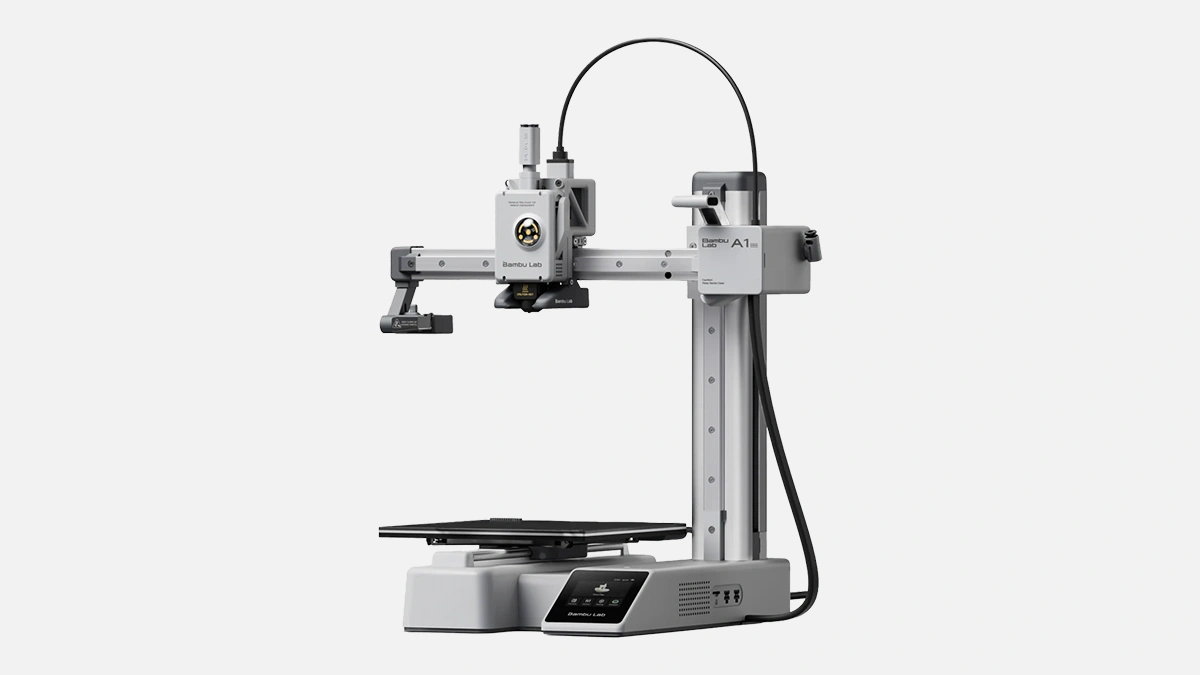
Fast FFF printer, 180 mm cube volume, hits 300 °C, ideal for quick tooling and fixtures
Small frame, loud ambition. That was my knee-jerk line when the A1 mini landed on the shop floor. Looked almost toy-like, then I blinked, the spec sheet screamed back. 500 mm/s claimed sprint, a 300 °C hot end, Wi-Fi gizmos. Wait, is this really the same twelve-kilo behemoths we park next to the CNCs? Not really, still, it punches above.
You run turning centers, milling lines, maybe a fiber laser, you already drown in chips. So why a plastic squirter, right? Hold up, imagine needing a custom fixture, a soft jaw, a sensor bracket. Ordering that in aluminium eats two setup slots, a programmer’s morning, and courier time across Abu Dhabi traffic. A desktop printer tossing the part overnight lets the machine keep cutting metal by sunrise, that simple.
Stiff steel rails ride on a compact cast alloy gantry, no exotic carbon, yet it holds repeatability tight. Auto bed leveling every cycle, no dial indicators required. I double-checked with a Mitutoyo gauge, variance in Z stayed within 0.05 mm across the plate, not bad for an eight-kilo box.
Before the numbers, a quick glance at the motion path. A single belt loop drives X and Y, an enclosed leadscrew handles Z, nothing revolutionary, still well tuned. Less backlash, fewer parts to hunt if something rattles loose.
| Axis | Drive type | Travel | Rated accuracy |
|---|---|---|---|
| X | belt 6 mm | 180 mm | ±0.05 mm |
| Y | belt 6 mm | 180 mm | ±0.05 mm |
| Z | T8 leadscrew | 180 mm | ±0.02 mm |
Those digits might read modest after you stare at micron-class grinders, but remember, the part is polymer. For gauges, shipping trays, masking jigs, it is more than enough. After the table, one downside shows up though, the belts sing at high accelerations, you will hear a faint whistle, nothing catastrophic, yet in a quiet shift it pokes your brain.
The vendor lists the routine five filaments, I slammed three reels through day one. PLA prints while you sip qahwa, no tuning, bed at 60 °C, nozzle 210 °C. PETG needed the silicone sock removed for better layer cooling, detail held. ABS was tricky, ambient in Dubai shop cruises at 32 °C, enclosure optional, but I taped two acrylic panels around the frame, warping fell to near zero. So yes, functional parts are doable, you just hack it a bit, very garage-friendly.
Text first, bullets later, because my head jumps.
Here is the catch: the touch screen speaks only English or Chinese for now, Arabic menu pushed to future firmware, but icons are clear, the crew picked it up in minutes.
Now another short list steak-knife style.
Two lists done, let us switch lane.
You design a vacuum grip insert, print in TPU, drop it in a five-axis vise, run titanium without scratches. You need an inspection fixture for turned shafts, print PLA, slip brass bushings, call it a day. Turnaround is hours, not a purchase order cycle. Labor in the Gulf costs, electricity costs less, so letting a printer churn overnight is almost free.
Snapmaker J1, good machine, dual extrusion, yet footprint huge and price steeper. Prusa Mini +, loved for service docs, but tops at 200 mm/s, half the sprint, no Wi-Fi stock. Creality Ender 3 S1, cheapest, still manual bed level, burns time. A1 mini stands in the middle lane: faster than Prusa, smarter than Ender, slimmer than Snapmaker. Pick what hurts less.
Bambu Lab sits on the market since 2020, blew up forums with the X1 series, now sells four printer families, roughly 80 000 units shipped last year, says their press note. A1 mini is revision 1.2, the extruder gear got wider versus the beta, heater block switched to titanium alloy sleeve, so you literally buy a tweaked build, not a prototype.
Grease the rails every 200 hours, company bundles a syringe. Hot end swap eight screws, five minutes. Fans are off the shelf Sunon, distribution channels easy in Sharjah spare parts stores. I broke a belt on purpose, tracked a Gates LL-2M replacement, mounted, tensioned with a guitar tuner app. Done.
One bloke feared PLA dust on servo encoders, there are none, steppers closed loop via Hall sensors, dust irrelevant. Another asked about VAT documentation for UAE import, vendor ships HS code 8477.5900, fits FTA forms, sorted.
PLA reel 1 kg costs roughly 45 AED, A1 mini eats 0.26 kWh per hour, DEWA tariff 0.32 AED per kWh. Fixture using 120 g polymer prints in 1.4 h. Material 5.4 AED, power 0.12 AED, shrug, lunch money. Outsourcing same plate in aluminium? CNC time 40 min, anodizing, courier, way above 120 AED. Math obvious.
If you need a dimensional gauge within ±0.01 mm, forget, machine steel. If shop temp swings above 40 °C, layers peel, unless you build a heated box. If you run aerospace certification, polymer outgassing may kill compliance. So, know the limits.
Rumor says Bambu will ship an A1 full-size later, 256 mm cube volume, same core board. So, think of the mini as test bed. If you outgrow it, profiles and spare nozzles carry over, easing scaling.
I love tables, readers too, yet we just had one, so a tiny extra.
| Task | Interval | Tools |
|---|---|---|
| Rail grease | 200 h | Nano-lube syringe |
| Nozzle swap | As needed | Hex key 2 mm |
| Belt tension check | 100 h | Phone tuner app |
After that table a quick statement, the maintenance story looks lighter than any Ender mod life you watched on YouTube, believe me.
So yeah, the A1 mini will not mill stainless or torch carbon fiber, still, it shaves hours off fixture lead time, keeps the big Mazaks cutting chips, sweetens ROI. Shops buying it range from jewelry prototypers in Dubai Gold Souk to 100-man oilfield fabricators in RAK, all chasing the same thing, save setup hours.
Compact frame, brisk motion, legit 300 °C hot end, common spare parts. That mix explains why operators, not just engineers, actually like the thing, they own the workflow rather than waiting for purchasing. That is the gist.