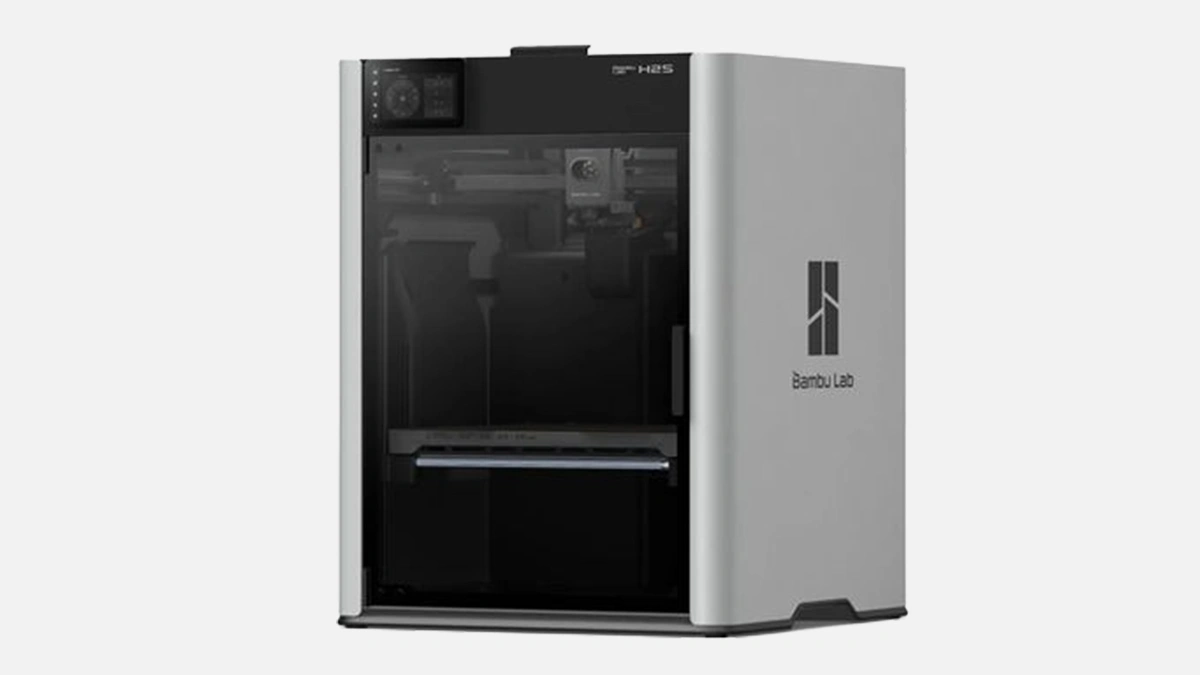
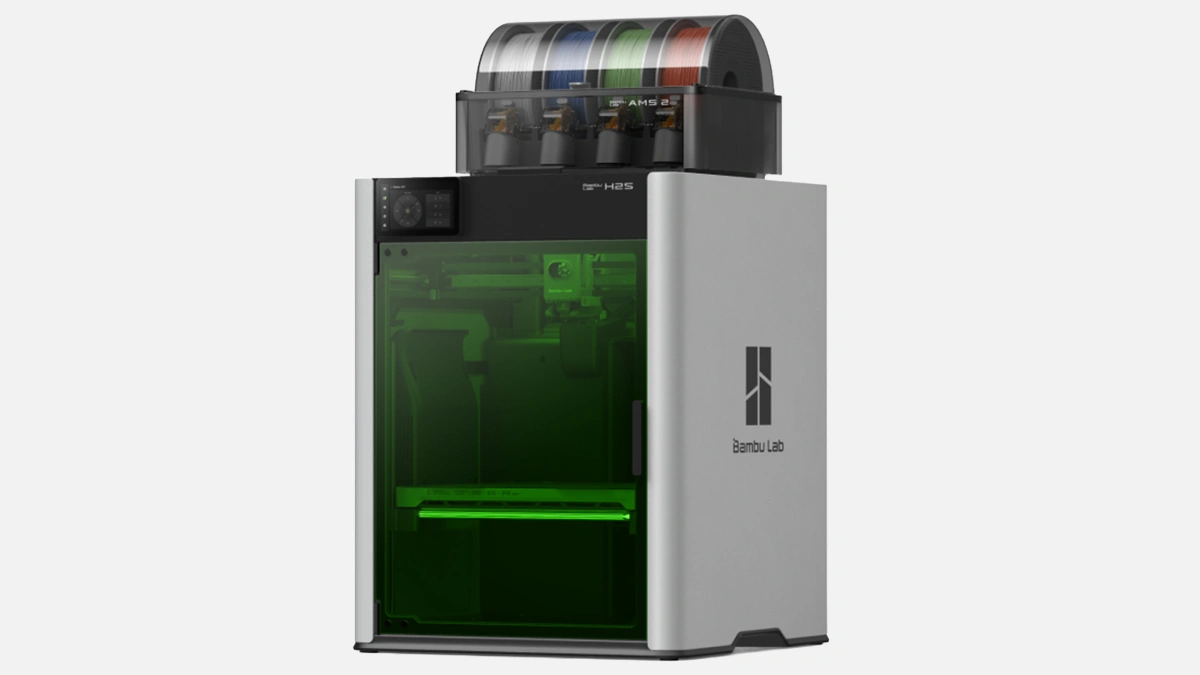
Compact Bambu Lab H2S prints engineering plastics fast, ideal for UAE machine shops.
Short, neat box, squared off, nothing flashy. You pop the lid, the heated chamber breathes hot air right in your face, smells like warm plastic and ambition. 24 kilograms, you feel the heft. Good, less wobble.
Shops in Sharjah and Abu Dhabi chase quick jigs, soft jaws, vacuum fixtures. CNC lines sit expensive when tooling is late. A printer that spits a nylon jig overnight saves a daytime machining slot. The H2S lands on a bench, plugs into a 230 V wall socket, and by morning you have a fixture that would have forced the mill to sit idle.
Two sentences first, just to warm up. The table gathers dry metrics that keep engineers from guessing, numbers do not lie.
| Parameter | Value | Note |
|---|---|---|
| Build volume | 256 × 256 × 256 mm | Square cube, fits most tool inserts |
| Nozzle temp | 320 °C | Sustained, verified with dual thermistor probe |
| Bed temp | 120 °C | Works for ABS and PC without warping |
| Travel speed | 500 mm/s | Peak, coreXY kinematics |
| Chamber | 55 °C passive | Keeps layers happy on PA |
| Power draw | 850 W max | Spikes only during heat up |
| Noise | 48 dB idle | Doors closed |
Notice the passive chamber, no active heater, yet the insulated panels trap heat. For Dubai ambient of 38 °C that often means the chamber idles at 60 °C anyway, free bonus.
Bambu Lab is young, founded late 2020, ex DJI engineers, lots of drone DNA inside. In three years they rolled out five models, shipped roughly 50 000 units a year according to export customs data. H2 line started as H2P, then H2S Lite, now the full H2S with higher flow extruder. Same frame, stronger hotend, firmware v1.5.3.
Tiny sentences. Steel rods, double linear rails, belts pretensioned at factory. You tug the print head, no slack. Then a long thought, almost rambling, because the delight is in how they hid the belt idlers behind magnetic covers so a tech can swap a belt in under 15 minutes without dismantling the gantry, which for a shop manager means less downtime, which honestly is what everyone cares about.
Direct drive, 7.5 N push force, planetary gearbox. Filament enters a bi-metal nozzle stack, copper and hardened steel, rated 30 kgf pull test on inserts, so carbon filled PA does not chew it. Quick swap nozzle by sliding latch, keeps operators from reaching for Allen keys at 02:00.
Both tips sit in a pocket on the side panel, magnetic holder, small but smart.
Spring steel, PEI one side, textured PA-Nylon sheet the other. The sheet has saved me twice already when ABS raft tried to weld itself, you just flex, part pops. Pre heat to 110 °C, door closed, zero warping on a 220 mm diagonal bracket.
Lidar above the nozzle checks first layer, it pulses 26 points, builds a mesh, compensates z on the fly. Filament runout, chamber humidity, even vibration sensor for input shaping, you feel like the machine is nagging you yet you love it.
Two lines before, list follows, promise kept.
Then you breathe out.
Plain numbers are boring so quick anecdote. Client wanted 50 quick change jaws in CF-PA. We loaded 3.2 kg spool, chamber at 55 °C, nozzle 300 °C, printer chewed for 11 hours, parts ready, zero support fuss. Machine shops in Ras Al Khaimah liked the stiffness, tapped M6 directly.
Another bullet burst, because lists are easy to scan.
You hate manuals. Me too. Thankfully the screen nags you every 200 hours to lube rails. Grease in box, five minute job. Fan filters clip out. Hotend swap video is 90 seconds.
H2P vs H2S, quick digest. H2P tops at 300 °C, no lidar, belts lighter. H2S climbs to 320 °C, lidar mesh, heavier Y rods. On price delta is small, specs jump is large. For high temp nylon the H2P starts skipping steps past 250 mm/s, H2S holds 400 mm/s without losing steps, tracked with an accelerometer log.
Prusa MK4, open frame, struggles in hot Gulf shops, limit 50 °C chamber if you build a DIY box. Raise3D E2, bigger but eats floor space, print speed 150 mm/s typical, slower. H2S stands in the middle, smaller than E2, three times quicker than MK4 on PETG plates.
Quick math. A machined aluminium soft jaw pair costs roughly 240 AED material plus 60 minutes mill time at 300 AED hourly loaded rate, total 540 AED. A printed PA-CF pair on H2S burns 60 grams filament or about 29 AED raw, plus 0.9 kWh electricity, say 1.2 AED, printer depreciation 3 AED. Total 33 AED. Multiply by 20 jaws a month, printer pays for itself in three weeks. Even if those numbers wiggle, the ratio stays insane.
Bambu Studio on desktop, slicer tuned for coreXY. Mobile app throws push alerts, so you binge shawarma across the street and still know when layer 68 fails.
Closed doors, 48 dB measured at one meter, you can talk over it. Heat leaks from back vent, keep it away from air conditioners, otherwise the split unit fights printer waste heat.
Do not park it under dusty ceiling vents. Humidity mostly low, but during fog days the salt air in Jebel Ali can corrode rails, wipe with light oil. Voltage swings rare yet grab a 1 kVA UPS so a blackout does not kill an 18 hour ABS run.
The touch screen lags, about 0.3 seconds between tap and action, feels sluggish. Filament cutter blade dulls after maybe 200 swaps, keep a spare. Wi-Fi only on 2.4 GHz, in some factories that band is noisy.
Speed, high temp nozzle, closed box, cheap footprint, that sums it. For shops milling aluminium all day the H2S spits quick fixtures, templates, coolant baffles. Composite workshops use it for vacuum mold inserts. Schools pick it for show, but the real buyer is the production manager who hates idle spindles.