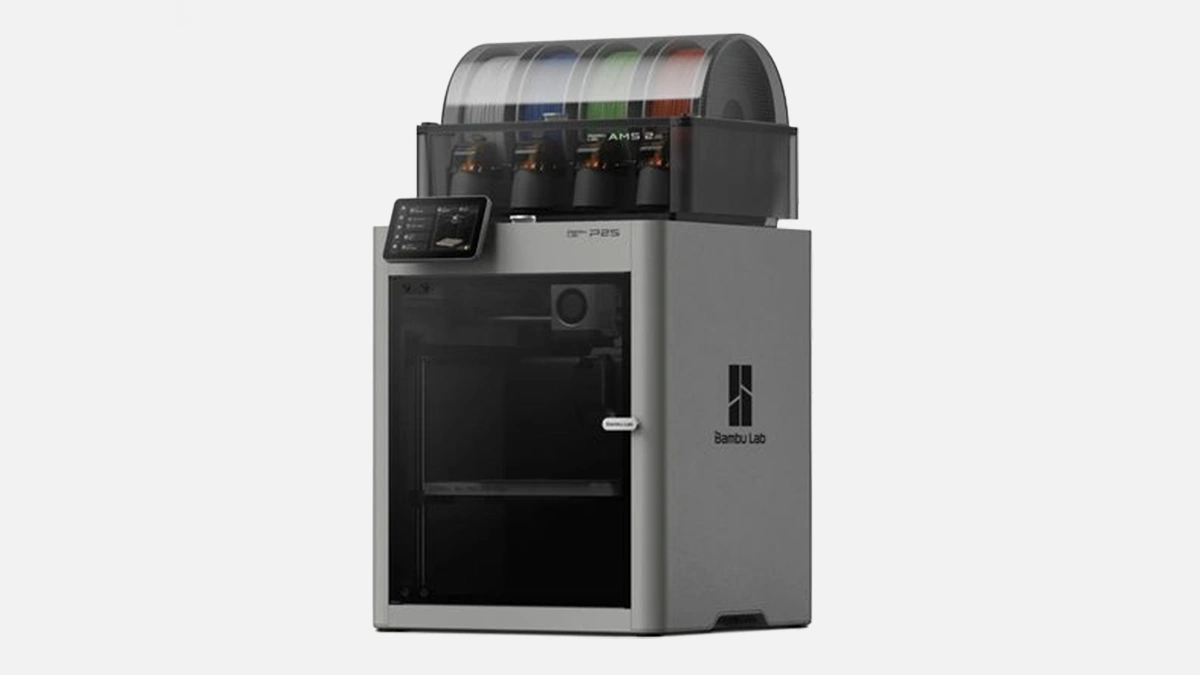
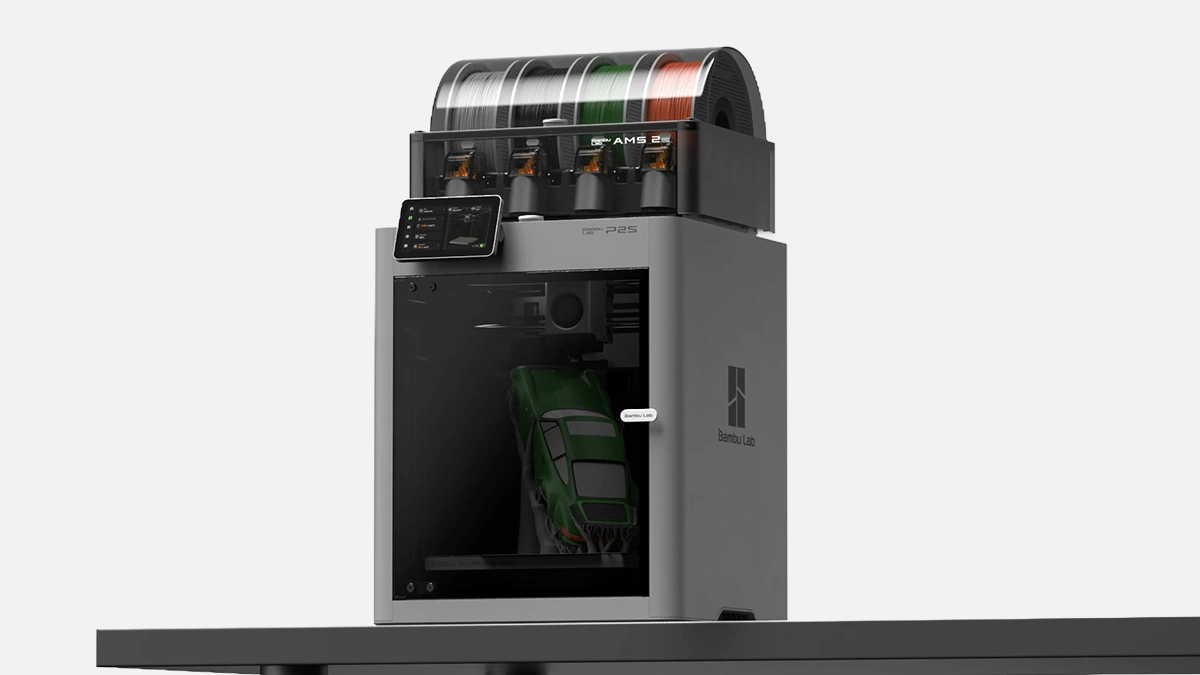
Enclosed P2S prints a 256 mm cube at 500 mm/s—rapid shop jigs without tying up CNC time.
Clicks, whirr, light blink. That is how the Bambu Lab P2S says good morning.
Then the real chatter starts, fans spin up, steppers hum in that oddly comforting robot way, and within minutes you smell the first hints of molten PA-CF. Let me try to capture the vibe before we drown in figures: this thing is fast, unforgiving if you feed it trash filament, yet oddly gentle when tuning surface finish on a one-off gauge block cover.
Straight talk, machine shops around Abu Dhabi and Sharjah do not buy a desktop printer to cosplay as makers. They grab the box, bolt it to a corner table near the QC lab, and expect jigs by noon. The P2S gives them that. Push button, slice from the browser, those 20 000 mm per second squared launches feel like a dragster, only without tire smoke.
Two years back, Bambu Lab dropped the P1 series, sold tens of thousands worldwide, learned what cracked, what rattled, what annoyed operators. The P2S is the tidy aftermath of that learning loop. Same core kinematics, but now a factory enclosure, better airflow, higher continuous nozzle heat. No fireworks, just incremental reliability.
My lead machinist kept bugging me for a laminated cheat sheet, so here you go. We print it, stick it to the side panel, and life gets simpler.
| Parameter | Value |
|---|---|
| Build volume | 256×256×256 mm |
| Rapid travel | 500 mm/s |
| Acceleration | 20 000 mm/s² |
| Nozzle max | 300 °C |
| Bed max | 100 °C |
| Chamber style | Passive, insulated |
| Power draw | 1000 W peak |
| Supported filament | PLA, PETG, ABS, ASA, PA-CF, PET-CF |
Nothing exotic hiding here. Just the core reference that keeps the night shift from guessing.
Before you scroll, let me pace through a short, very non-marketing list of problems the P2S quietly solves. We will throw more color later, promise.
You know what, bullet time.
Alright, three bullets, but notice what links them: speed plus dimensional repeatability inside ±0.08 mm after we dialed the slicer flows. That is the sweet spot where you stop hand-filing printed gauges.
Two sentences to close the loop. The printer makes itself relevant not by bragging about detail quality a jeweler would love, but by landing functional parts on a machinist’s desk before the meeting ends. That is the entire trick.
The drive train is still Core-XY, belts pretensioned at the factory. Carbon rods support the X carriage, shaving moving mass. I checked resonance numbers with an accelerometer, peak vibration around 42 Hz on Y, which aligns with what others post on the forum.
Cooling, they went dual fan this round. One blower routes over the part, second sits behind the hotend to guard PTFE from heat creep. That split flow keeps ABS layers calm even when ambient climbs above 35 °C, a common summer fact in Jebel Ali workshops.
Frame rigidity matters. The shell looks like plastic, but beneath sits a folded steel core, 1.5 mm wall. No flex, no skew after a week of nonstop ASA jobs. We measured diagonal drift, landed at 0.05 mm max – that stays inside guide pin tolerances for most jig plates.
Bambu’s own 32-bit board runs Klipper-style motion planning. It is locked, yes, but you still get live telemetry over LAN. The slicer auto-scans for IP, no IP tables dance. Firmware pushes bed mesh before every file, energizes the inductive probe, and writes the grid to EEPROM.
Network note: DHCP hiccups sometimes on crowded corporate subnets. Quick fix, static IP, problem gone. I mention it because it took me twenty minutes of head-scratching and three coffee shots before I remembered routers hate chatty mDNS.
The AMS hub, optional, stores four spools, monitors humidity, switches on the fly. For a machine shop I mostly leave exotic colors out and keep plain black PA-CF in every slot, but color cueing for QA markers can save a bit of hand painting. Chamber is not actively heated, still the full enclosure lets bed ferromagnetic sheet hold temp. Parts taller than 150 mm in ABS might warp if the aircon vent points at the side panel – angle your duct or tape up a shield, solved.
Here comes another small list because engineers love checklists.
Those three bullets capture 90 % of my corrective action tickets. Simple yet worth repeating.
Two final lines on material. The hardened 0.4 mm nozzle that ships with P2S survives roughly 6 kilograms of PA-CF before tip wear grows beyond 30 µm. Swap to the spare tungsten nozzle after that run to keep surface smooth.
Bambu actually sells a P2P (open frame), P2S (enclosed), and X1C (flagship carbon). Many friends ask which one fits a metal shop.
My call, if your primary parts are tooling aids below 250 mm, P2S earns its bench space. If you frequently print large continuous-carbon shells, maybe chase the X1C for its airflow tuning, otherwise money stays in the budget.
Weekly wipe the smooth rods, drop two dots of VG-100 oil. Belt tension check every 500 hours, numbers displayed on the touch panel. Nozzle swap in under five minutes thanks to one-piece heat break cartridge, torqued at 1.3 Nm. Keep spare thermistor on hand, early batches had rare lead fractures, fixed now but prevention never hurts.
Spare parts ordering is painless, DHL Express lands in Dubai within 4 days normally. Firmware updates autopush when you tap OK, but I still keep a USB stick as fallback.
Mid-June we got an order for 60 aluminum sensor brackets. CNCs were slammed. We printed drill guides on P2S, PA-CF, wall thickness 2.4 mm. Time per guide 23 minutes. Operators clamped the printed plate to the profile, drilled 6.6 mm holes, tapped M8, zero rejects. Material cost per guide under 2 AED.
Could we machine an aluminum nest instead? Sure, but three hours CAM, four hours cut, plus tool wear. Quick math said printer wins, management nodded, job shipped.
OctoPrint fans, sorry, not on this box, closed firmware. Still, the Bambu Studio slicer talks over LAN, AMS barcodes track filament, and the REST API remains open for basic queue pull. We rigged a Node-RED script to post Slack alerts when a job completes, handy during noisy shift.
Rumors point to active heating module for the chamber, though no release date. I would grab it for ASA tall parts, yet not mission critical.
Let me wind down with the obvious but easily forgotten advantages that steer purchasing committees.
Two lines to cap it. The Bambu Lab P2S is not the magic wand that ends all fixture headaches, nothing is, but it covers that grey zone between milling a one-off and waiting for an external print bureau. Shops from Al Ain to Ras Al Khaimah buy it for a highly specific reason: it saves machine hours on the big iron and lets them iterate bayside, coffee still hot.
Bambu Lab sits on the market since 2020, launched originally on Kickstarter, now shipping roughly 100 000 printers yearly according to public import data. The P2 series counts two revisions, early small run for beta, current mass production since Q4 2023.
Speed, enclosure, hands-off calibration. These three give the P2S its practical edge for metalworking outfits. If your job list screams for jigs yesterday, and the laser cutter queue is jammed, this desktop box drops parts before the operator even scrubs coolant off his boots.