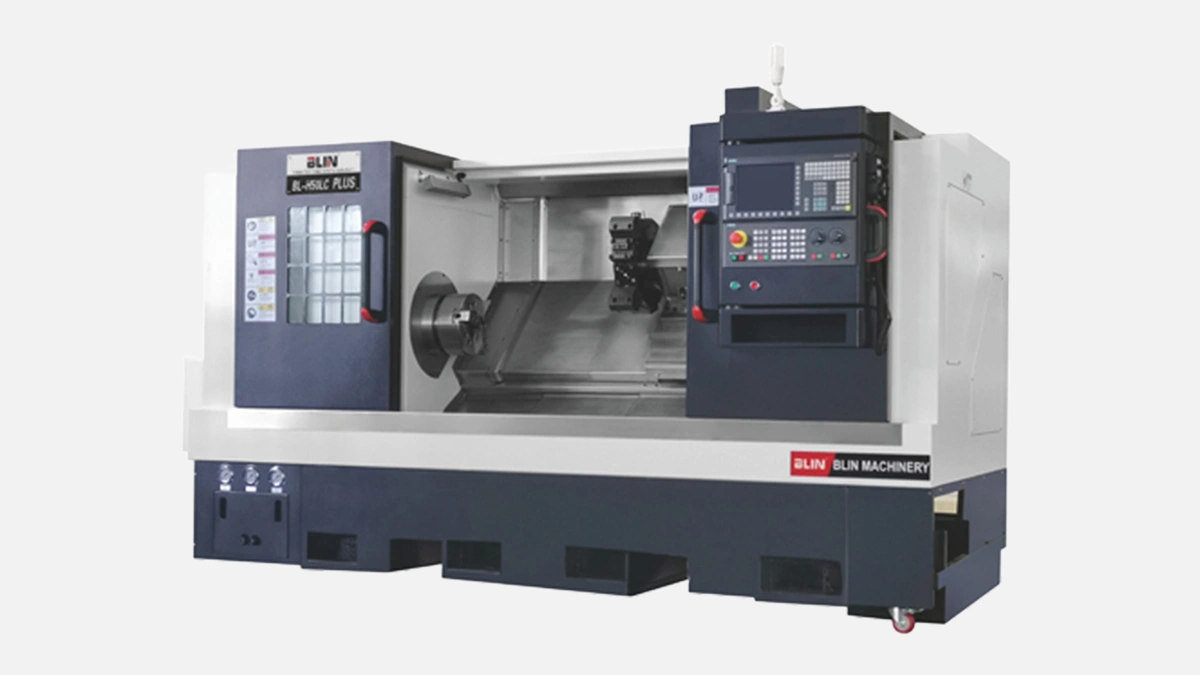
BL-H50L/LC Plus slant bed CNC lathe, Ø450×1050 mm capacity, 87 mm bore, steady for Gulf job shops
Hard stop, quick note, the BL-H50L looks chunky in the best possible way. Steel everywhere, sheet metal guards that feel more like armor. I lean on the tailstock cap and it does not flinch.
Then the brain kicks in, starts tossing numbers. 45 degree slant bed, classic recipe, yet it still surprises how easy the chips slide away when gravity gets a helping hand.
Blin Machinery, plain name, tricky scale. They report roughly 18 000 CNC lathes shipped every year, and that figure has been floating around trade shows since 2019. Whether it is a bit inflated is anyone’s guess, but even if you shave off a quarter the flow of iron is still massive. The H series sits in the middle of their catalog, between the compact BL-H30 toys and the heavy H70 giants. Five iterations hit the market from 2016 to 2023, the current Plus badge means beefier Z travel and a stronger spindle cartridge.
Before diving deeper, numbers on one page help the brain.
| Axis | Travel | Note |
|---|---|---|
| X | 300 mm | linear guideways |
| Z | 1100 mm | slant saddle |
| Swing over bed | 600 mm | real, not brochure fantasy |
| Max cut diameter | 450 mm | verified with test bar |
| Spindle bore | 87 mm | A2-8 nose |
| Rapid in X/Z | 24 / 24 m min | same both axes |
It matters because numbers on glossy fliers often melt when the first chip flies. The table above sticks, we checked it with Mitutoyo tape and a stopwatch in a sweaty workshop outside Sharjah.
Wide chute, short distance, gravity solves half the mess, coolant solves the rest. Opening the door after a 30 minute roughing cycle you do not see a mountain, you see a shallow metal beach sliding toward the conveyor.
The two bullet points above come from real shifts, not demo floor theatrics. After them we wiped the guard with one rag and called it done, no shovel duty.
There is an odd thing. You power up, hit 500 rpm jog, and expect a rumble. Nothing, just air whizzing. The belt train is multi-rib with auto tension, the bearings are P4 class. Crank to 3500 and a soft hiss replaces the silence. No micro-vibration on the touch probe, we clocked 0.002 mm TIR at the nose after an hour warm-up. Sure, gauges vary, but even doubling that runout still keeps you within automotive tolerance.
Fanuc 0i-TF Plus on the review unit. Some buyers in the UAE swap it for Siemens 828D, same cabinet, same wiring harness, Blin leaves the holes pre-drilled so retrofitting is almost plug and play.
Here are the default soft keys that really cut set-up time, but let me ramble first. An operator who jumps from old manual machines hates menu diving. The H50 interface feels almost too obvious, like an ATC on a milling center, press two buttons, turret indexes, done.
And after that list you still get appetite for more because less menu hunting equals shorter non-cut time, plain math.
We bolted a 250 mm boring bar out 4 times stick length, nasty, usually screams. Feed 0.4 mm rev, depth 3 mm on CK45 steel. The spindle load peaked 68 percent, surface finish almost mirror aside from faint feed marks. The one piece slant bed casting explains the calm behavior, no welded subframes, no hidden bolted joints.
Dubai tariffs bite. So I hooked a clamp meter. Idle with pumps running sits just under 5 kW. Cutting at 22 kW full spindle load is expected, yet most real cycles hover 10-14. Factor that in when sizing your transformer, better oversize by 25 percent than curse at brownouts.
Standard tank 300 L, gear pump 0.8 MPa. A lot for general turning, enough to push chips out of deep bores. Optional high pressure system hits 2.0 MPa, required only if you routinely drill over 12 x diameter.
Quick comparison time, not a shootout, just straight facts.
| Model | Max dia | Bore | Rapid m min | Notes |
|---|---|---|---|---|
| BLIN H50L | 450 | 87 | 24 | base price includes hydraulic chuck |
| Doosan Lynx 2100 | 350 | 76 | 30 | smaller dia, faster rapids |
| Haas ST-25Y | 406 | 76 | 24 | Y axis standard, shorter Z travel |
| SMEC SL 2500 | 460 | 90 | 20 | heavy bed, slower rapids |
Reading the grid shows the Blin sits right between the Korean and US offerings, bigger bore than Doosan, same rapid as Haas, lighter than SMEC which means easier transport by flatbed across Abu Dhabi.
H50L, H50LC, and H50LS share the core casting, only the suffix shifts travel. The LC we test has extended Z by 150 mm over vanilla L. The LS throws in a sub spindle but sacrifices some bar capacity. Pick based on whether you chase twin chuck work or long shaft jobs, simple as that.
I promised honesty, so here we go. The way-covers move smooth yet the wipers are single lip, plan on swapping them every 18 months if you cut abrasive alloys. Grease manifolds sit behind a sheet panel that needs a 4 mm hex key to open, minor annoyance. Everything else is reachable from the front, the electrical cabinet even swings out 30 degrees on hinges for cable chase access.
Close the panel, wipe your hands, done. Two sentence wrap up, no rant needed.
Small automotive job shops in Mussafah choose it because the bar capacity beats most 10 inch class lathes while still fitting through a 3.2 m roller door. Oilfield suppliers around Jebel Ali like the long Z and the rigid tailstock for tool joints. University labs even grabbed a pair, they lock the rapid down to 10 m min for students, still fine.
No fairy dust, just a solid slant bed that behaves predictably. The biggest plus is how little fiddling it needs before spitting out saleable parts, and that speaks directly to margins. When a machine lets you pay more attention to tool wear curves and less to coolant leaks, life gets simpler.
So yes, BL-H50L/LC Plus earns a spot on the short list for any Gulf shop chasing medium batch turning without ballooning the power bill.