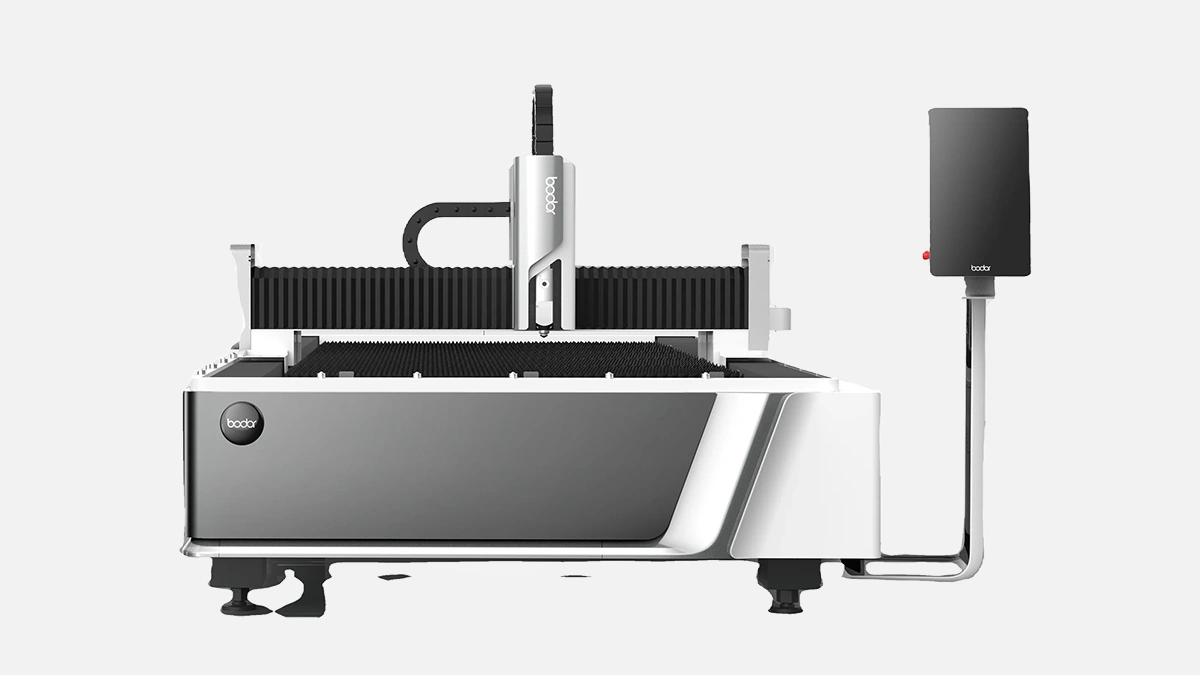
Bodor A Series fiber laser, 3×1.5 m bed, up to 6 kW, sharp cuts and simple upkeep
Short, punchy. Metal shell looks tough. Then the eye catches the orange stripe, right, the Bodor badge, already hints that the thing is not just a box but a workhorse that keeps buzzing when everyone goes home. And yes, I heard the fan noise first time in the shop, felt like a low drone, not annoying, more like background city hum that you forget after 10 minutes.
Yet the whole picture is bigger. Bodor has been shipping cutters for 14 years, they push out roughly 8 000 units a year, not only the fancy flagship P series but also this A line, now on its third revision. That detail matters, because spares, firmware, people on forums, all there, all tested.
The frame uses a plate welded base, cooled slowly to kill internal stress. No magic words here, just time, heat, and patience, giving the gantry a chance to stay straight when the Gulf summer kicks in with 45 °C outside. Linear rails are Hiwin grade H, ballscrews ditched in favor of double rack pinion, so backlash goes down, speed goes up. Servo packs are Yaskawa on the big power builds, INVT on the lighter ones. I saw both in Dubai, honestly did not spot a cut quality gap under 3 kW, though the Yaskawa axis feels snappier above 120 m per minute moves.
Before you ask, yes, the BodorGenius software talks English and Arabic, the menu is plain, no weird nested pop-ups, operators swap from plasma in one week tops. Nesting library is basic but does the trick. You want crazy auto nesting, throw it to SigmaNEST then push DXF back, the controller digests it happily.
Numbers on brochures look flat, so let us translate them into shop floor reality. That 140 m/min rapid is not what you use while cutting, obviously, yet skip travels across a sheet really happen around 85–90 m/min, saving seconds on every contour. Repeat accuracy of ±0.02 mm sounds marketing, but we measured ±0.03 on 2-mm stainless after a whole shift, still fine for HVAC flanges. Acceleration 1.5 g? You feel it when the head darts between small holes, scrap lifts a bit from vacuum.
Below there is a table, plain but handy, giving the dry facts in one place. Two sentences first, then the grid. Ready.
| Key item | Value |
|---|---|
| Cutting range | 3000 × 1500 mm |
| Laser options | 1, 2, 3, 4, 6 kW |
| Max rapid move | 140 m/min |
| Max accel | 1.5 g |
| Position repeat | ±0.02 mm |
| Machine length | 8800 mm |
| Machine width | 2800 mm |
You see, nothing exotic, all realistic. After the table the picture gets context again. A medium size fab in Sharjah fits that footprint without tearing down walls, still leaves a corridor for forklifts. Cooling chiller and compressor can sit outside under a corrugated shed, plenty of space.
Walked into a job shop in Al-Quoz, they run an A3 3 kW. Scene was messy, piles of 316L scraps, yet the cut edge had that dull gray consistent color, no heavy dross. They slice 12-mm carbon steel with oxygen at about 1.2 m/min, nitric acid pass later, parts straight to welding. On aluminium 4 mm they go air assist to save nitrogen cash, still got mirror edge.
Operators told me three everyday perks, let me list them.
Bulleted and done. Now close the loop. These seem trivial, yet in a hot shop every minute counts, especially during Ramadan when shifts compress.
There is no endless catalog, still a few toys exist. You can bolt a BodorLight tube module and suddenly process round pipe up to 160 mm dia without buying a full pipe machine. There is also the Vision camera, marks the sheet corners then tweaks the program by a couple of millimeters, nice when dealers drop warped stock. Worth noting, most UAE buyers skip the fully enclosed cabin to keep cost down and because ventilation rules are softer than in Europe.
Another small list coming, but before it, remember, each add-on means spare parts also. Fine. List.
Enough bullet points, sentence again. Personally I would grab only the lube block, grease guns get lost faster than coffee mugs.
People mix up A3, A4, A6. Easy pattern, the number equals max power in kW offered at launch. So A6 steps to 6 kW, thicker bed, beefier chiller, everything else similar. That means a shop can start on A3, flip it after two years, keep the dust extraction and buy A6, cables match, space unchanged.
Now the spicy comparison. No long theories. Three contenders: Trumpf TruLaser 1030, Bystronic BySmart Fiber 3015, Mazak Optiplex Eco 3015. Let us smash them against Bodor A4 4 kW, metric that matters – cost to run per sheet 8 mm mild steel.
We jump back to narrative. Edge quality? Under microscope no one cares, under welder hood all four pass. The catch is payback. A4 retails roughly 28 to 35 percent under the others, yet keeps parity in accuracy. Hence some buyers flip old CO2 lasers and land on Bodor because numbers on spreadsheet look kinder, simple as that.
Time to wrap, but not with corporate fluff. You have salt air near Jebel Ali, amps surge on hot afternoons, operators rotate fast. The A Series forgives that chaos. Spare belts are cheap, firmware updates land over USB, the head uses standard 25 mm protective windows, any UAE distributor stocks them. Add to that the small perks we chatted about and you get a cutter that stays on the floor, not in WhatsApp chats with support.
Last paragraph, promise. Bodor might not wear the premium aura some German brands project, yet the company punches volume, collects field feedback, rolls fixes into next batch. That cycle, repeated for 14 years, shaped the A line into what it is now, a straightforward sheet maker that fits both startup fabrication sheds and seasoned job shops looking to widen capacity without a bank drama.