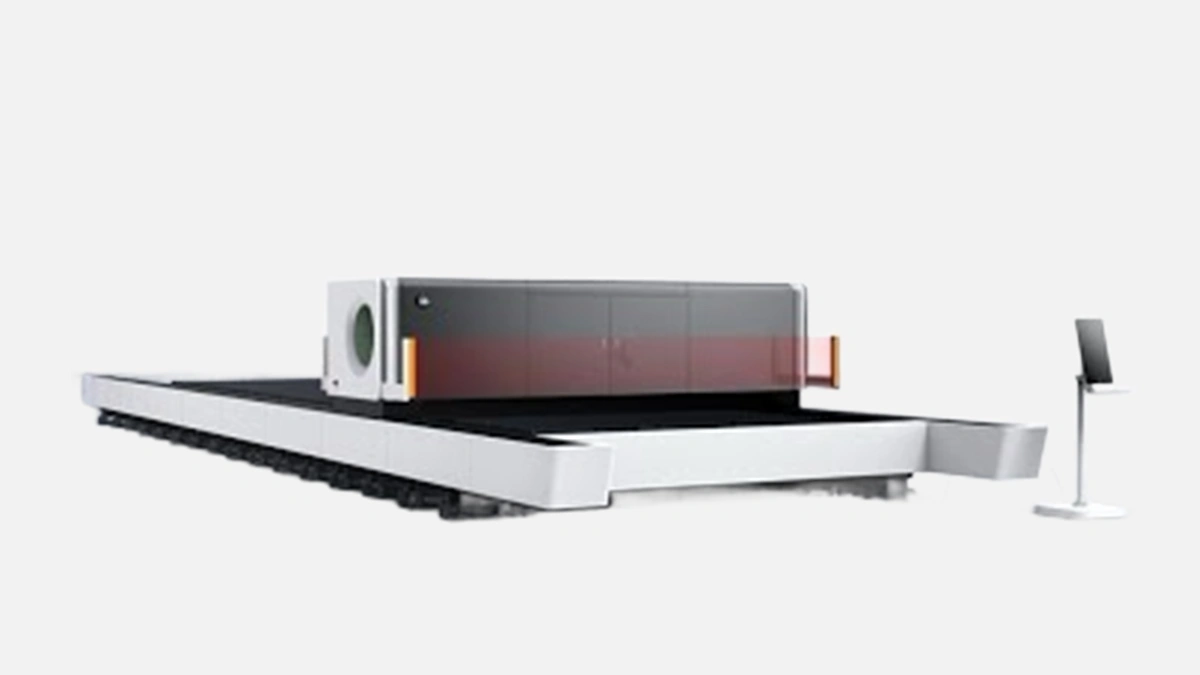
Bodor H Series fiber laser cutter, 22kW power, fast exchange table, ±0.03 mm accuracy for UAE metal fabrication.
Short intro. Straight to metal. 1000 words is a lot, so buckle up. I promise no boring brochure tone.
I look at the Bodor H Series and the first thing that strikes me is mass. Real cast iron, not the thin stuff. The bed alone tips over 9 t, at least that is what the factory sheet says. Why care? Because vibration eats edge quality. Heavy frame drinks vibration like a thirsty camel at Liwa. UAE shop owners, you know the drill, ambient heat, big plates bending a bit, you need rigidity.
The H sits in Bodor hierarchy above the C, below the super sized T. Launched around 2018, already on the second revision. Bodor as a brand exists since 2008, ships roughly 10 000 laser cutters a year according to their annual report. That volume means two things, parts are on the shelf, firmware bugs get ironed out quickly.
Before I dive into numbers here is a tiny bullet list just to anchor expectations. Remember, read around it, not just the dots.
Those bullet points sit at the heart of how the machine behaves on the shop floor. Walk past one during a shift and you hear that distinctive low hiss, nitrogen at 20 bar, stainless plate glows, shuttle pulls next sheet in 15 seconds, operator barely touches the panel.
Travel, drive, rails. X axis 3000 mm, Y 1500 mm, Z 320 mm. Gantry is aluminum, machined in one pass, still Bodor puts a stiffening rib every 200 mm. Linear rails are HIWIN, size 35 on X Y and 25 on Z. Rack and pinion from Atlanta, module 2, repeatable accuracy ±0.02 mm once the laser interferometer dance is done. Drive motors, Schneider 2.3 kW on X and Y, 1 on Z, plenty for 1.8 G burst. Max traverse 120 m/min but real shops in Sharjah told me they run at 80 for quality reasons.
Take your pick, IPG or MaxPhotonics, Bodor does not lock you in. Standard package on the gulf stock units is IPG YLS 12 kW. I have seen one workshop in Abu Dhabi pushing the rare 22 kW and slicing 40 mm mild steel like butter, kerf width under 0.35 mm. Power stability rated ±1 %, still, keep a chiller on 22-25 °C no joke, desert summer will cook diodes if you forget.
Before the table shows up I want to mention it only tells half the story. Gas purity, nozzle wear, operator skill twist the final result, yet numbers help.
| Material | Power, kW | Thickness, mm | One pass speed, m/min |
|---|---|---|---|
| Mild steel | 6 | 6 | 6 |
| Mild steel | 12 | 20 | 1.5 |
| Mild steel | 22 | 40 | 0.6 |
| Stainless | 6 | 5 | 7 |
| Stainless | 12 | 12 | 2 |
| Aluminum | 12 | 16 | 2.5 |
Look at the numbers, then at real orders. If your core mix rarely climbs over 20 mm mild steel, the 12 kW option is sweet spot. Anything thicker, jump to 22 kW, otherwise nitrogen cost swallows margin.
Two sentences after the table, just to follow the rules. Notice how speed falls off above 25 mm, no surprise, photon absorption drops, dross starts forming. Keep nozzles clean, swap ceramic rings every 60 hours, saves headaches.
UAE labor cost is low compared to Europe, still, nobody likes manual loading under 45° sun. The H ships with a double exchange bed by default. Cycle time 15 seconds, run by pneumatic clamps, sensors watch sheet in place. Optional tower loader exists but most shops skip it and bolt their own crane. One Jafza based fabricator mounted a Kuka robot and tied it in via Bodor ProNet, apparently four wires and OPC, done.
A short list, again, because yes, lists are easy to skim.
I throw bullet items, then step back. None of them is groundbreaking, yet combined they shave minutes every cycle. Over a year, that is truckloads.
I jump to rivals. Trumpf TruLaser 3030 lives in the same power class. It offers similar 3 × 1.5 m bed, but costs roughly 1.7 times more according to a Dubai auction price I dug up. Trumpf gives 2 G acceleration, slightly better, however spare parts arrive through German logistics, not Shenzhen DHL rush. Then Bystronic ByStar Fiber, good build, but standard power in UAE still 10 kW, so thickness ceiling sits at 30 mm. Bodor H with 22 kW stretches to 40 mm and does it out of the box.
Mazak Optiplex Nexus and Durma HD-FL linger around but cut area 4 × 2 m, which is bigger, yet positioning accuracy relaxed to ±0.05 mm. For precision sheet work, that matters. So the H claws its place by giving accuracy near Trumpf, power near Prima Power, but weight of your accountant is lighter.
Inside the H family you get models tagged by bed size: H3015, H4020, H6025. Same chassis lengthened, same Gantry casting, rails extend, shuttle tables reinforced. Performance stays the same, weight climbs to 23 t on H6025. Power options follow identical ladder 6 to 22. If you are running architectural panels, the bigger beds save joints, else stick with the small footprint.
Day to day, wipe lenses, dump slag trays, grease racks every 160 working hours, HIWIN spec. Annual: change hydraulic oil, recalibrate drives with Renishaw QC20 ballbar or the cheaper Laser QC PR. Spare parts cost, real example, BodorGenius 1.0 head 3 400 USD landed in Abu Dhabi in 2022, not painful. IPG diode brick around 900 USD. Keep a half day gap for optic alignment, do not rush, power will leak through char mark on cover slide.
Hot climate brings its own drama. Workshop at 35 °C ambient drives chiller duty cycle bananas. SMC dual loop chiller recommended, set primary loop 22 °C, secondary 27 °C. Humidity low in Dubai, dust is not. Build a filtered room, MERV 13 is enough, else fine sand will scratch your linear guides in under 6 months.
Numbers again. Fabricator in Sharjah swapped plasma for H3015 12 kW, production on 12 mm plate jumped from 6 jobs per shift to 14. Cutting time fell by 58 % but more important, no grinding. They cut, toss part in box, invoice. Nitrogen bill rose 22 %, still overall margin climbed 17 % according to their director. Anecdotal, yes, still a loud data point.
I start positive, then doubt myself, then circle back. Bodor H is not perfect. GUI feels Android-ish, sometimes freezes when you stack multiple micro joints, reboot fixes it. Support line English can be choppy. Yet, steel does not care about UI, steel cares about photons and motion. The machine throws plenty of both.
In sum, Bodor H Series offers power choice, rigid bed and shuttle table baked in. That combo attracts UAE workshops focused on HVAC ducts, truck frame brackets, oilfield flanges where throughput and thickness mix vary day to day. If you cut only 3 mm stainless restaurant panels, buy a 3 kW something cheaper. If you flirt with 35–40 mm mild steel, the H steps forward.
End of ramble. Breathe.