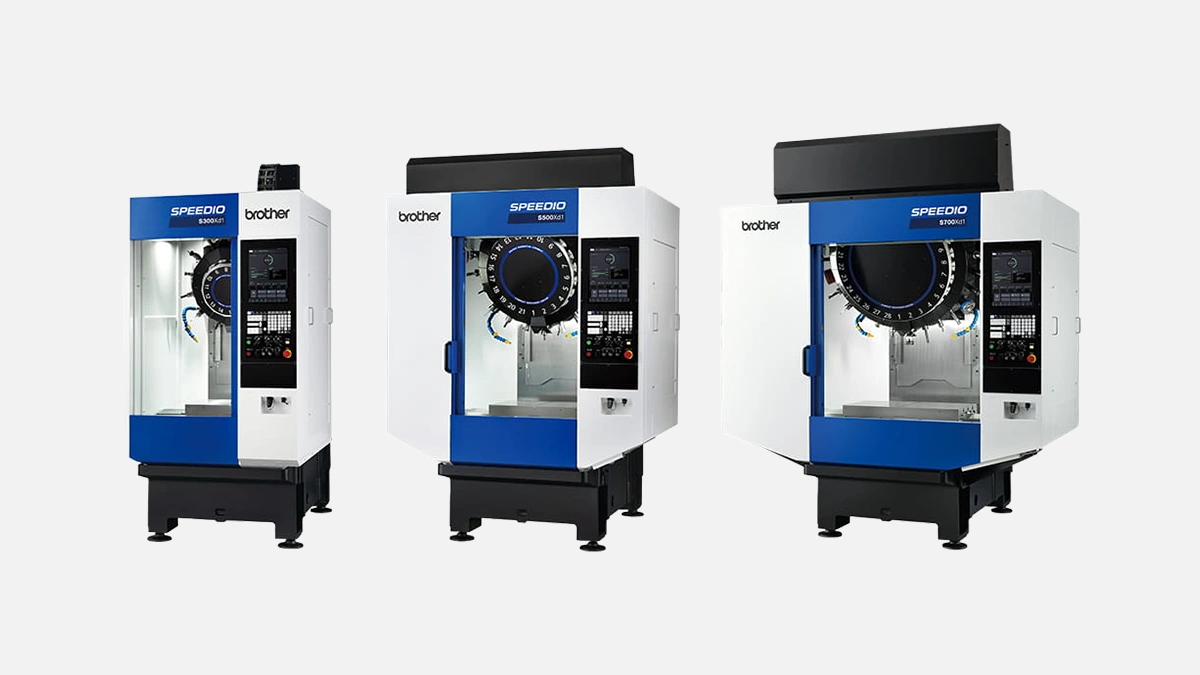
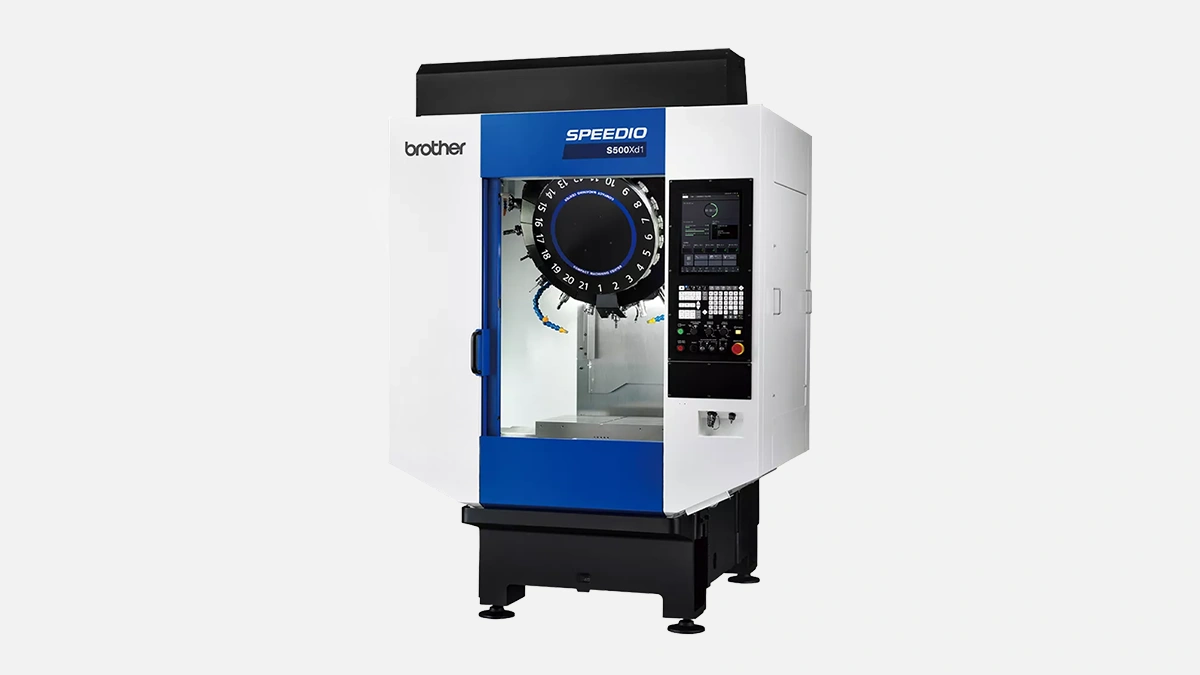
Compact five-axis Speedio S500Xd1-5AX: 500×400×300 mm travels, 10 000 rpm, rapid 50 m/min, ideal for UAE shops.
Small footprint, loud personality. I walk past the Brother Speedio S500Xd1-5AX and, honest, the first thought is: this box looks like it wants to sprint. Tight casting, no wasted sheet metal, doors glide almost too fast.
Then, boom, the specs hit you. 500 × 400 × 300 mm travels, rapids at 50 m/min in X and Y, a shade quicker in Z. Numbers alone never tell the full story, still, they set the tone.
Brother has been shipping CNC machines since the early 1980s, and today the Nagoya plant pumps out roughly 10 000 units a year, give or take the market swings. The Speedio family itself counts more than 30 distinct variants, S-series being the straight-up vertical line, F-series for larger tables, R-series for twin-pallet niche. Inside the S-series the S500 went through three iterations: X1, Xd1 and now Xd1-5AX. Every step, a bit more travel, a bit stiffer column, fresh control firmware. Nothing radical, just steady, almost boring progress. I like boring when it cuts chips all day.
Before diving into feel, here’s a tidy table. Drink it in, question it later.
| Axis | Travel (mm) | Rapid (m/min) | Acceleration (G) |
|---|---|---|---|
| X | 500 | 50 | 1.2 |
| Y | 400 | 50 | 1.2 |
| Z | 300 | 56 | 1.5 |
Those acceleration numbers come straight from the Brother maintenance PDF, not from glossy brochures. Operators confirm them on servo trace screens, give or take 5 % variance.
Two sentences after the table, because nobody likes a cliff edge. Point is, the machine pulls hard yet stops on a dime, which matters when your cycle time target is a stubborn 34 seconds per side on a medical implant blank.
I threw a Ø16 mm carbide rougher, 2 flutes, 12 000 rpm, 2 mm DOC on a 6061-T6 plate. The sound, more hiss than growl, told me the spindle was comfy. Servo load hovered around 45 %, no alarms. Swarf evacuated clean through the side flush, big plus in the desert climate of the UAE where chips clog way faster once coolant picks up dust.
Those bullets barely scratch the surface, but they already hint at the combo: speed, repeatability, little babysitting.
Space costs. The S500Xd1-5AX footprint sits at roughly 1 450 × 2 800 mm, power plug to coolant tank. That’s less than half the floor patch of a typical 40 taper five-axis. Two guys slid it through a 2.5-m roller door without uncrating the spindle head, mild miracle. Touch the leveling screws, hook the chiller, done.
“We were cutting parts before evening prayer,” says Saeed, lead machinist at a Sharjah subcontractor. Real quote, I asked him last month. The man likes machines that let him go home early on Thursdays.
Menu flow is dead simple, soft keys well spaced, even with oily gloves. Macro B as standard, probing cycles baked in, Ethernet DNC out of the box. Some still whine the screen feels 1999, I say who cares if the cycle start keeps making money. A quirk though, you can’t edit macro variables while in single block, forces you to trust the code.
Mazak Variaxis C-600? Heavier, slower to drop tools, 30 % pricier on the street. Haas UMC-500? Cheap, yes, yet rapids stall at 30 m/min and you baby the rotary brake under heavy billet. DMG MORI CMX 50 U? Sweet surface finish, but the CELOS control feels over-decorated when all you need is a green cycle lamp. Against that backdrop the S500Xd1-5AX positions itself as the lean middle lane, the machine that skips fancy skins and focuses on uptime.
| Model | Travel X/Y/Z (mm) | Spindle rpm | Pallet changer |
|---|---|---|---|
| S300Xd1 | 300/300/300 | 16 000 | No |
| S500Xd1 | 500/400/300 | 10 000 | No |
| S500Xd1-5AX | 500/400/300 | 10 000 | Tilting rotary |
| S700Xd1 | 700/400/300 | 10 000 | No |
Why pick 5AX over plain S500? Because multi-face machining in one clamp saves fixtures, saves errors, saves that nasty second op when tolerance stacks hunt you down at ±0.01 mm.
Live with the machine a year, those details matter more than brochure charts.
Aluminium aerospace brackets, stainless dental abutments, even small copper EDM electrodes, all see short cycle times and predictable accuracy. High ambient temperature? The oil-cooled spindle keeps delta-T under 2 °C, verified during the July humidity spike in Abu Dhabi. Limited mains capacity in older industrial areas? The Brother pulls under 15 kVA peak during ramp-up, your landlord’s fuse box will survive.
The ATC claws hate oversized retention knobs, watch your pull-stud spec. And the control still prints alarm logs on thermal paper like it’s Y2K, Brother, please, PDF export next firmware.
So, messy mind dump over. The Brother Speedio S500Xd1-5AX lands in that sweet spot where a small UAE shop wants five-axis capability without sinking capital into a massive casting. Fast, compact, steady, and, yes, a tad loud when the spindle hits 27 000 rpm, but that’s part of the charm. If your parts fit the envelope, this thing just gets on with the job.