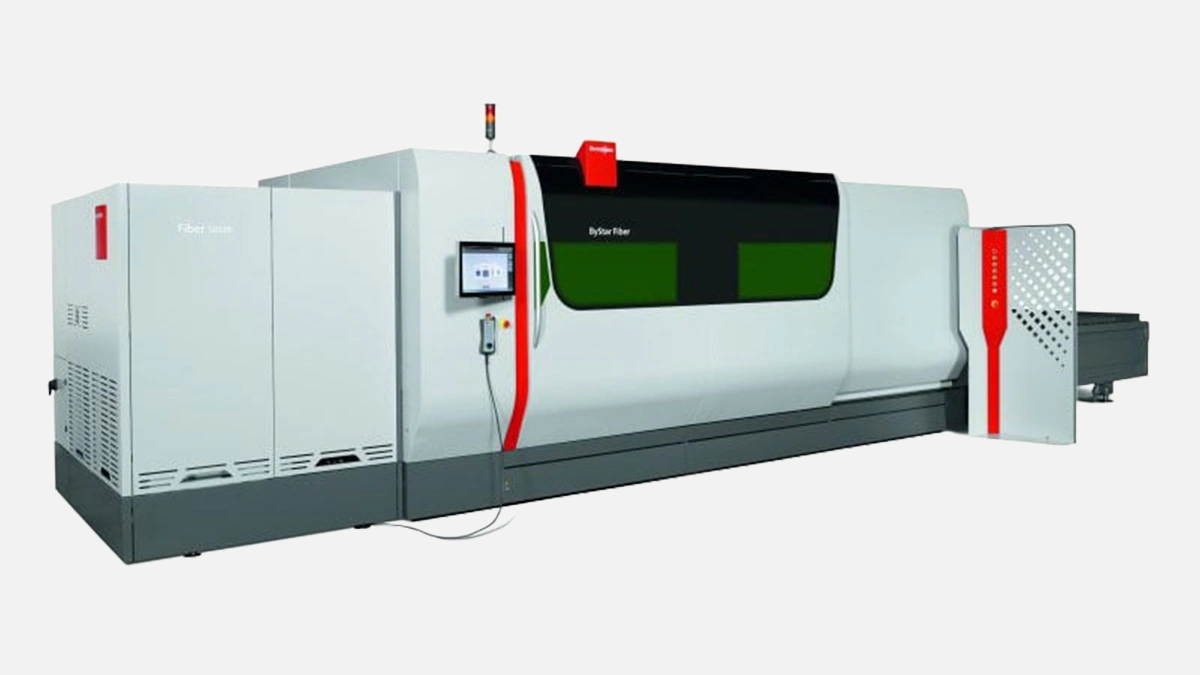
ByStar Fiber 3015 cuts 30 mm steel fast, 140 m/min travel, Swiss build.
Short line, like a jab. Then another. Now a long breath that wanders around the shop floor, jumps over a coil of oxygen hose, stops by the operator’s coffee mug, and finally lands on the Bystronic logo painted on that tall gray housing in the corner, the one people still call the new guy although it has already pushed three shifts since October.
Dubai shops crave throughput, no time for slow pokes. The ByStar Fiber steps in, unapologetic. 40-degree outdoor heat is normal here, so the sealed fiber resonator hiding under the hood, safely away from dusty desert wind, is not luxury, it is survival. Colleagues in Sharjah keep saying the same, they swapped their aging CO₂ for fiber last year, power bills dropped, night shift got quieter.
Before I drown you in figures let’s map the metal rectangle you are really paying for. 3000 by 1500 millimeters, that is the bed size for the 3015 variant most yards import. If you need bigger, Bystronic sells 4020 and 6225 bodies, yet the engine remains identical, so scaling up is logistical, not technical.
Two sentences done, now a table is coming, breathe.
| Item | Value |
|---|---|
| Laser module | IPG YLS fiber, 3-12 kW |
| Focus head | Bystronic SSC with motorized lens |
| Acceleration | 2.7 g peak |
| Rapid traverse | 140 m/min dual-axis |
| Position repeatability | ±0.03 mm |
| Assist gases | O₂, N₂, compressed air |
| Pallet changer cycle | 35 s swap |
The grid above looks dry, sure, but every entry has a story. That 35 second pallet change, for instance, saves roughly 7 minutes per hour on a busy nesting schedule, which sounds tiny until you stack it over a fiscal quarter, suddenly the machine produced two extra full days of parts without hiring anyone new.
Blink, I jump to another microtopic. ByVision Cutting lives on a big touch screen, feels more like a tablet than a hardcore CNC controller. Operators who grew up swiping Instagram adapt in half an afternoon. Yes, the back-office engineer can still remote in through OPC-UA, yes, the machine logs every pierce. No, you do not need Swiss VPN wizards to pull data, the interface exports plain CSV, we tried, it works.
Two lines first. Users ask, what pockets does this laser really fill in a Gulf region job shop.
– Cutting thick mild steel flanges in single pass, nitrogen off, to dodge oxide edge
– Speed running 1 mm stainless signage without micro-burr so sanding crew stays home
– Hot swapping materials through the shuttle while the laser stays on, avoiding idle dwell
That last point deserves a few extra words. The twin table system is not exotic now, yet Bystronic tuned the hydraulic pins so sheets land flat even if a forklift drops them skew. Small trick, big comfort.
Everyone pretends capital expense is the mountain, but in Jebel Ali clients actually fear the utility bill. Fiber tech uses roughly 30 % less electric juice than a same power CO₂ tube, partly because no turbo blower screams all night. Add that to nitrogen generation on site, and you start seeing managers smile during monthly meetings, rare view indeed.
Quick jump to rivals. Salvagnini L5, Trumpf TruLaser 5030, Mazak Optiplex Nexus 3015, all dance in the same wattage league. Yet the ByStar keeps three edges.
* First, IPG modules are field-swappable, a three hour pit stop, while some competitors seal everything beyond warranty.
* Second, the Bystronic head uses a single collimator lens, fewer disposables when optics collect splash.
* Third, Bystronic’s UAE tech hub stocks filters and chiller hoses locally, shipping from Dubai, so downtime stays under 24 h for common consumables.
Notice I praised service then, contradicting my earlier rant about self sufficiency. Fine, humans are inconsistent, machines too.
ByStar Fiber itself split over three waves since 2015. Generation one topped out at 6 kW. Gen two, late 2018, jumped to 10 kW and a beefier gantry. The latest refresh nudged to 12 kW, tweaked cooling, plus embedded camera for nozzle centering. If you already own an older ByStar, upgrading optics is possible but budget wise buying fresh metal sometimes wins, depends on duty cycle.
Ahmed, night shift foreman at a Ras al Khaimah fab shop, muttered last week that piercing 25 mm S275 with oxygen takes 4 s versus 7 s on his prior CO₂. Tiny delta, yet overtime vanished. One anecdote is not science, still feels real when the guy logs the numbers in an oily notebook, not in glossy brochures.
Let us be candid, this laser is not flawless.
– The factory cabinet needs 230 V single-phase for auxiliary fans, tricky if your plant is exclusive 400 V three-phase
– Dust drawer sits low, tall operators bang knees pulling it out
– The official bottle rack assumes European 50 L cylinders, UAE shops often use 80 L, you will weld a bracket
Criticism spoken, back to praise.
Assume 8 kW source, 6 mm mild steel, 50 % sheet utilization, three shift regime. Our own nesting software spat 28 tons monthly, loading crew of two. Swap to 12 kW, same geometry, cycle time dropped 18 %. Not gospel truth, just numbers from a Sharjah case study, still gives a vibe of scale.
Bystronic exists since 1986, pumps out roughly 900 laser machines annually, with five fiber families on catalog. Buyers in the Gulf pick ByStar mostly for raw speed plus the brand’s uniform UI across press brakes, meaning one touch panel less to decode. Also resale value holds, older 2017 units still fetch over half of initial cost on regional auctions.
The ByStar Fiber slices metal fast, sips power, comes with Swiss rooted build yet does not sulk in desert grit. That is the pitch, take it or scroll on.