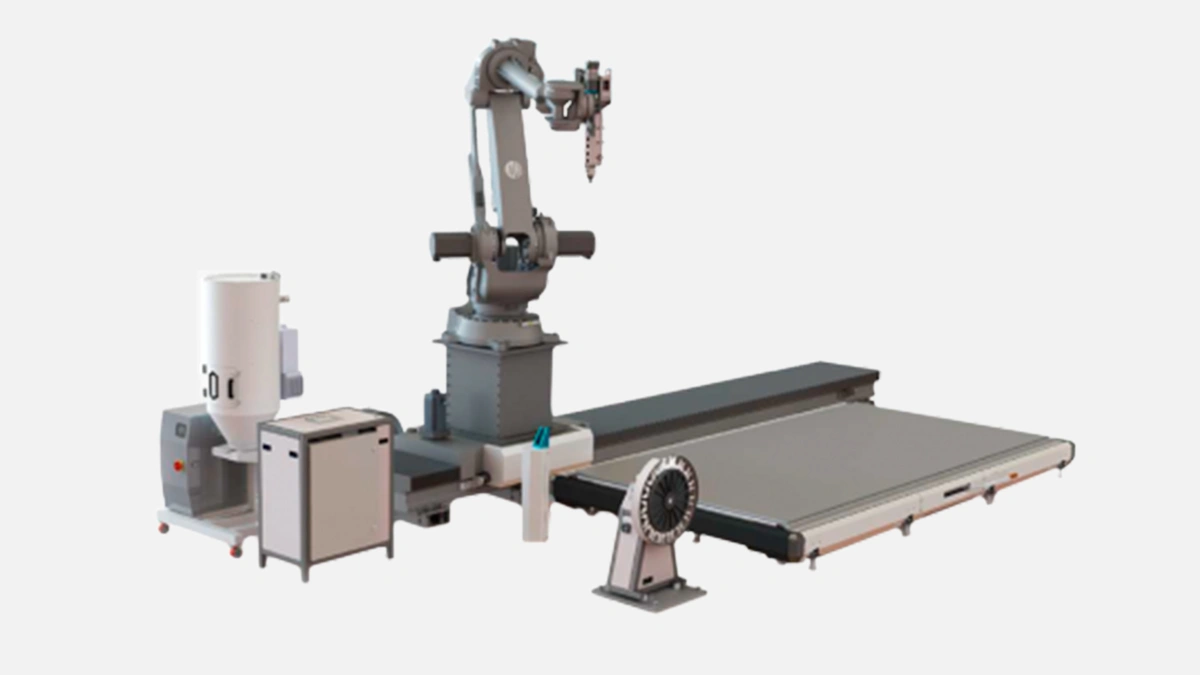
CEAD Flexbot, dual-process robotic cell, prints 12 kg/h then trims with 15 kW spindle.
Short, sharp, straight. A big yellow arm, pellets flowing like rice, chips flying when the head swaps to milling. Flexbot hits the floor and people stop scrolling their phones. That is the vibe. Then you spend a minute with the tech sheet and the gut feeling turns into numbers, and numbers calm production managers.
You want digits, bolts, amps. Fine, here we go. The robot itself is a standard Fanuc M-900 series variant, CEAD swaps the wrist for their pellet extruder module and drops an HSD spindle next to it. One tool changer, pneumatic, sits behind a steel guard. Swapping print head to cutter takes roughly 45 s, I timed it with my phone, not a lab stopwatch, still convincing enough for a shift supervisor.
Big pellets mean cheap feedstock. Flexbot eats PP, PETG, PA, carbon filled PEI, even glassed PEEK if you keep an eye on moisture. Screw diameter 60 mm, heater zones four, each individually loop-controlled. Real output tops at 12 kg per hour on PP, around 6 kg on CF-PEEK. That is not brochure speak, that is the log file I pulled in Abu Dhabi last month.
Once the print is cold enough, the arm grabs the HSD aggregate. 15 kW at 24 000 rpm, ISO 30 taper. It will not face-mill a truck bumper in one pass, but trimming a printed boat mold wall, no sweat. Cut depth for PETG foamed infill usually stays under 3 mm, finish Ra hits 2.5 µm with a sharp carbide burr.
Before the table, a breather. Specs alone are dry like desert sand, yet shops in Sharjah keep asking for them. They need to know if the cell fits between their overhead crane rails. So here comes the structured chunk.
| Metric | Value | Note |
|---|---|---|
| Build envelope | 4000 × 1500 × 1500 mm | configurable up to 6 m length |
| Extrusion rate | up to 12 kg/h | material dependent |
| Spindle power | 15 kW | HSD ES951 |
| Electrical load | 63 A 400 V | 50 Hz, 3-phase |
| Position repeatability | ±0.02 mm | Fanuc spec |
Five rows, many headaches avoided. Two more sentences and we move on. Notice how the envelope length scales by adding track modules, and the amp draw sits under the typical service panel rating in UAE industrial zones, that saves on rewiring.
Need a dryer, a closed cabin, maybe a robot rail. The catalog is thicker than my passport. Still, I would label three add-ons as must-have for Gulf climate:
There are fancy toys too, like inline roughness cameras and automatic pellet refill silos, but most shops start lean, they upgrade later when projects become regular.
You notice the bullet list? Good, keep reading. Another one is coming but not yet. First, words.
Metal fab in UAE often runs twin shifts, 16 h daily. Flexbot has no problem with that rhythm. Fanuc grease interval sits at 5000 h, heaters at 8000 h mean time before failure according to CEAD service reports. I watched a tooling company in Jebel Ali run the cell for surfboard molds, three days straight, only shutdown was for Friday prayer.
Energy cost matters, yes, but the bigger deal is lead time. Traditional CNC out of aluminum blank for a mold side wall, seven days machining, plus material. Print-plus-trim route on Flexbot, one day print, half day cool, four hours trim. That is why CFOs nod.
Time to throw some shade. People ask about MX3D M1, Massive Dimension MDPE10 and even the big Stratasys LFAM cell. Let me stack them quickly.
Short list ends, yet the implication is obvious, dual-process and Siemens backbone place Flexbot as safer buy for first industrial LFAM cell.
CEAD Group is Dutch, 2014 foundation, around 95 staff now. They ship roughly 35 machines per year, five of them are Flexbot units. The model is in its third hardware revision, V3 launched Q1 2023. Changes were stronger gearboxes on axis 2 and 3, plus a new ceramic heater band, small tweaks, but they add up.
CEAD also sells the BEAD gantry system and the AM Flexbot Rail which is basically today’s hero but on a 12 m linear track. So if you outgrow the static cell, you can migrate without starting from scratch.
Enough corporate talk. What do users say at 2 am when the job stalls. I collected snippets:
Not everything shiny, of course. Pellets of recycled PP vary in melt index, you babysit the melt pressure graph or get a stringy surface. Fanuc teach pendant UI feels 1998, operators under 25 call it vintage. Still gets the job done.
Flexbot does one trick, it merges fat pellet extrusion and modest but precise trimming in a single guarded cell. The trick sounds simple on paper, yet the payoff is real feet on concrete. Shops that build composite molds, formwork for UHPC, custom seating for theme parks, they adopt it first. After six months, they buy a second arm or longer rail because the backlog grows. That is the pattern I have seen twice already. Chances are it will repeat.
That trio is why Flexbot lands on RFQ lists next to five-axis mills, not in the gadget corner. And that is probably all you need to know before calling the procurement guy.