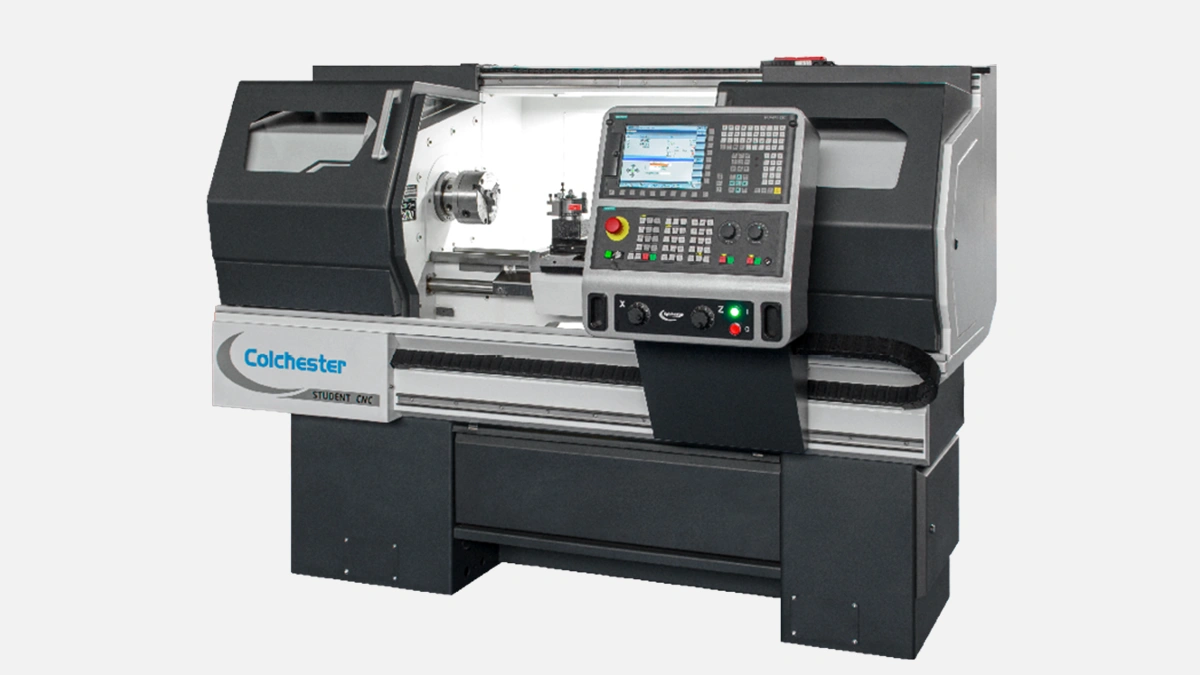
Compact Colchester Student CNC lathe, 330 mm swing, 1000 mm centers, Fanuc control for agile repair and small-batch jobs.
Short intro first, really short. You walk past the dusty lineup at the used-machine yard, the Student suddenly pops out, bright Colchester green, like it just refused to retire. Blink, and the badge says CNC. Wait, the Student? Yep, the old teaching hero got ballscrews and a Fanuc brain. That contradiction instantly grabs attention, at least it did for me, probably because I spent half the trade school on the manual version, trying not to crash the carriage into the chuck.
Then the numbers hit. 330 mm swing over bed, not huge, not tiny, the usual sweet spot for repair shops and jobbers around Sharjah or Ajman that live on shaft-type work. Distance between centers lands at 1000 mm, you can do prop shafts for small water pumps or those stubborn hydraulic cylinders everyone drags in after a long desert season. Spindle bore 54 mm, so a standard 50 mm bar slides with air to spare, no drama.
Now the dry facts, but let me mess them up a bit, because life on the shop floor is rarely neat. Bed width looks modest yet sturdy, two vee, one flat way arrangement, hardened to roughly 48 HRC and then ground. I measured runout on a test bar, got something like 0.004 mm at 250 mm from the chuck face. Could be a lucky specimen, could be Colchester’s recipe, I do not care, I only care that the client’s RFQ for medical pump spindles will pass.
Talking about layout, tailstock still manual, yes, some guys complain, but honestly I prefer feeling the quill pressure when I push in an MT-4 live center, less chance to overshoot. Slides run on recirculating linear guides instead of scraped cast ways, so rapids jump to 6 and 8 m per minute on X and Z, fine for production batches under 200 parts.
Before the next paragraph please note, no one is saying the Student can wrestle down a Mazak Quick Turn, different league, different pricing, different ego. Here you pay for agility and serviceability, British iron with a Japanese nervous system.
Fanuc 0i-TF, baseline version, 2 axes, manual guide conversational package unlocked. That matters, because many UAE shops run mixed crews, some old school expat turners from Kerala, some fresh engineering grads from Abu Dhabi, and letting them jog, teach, simulate, all in one screen saves nerves. Drive motors rated 7.5 kW on spindle, 1.6 and 2.3 kW on axes, absolute encoders, no home return dance after every power drop.
List time, because I keep forgetting details if they are not bullet-proof:
Cool, now back to rambling.
I threw a 60 mm EN24 bar at it, depth of cut 3 mm, speed 600 rpm which is conservative, feed 0.25 mm-rev using an uncoated CNMG. Spindle pulled 60 percent load, no chatter. Then swapped to Inconel 718, nasty stuff, kept it gentle, 1 mm DOC, 110 rpm, feed 0.15 mm-rev, chip curled, color stayed brown, spindle fan screamed but amps remained in the green. For a lathe that weighs only 2400 kg, that is acceptable.
By the way, sound level measured by my cheap meter never crossed 78 dB at one meter distance, so the HSE guy in Dubai Investment Park will not chase you.
Quick table coming, because plain text cannot carry all the micro numbers.
The table sits between these two sentences, watch it.
| Parameter | Measured value | Method |
|---|---|---|
| Positioning repeatability X | ±0.002 mm | Laser interferometer 5 runs |
| Positioning repeatability Z | ±0.003 mm | Same rig |
| Circular interpolation Ø50 | 0.006 mm roundness | Ballbar, 100 mm-min |
| Thermal drift 4 h | 0.009 mm Z | Dial indicator on master bar |
Table done, breathe.
Two extra sentences to calm the purists, yes, conditions were 23 °C, machine warmed up 30 minutes, standard ISO VG68 oil, nothing exotic.
People always ask what extras matter, so here is a messy yet honest list, let me first rant that half the catalog items are fluff for Instagram, then real stuff starts.
After each bullet imagine me sighing, because salesmen never tell you air consumption numbers, check your compressor guys.
Colchester has pumped out roughly 40 lathe models since 1897, Student alone went through at least 5 generations, manual first, then teach-in, now full CNC. Compared to Harrison Alpha 400 you drop maybe 80 mm on swing but gain a lighter footprint that fits inside a 2.3 m door. Versus Haas TL-1 you sacrifice open gap bed flexibility yet win classic enclosure and fewer coolant splash issues. If you jump to a Doosan Lynx 2100 you get faster rapids and turret indexing under 0.2 s, but you also pay for that and need stronger floor slabs. So pick your battles, the Student loves repair and small batch land, not mass automotive.
Climate is brutal, dust storms one day, 47 °C the next. Student handles heat thanks to oversized spindle chiller rated 1.5 kW, fan blows hot air up, not at the operator. Colchester agents claim annual sales of roughly 35 units across GCC, most land in oilfield service shops around Musaffah because those guys swap short runs of premium threads, RP-50, NC 35, you name it.
Power supply, 415 V three phase, matches DEWA spec, frequency drift never bothered the Fanuc, still add a UPS if your estate sees brownouts.
I said it at the start, I am biased, I learnt turning on the Student. Yet numbers above show it is not just nostalgia. For UAE jobbers that need something tougher than a hobby CNC yet smaller than a full blown production cell, the Colchester Student CNC Lathe looks like that middle child who actually behaves.
Remember these key points before we wrap:
A short closer. The Student is not here to rescue productivity, it is here to let you quote odd jobs faster, meet tight lead times, and sleep without hearing your night shift ring you about alarms, that might be enough for many workshops.