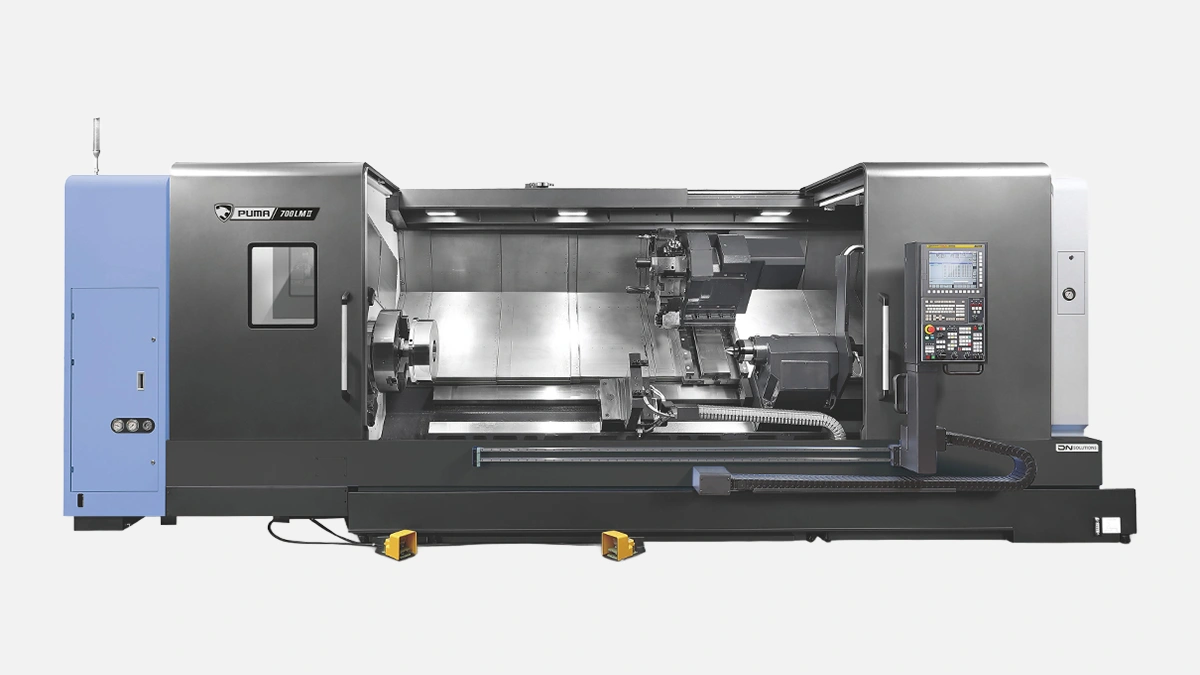
Doosan PUMA 600-800 II, heavy CNC lathes for big shafts, 24″ chuck, up to 5 m Z travel.
Short intro, no fluff. Heavy iron, real chips. PUMA 600 right next to me yesterday, the coolant smell still in my hoodie. The 700 and 800 look identical from five meters, yet inside every casting hides small tweaks, tiny clearances, a slightly stiffer rib here, a thicker plate there, typical Doosan pragmatic vibe, nothing fancy, just works, works, works.
So, short burst done. Now a long meandering sentence because brain jumps, trying to recall the first time I saw a 24-inch jaw chuck slicing through an Inconel ring, torque humming, operator grinning because roughing feed was north of 0.7 mm-rev, and the spindle did not even blink, proving again why gulf workshops pick this series instead of anything lighter, there is simply no replacement for mass, you need kilograms to push through stubborn alloys.
Two sentences before the list, remember. The heart is the two-speed gearbox, oil bath, no drama, quietly changing ratios while chatter stays outside the door. Engineers keep power flat until nearly half of the 1500 rpm band so you do not have to baby the cut.
Two more lines after the bullets. I like the service hatch, big enough for a grown man, or at least a motivated apprentice with a flashlight. And yeah, the oil pump is external, you pull it out in under 15 min if it starts acting weird.
Axis travel feels boring on paper yet it decides if a project is a nightmare. The X stroke tops at 570 mm, Z varies, in the long bed version you get that crazy 5050 mm and the carriage still glides like butter, linear guides on X, box ways on Z, mix that older machinists accept because the cut pulls in Z, the heavy box keeps it honest.
Below comes a table. Breathe.
| Model | X travel | Z travel | Max OD | Bed length |
|---|---|---|---|---|
| PUMA 600 II | 570 mm | 2100 mm | 770 mm | 3120 mm |
| PUMA 700 II | 570 mm | 3200 mm | 920 mm | 4250 mm |
| PUMA 800 II | 570 mm | 5050 mm | 920 mm | 6100 mm |
Two sentences after the table because rules. Notice the X travel stays identical, saves Doosan from stocking three turret castings, clever cost cut that ends up cheaper for us. Z just keeps growing, makes the 800 II pretty much a small railway car, you need a pit or at least 500 mm extra height in the bay to slide it in.
Fanuc 0i-TF Plus as baseline, Siemens available but in the gulf nobody orders it, local technicians live and die by grey Fanuc buttons. Manual Guide i overlay helps the operator rough out a program during a night shift when the programmer is asleep and WhatsApp messages go unread.
Before the next list two lines. Hydraulic steady rest, tailstock, C-axis, Y-axis on mill-turn subvariant, the catalog pages go on forever.
Couple of sentences again. I skipped the built-in probing because most buyers still rely on old school OD mics, they call it habit, but the interface is there, plug Renishaw anytime. Regarding power, mains in UAE run 415 V, transformers are included inside the cabinet, no need to shuffle extra boxes around.
People love spreadsheets, yet in reality choice is blunt, you buy the 600 if max part stays under two meters, you jump to 700 once shaft components cross that, and you grab 800 the moment oil-field pipe shows up. Simple.
Versus Mori NLX or Mazak QTN 600, the Doosan punches with more torque but gives up a bit on fancy automation, though new gantry loader option appeared last year, still early days. Versus Chinese horizontals in the same class the gap is reliability, Koreans log fewer spindle alarms after 10 000 h, forum threads back that up, not just marketing.
Doosan Machine Tools has been shipping metalcutters since 1976, portfolio counts over 500 configurations, roughly 12 000 units leave their Changwon campus every year. The PUMA label itself is on generation four, each revision shaving a few decibels off the spindle, tightening servo response, small iterative grind instead of dramatic re-design.
Heat, dust, wide voltage swings, that is daily life from Abu Dhabi to Ras al Khaimah. Gulf shops reach for heavy cast iron because aircon cannot tame every corner of a warehouse, thermal mass smooths spikes. One client in Jebel Ali drives a 700XLY on API drill collars, cycle time dropped 18 percent compared with an older V-turn, main reason is higher feed not speed, torque lets them dig deeper every lap. Another owner in Al Ain praises the through-spindle coolant header, he runs duplex stainless for desalination valves, tool life roughly doubled, his words not mine.
Do not overthink. Measure your longest job, add 200 mm, match the model, check that crane can lift at least 25 ton because the crate weighs more than the catalog tells. Spend money on the steady rest and the chip conveyor, skimp elsewhere, those two save hours each shift.
Two lines intro. Nothing exotic, preventative schedule mirrors other box-way lathes, still a reminder never hurts.
A couple of lines to close. Parts ship through Dubai hub, typical lead time 4-5 days, rare bearings may stretch that to two weeks. Remote Fanuc diagnostics over ethernet in case alarms pop at 2 am.
I could keep rambling yet the core stands clear, mass plus torque plus a catalog of steady rests equals predictable chips on the floor. That is why shipyards, oil service contractors, even artists welding giant sculptures, all queue for the PUMA 600/700/800 II badge. No magic, just solid iron doing solid work.