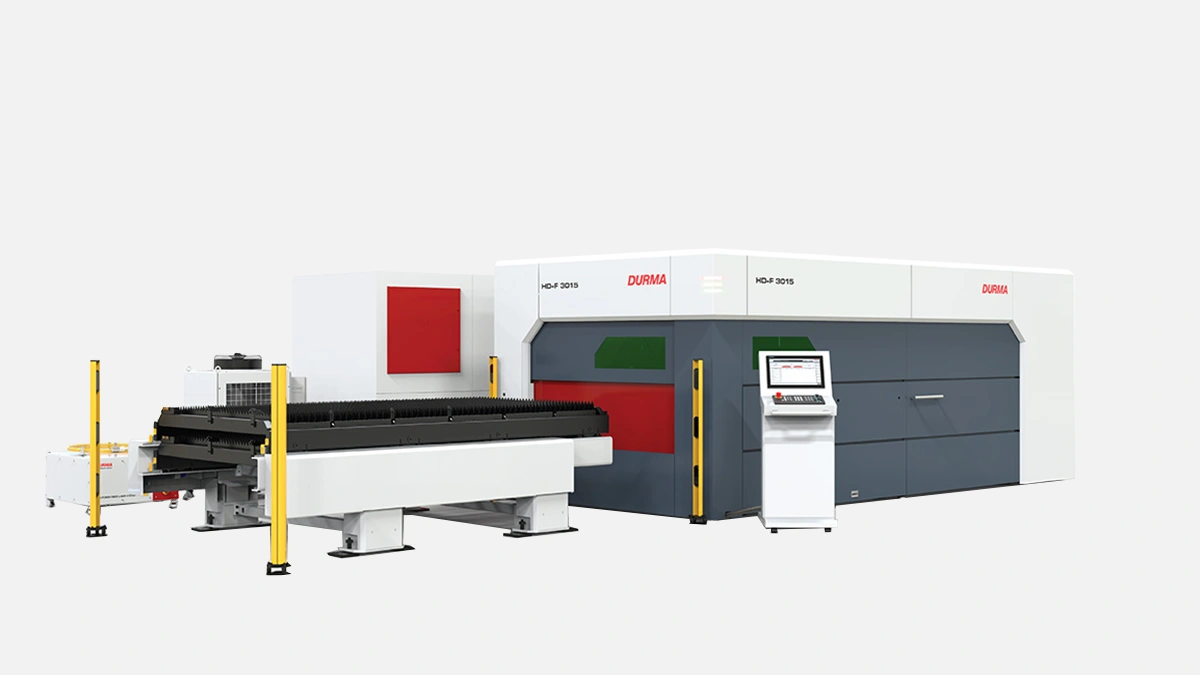
Durma HD-F 4020 fiber laser cuts 4×2 m sheets up to 25 mm, stays cool in UAE heat.
I look at the Durma HD-F 4020 and the first thought is simple, almost blunt, 4000 by 2000 millimeters of pure possibility, the sheet is there, flat, cold, waiting, you hit Cycle Start and the red line of light snaps across like a nervous cat.
Another day in the shop, loud fans, the smell of cut stainless, operators trading jokes in three languages, someone swears about the heat, we are in Sharjah after all, that is the vibe.
But let me not drift too much, focus, the numbers matter, they always do.
Before any metal even touches the bed you want to know the hard limits, because a project manager in Dubai will throw a 3950 mm part at you on Friday night and expect it ready Sunday morning. So, yeah the envelope is 4000 × 2000 mm, stack up to 950 kg on the shuttle table, the carriage does not flinch. Durmazlar claim positioning accuracy of ±0.05 mm, repeatability ±0.03 mm, I have seen it hold that tolerance on real parts, 3 mm AISI 316, even when the air-con quit.
| Metric | Value | Why you care |
|---|---|---|
| Max speed | 170 m/min | keeps big jobs under one shift |
| Acceleration | 2.5 G | pierce to pierce downtime falls |
| Laser power | 2–6 kW | cuts gauge to 25 mm mild steel |
| Controller | Beckhoff CNC | open, Ethernet, easy to network |
| Footprint | 10500 × 3300 mm | check your door width first |
The table above looks sterile, good, but numbers alone do not smell like ozone after piercing begins. Let me color that. When you press the pedal the machine ramps from standstill to top speed in something like 0.8 s, the servo whine blends with the extraction fans and you get that humming tunnel sound.
I have run CO2 lasers from 2008, fiber from 2016, switching optics, mirrors, cleaning dust traps, the usual grind. The HD-F series is the first where I almost forget about beam alignment, the IPG source feeds through an armored cable, sealed, done. Switch on, warm up less than 4 min, go.
Stray note, the automatic nozzle changer is optional, we bought it later, worth every fil, no hands inside the cabinet, no burned fingers.
Heat is the silent enemy, cabinets climb above 45 °C even with AC, the Durma enclosure has twin chillers, one for the laser, one for the electronics, they keep water at 22 °C stable even when outside temp hits 48 °C in August. That alone saves downtime, compressors hate heat.
Things we cut most here:
2 mm GI duct parts
6 mm stainless panels for food equipment
12 mm mild steel brackets for oil-field rigs
The HD-F handles all three without nozzle swap thanks to the auto head that stores 16 positions, but if you run heavy plate, say 25 mm S275, you will still swap nozzle to 2.0 mm and slow feed to 550 mm/min*.
Durmazlar started the HD-F line back in 2013, roughly 9 major firmware revisions since, five bed sizes, the 3015 and 4020 sell most units, figures from the factory hint at 400+ 4020 frames per year. The smaller HD-F 3015 has the same controller, same head, just 1500 mm narrow, good for elevators, but not enough for street-light poles. The big brother 6020 stretches to 6050 mm, eats floor space like crazy, the 4020 sits in that sweet spot, fits a standard shipping container lengthwise, shipping cost stays linear.
Time for a short cage match, no fluff. Trumpf TruLaser 3030 fiber, Bystronic BySmart Fiber, and Mazak Optiplex 3015 are the usual references. All three push up to 6 or 8 kW, similar bed speeds. Where Durma pulls ahead is cost per cut hour and service access, spare parts coming from Bursa arrive to Jebel Ali in 3–4 days, while German parts sometimes sit in customs a week. Also, Beckhoff control runs on Windows Embedded, easy for local IT teams to back up, the Swiss and Japanese boxes use proprietary OS images, headaches when images corrupt.
Some shops still ask, can 6 kW really slice 25 mm mild steel clean, or do we need 8 kW. I have samples on my desk, kerf 0.35 mm, dross minimal with nitrogen at 22 bar. But be honest, the cut time explodes after 20 mm, so if you live in heavy plate world go CO2 or a hyper power fiber, otherwise stick to 6 kW, you save on generator load.
Durma drops an OPC-UA endpoint in the PLC, plug your ERP, instant job tracking, no license drama. That matters because the local auditors here ask for digital traceability, ISO 9001 still not a paper game anymore. Plus, the machine exports piercing data, we used it to tweak nitrogen flow, shaved 12 % gas cost last quarter.
Cutting 3 mm stainless, 4 kW source, duty cycle 65 %, we meter 6.8 kWh total including chiller, that sits at roughly AED 2.2 with current DEWA tariff, not bad versus CO2 which hovered at AED 5. Lens kit lasts 3500 h, USD 900 each, quick math gives 0.26 USD/h for optics. Stack it on, still lower than plasma on thin gauge.
Class 1 enclosure, interlocks on every door, still I have seen shops override them, do not, reflections from 6 kW blind quick. Fume extraction rated 1600 m³/h, we tied it into a roof scrubber, no smell even when cutting brass.
Job shops chasing HVAC panels, elevator frame makers, truck body fabricators, plus those fancy architectural sign guys on Sheikh Zayed Road. They all share one thing, batches swing from 2 to 500 parts, so rapid setup and mixed thickness in one nest pay off. Durma HD-F 4020 hits that flexibility spot.
Durmazlar has 65 years bending steel, around 1300 employees, they push out about 7000 machines annually, lasers counted something like 2300 units in the last decade, the 4020 frame alone passed version V9.2 last spring. The track record is solid, service crew in Dubai knows the control, spare parts shelf stands inside JAFZA, you phone them, they ride out same day.
Bottom of the page, why should anyone care, simple, the HD-F 4020 cuts fast, stays stable in desert heat, and does not burn a hole in the OPEX budget. That combo is why yards from Abu Dhabi to Ras Al Khaimah keep signing for more units.