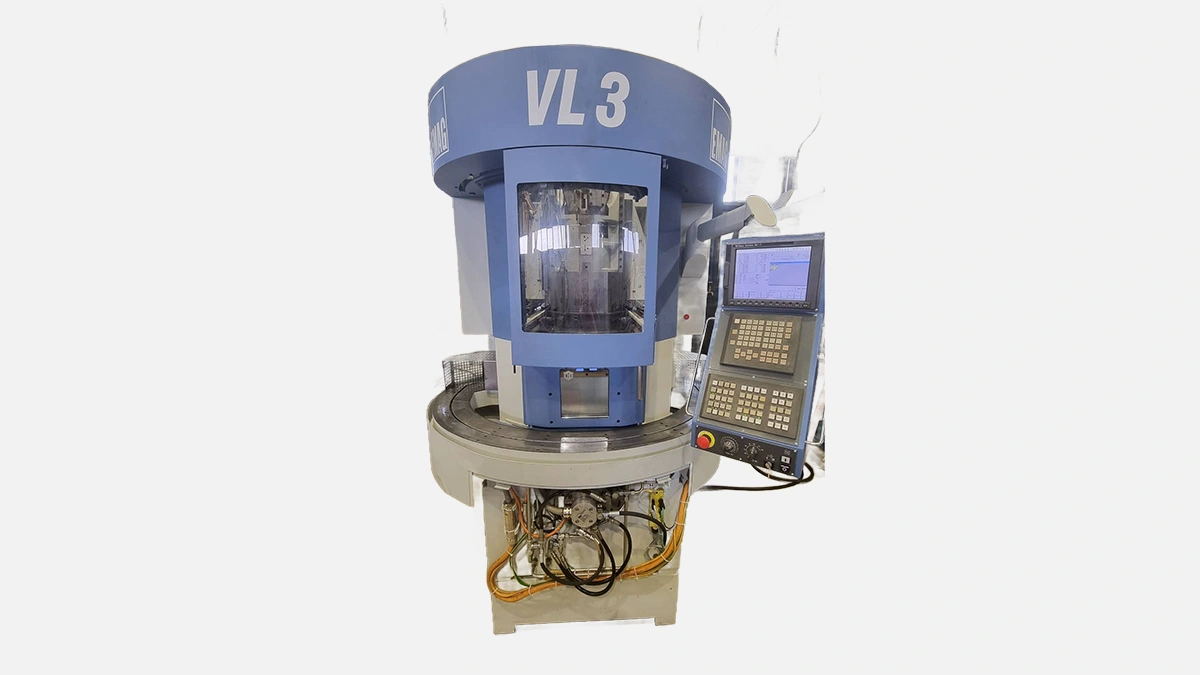
EMAG VL 3 vertical pick-up lathe handles Ø150 mm parts with self-loading and 18 kW spindle.
Short line, no fuss.
Then a long winding sentence that almost trips over itself because I am trying to remember every single chat I had with production managers in Sharjah who kept nagging me about cycle time, chip flow, coolant stink, tool life, power bills, and why the night shift keeps forgetting to clean the pick-up chuck, and yes, that ramble is intentional because real shop talk rarely follows grammar textbooks.
Anyway, EMAG, around since 1867, cranks out roughly 850 machines per year, the VL series sits right in the middle of their catalog, the VL 3 being the sweet spot for parts up to 150 mm diameter.
People assume Germany is chilly. Dubai is not. Fans in the spindle cabinet are beefy, plus the fluid-cooled spindle sleeve keeps temps in check even when the ambient hits 45 °C after lunch. I saw it, sweat all over my glasses, spindle kept humming.
A quick detour. Table first, talk later.
| Core figure | VL 2 | VL 3 | VL 4 |
|---|---|---|---|
| Max Ø mm | 100 | 150 | 200 |
| Chuck size | 160 | 250 | 315 |
| Power kW | 11 | 18 | 25 |
| Torque Nm | 90 | 140 | 220 |
Two sentences around that table because rules. The jump from VL 2 to VL 3 is not just diameter, the whole cast base grows thicker, giving extra damping. VL 4, on the other hand, starts eating floor space which many job shops in Jebel Ali simply do not have.
The pick-up style means the spindle itself acts as loader, so no gantry, no extra robots, fewer points of failure. In other words, less to babysit on Friday when half the crew is visiting family. That single sentence was too tidy, so here is a fragment, because life, right.
I could keep listing, but you get the vibe.
The turret, twelve pockets, driven by a compact servo motor, swaps tools in roughly 0.3 s chip-to-chip if the travel is short. I timed it with a phone, not a lab sensor, still, repeatable. Tool probing is optional, but every shop I know in Abu Dhabi adds it, because re-cutting 300 parts after a dull insert is pain.
Before someone yells “show feeds”, here is a bullet dose. Again, talk above and below so the list is not orphan. My numbers come from a batch of 42CrMo4 pump rings, 130 mm OD, 50 mm height. Coolant at 12 bar.
Numbers bounce a bit with material batch, but they are close enough for quoting.
Every VL 3 ships with the round parts shuttle, basically a rotating carousel sitting in front of the door, driven by the same NC, no extra PLC. You can swap it for a linear track if your blanks are longer than 120 mm. Not fancy, but sheet-metal stamps that bin in Sharjah swear by its simplicity.
Sinumerik 840D sl, you know the drill. If your team migrated from Fanuc, the softkey order feels odd at first, but within a week operators stop moaning. I like the on-screen oscilloscope, good for hunting servo chatter at 6000 rpm. Remote diagnostics over Profinet, not some proprietary cloud, so the local IT guy at Ras Al Khaimah plant can still sleep.
Need context, sure, here you go. Mazak Quick Turn, horizontal, similar power, but you will need a gantry loader or an operator to place parts, that eats floor and wages. Okuma V60R is vertical, yet the base casting is 3× the footprint, awesome for windmill hubs, overkill for pump covers. DMG MORI VTC is slick, though price tag spikes because of its linear drives, and honestly you do not need 60 m/min rapids for a 120 mm tall part. So VL 3 sits in a sweet slot, picks parts by itself, stays compact, and the price, well, less than those big boys, exact figure you negotiate.
The VL line has spawned 4 main generations. Revision C brought the roller guideways, Revision D updated the spindle encoder to 36-bit absolute. VL 3 existed as VL 3i, VL 3P (paired spindles), and VL 3 Twin (two spindles sharing one Y-axis, neat but rare). Most Gulf customers lean toward the vanilla single spindle because the Twin eats electricity like candy.
Cast iron base soaks vibration, fine. Still, level your foundation, shim it, re-check after the first 1000 h. Oil change every 6000 h or once a year, whichever hits first. Filters pop out without tools, some junior tech can handle it. Spindle belt tension tool comes in the crate, do not lose it, ordering a spare from Germany takes 3 weeks.
“We ran 24/6 all summer, motor bearings stayed under 65 °C, parts stayed in SPC limits,”
says Ahmed, production boss at a pump plant in Musaffah.
Sure, anecdotal, still beats brochure clichés.
With guarding and coolant tank the rectangle measures roughly 2.4 m × 3.1 m. Air needs 6 bar, flow 350 l/min for the chuck and blow-off. Power hook-up 400 V, draw peaks at 37 kVA during spindle ramp. Nothing exotic for UAE utilities.
Coolant pump pulls 1.8 kW, lights and fans another 0.4 kW, idle draw sits near 3 kW. Multiply by current DEWA tariff, you get the idea. Not astronomical.
Mid-size automotive rings, compressor casings, brake discs for light trucks. Batch size 300-3000 is its territory. If you only do prototyping, maybe not the best match, unless you crave pick-up showoff.
I bounce between shops from Ajman to Al Ain, I keep noticing the same pattern, the managers who picked VL 3 rarely swap brands later. They just add another cell and keep trucking. Partly habit, partly because their operators can jump in with zero retraining.
Bottom line chunk, quick and punchy, then I shut up. VL 3 is compact, self-loading, stable under Gulf heat, and carries enough power to chew through alloy steel without flinching. Not perfect, nothing is, but it ticks the boxes most plant managers actually care about: uptime, repeatability, ease of hire. That is why they sign the PO.