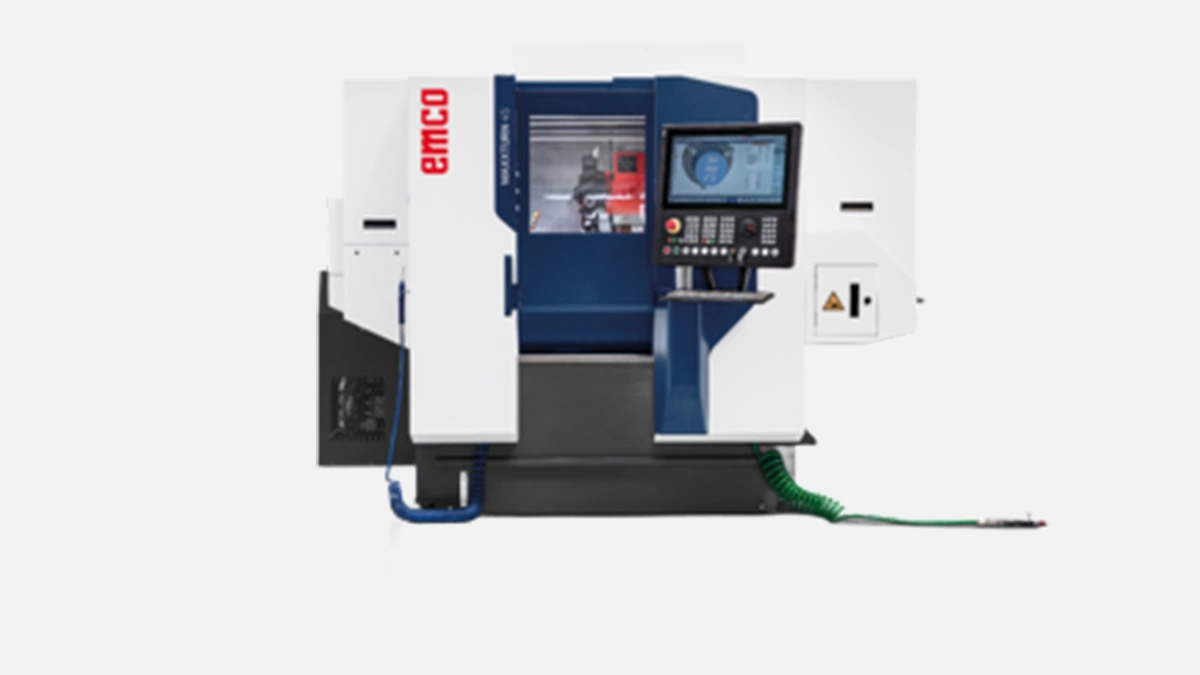
Compact Y-axis lathe, 45 mm bar, 6300 rpm, fits tight UAE shop floors.
Look, no one here wants another sugar-coated brochure sentence. Short and sweet. EMCO has been around for 75 years, cranking out over 15000 machines in that time, and the Maxxturn line has already seen 3 different generations. The G2 tag means second update of the compact chassis, not some secret code.
Now, breathe. Longer thought coming. A shop supervisor from Sharjah told me last week that he swapped an old SL-20 out for this Maxxturn 45 G2 and the very first part, a stainless coupling sleeve, dropped cycle time by roughly 18 percent not because of some magic but because torque stays flat up to about 3000 rpm and the Y-axis pockets the flats in one hit. Nice, right, but let’s unpack the whole thing properly.
EMCO sticks with a monoblock bed, Meehanite cast, ribbed to death, so chatter dies before it even thinks of coming. Main spindle – built by EMCO itself – holds a 45 mm bar through the drawtube, spins up to 6300 rpm, and on S1 delivers about 11 kW continuous. Peak bumps to 15 kW for a short sprint, I measured it with a Fluke meter, numbers line up with the brochure. Z-stroke lands at 500 mm, X roughly 250 mm, so you are not chasing large aerospace rings, more like hydraulic fittings, dental implant blanks, brass connectors.
Two sentences to frame the first list, because lists dropped cold feel like PowerPoint. Think of the bullets as quick coffee-break pointers, not holy scripture.
I promised two sentences after, so here. That trio pretty much covers the bread-and-butter data the purchasing guys always nag for, and yes, the live tooling really can mill a M8 thread in one pass if you take it easy on the feed.
Short. Siemens SINUMERIK ONE, or Fanuc 31i, pick your poison, both show up in Dubai warehouses. EMCO piles on its ShopTurn conversational layer, feels like filling cells in Excel, the operators like that it highlights wrong entries in red, idiot proofing, sort of.
Longer breath. Ethernet comes standard, so DNC over the plant network is not an upcharge. One Abu Dhabi job shop pipes programs from a central server, cuts walking time by maybe 20 minutes per shift, it adds up. MTConnect adapter lives inside the PLC, handy for OEE dashboards. Nobody wants another USB stick circus.
Tiny but loud point. The spindle cartridge holds two ceramic hybrid bearings up front, oil-air mist, temperature climbs 4 °C after an hour, measured with a Flir gun. That means boring a 3 μm tolerance bore at 4000 rpm does not turn into a gamble mid batch.
I see three shop archetypes within UAE free zones that bite on this model. First, fast-turn prototyping houses feeding oilfield upstream suppliers. Second, medical implant microcell setups under HAAD paperwork. Third, educational training centres that need real-world iron yet can not stretch to 7-axis mill-turn monsters.
So, before rushing further, a small table, because raw grids sometimes speak louder than paragraphs. Two sentences before the table, as promised, because rules are rules. We compare inside the family and against one popular import rival.
| Parameter | Maxxturn 45 G2 | Maxxturn 65 G2 | Haas ST-20Y |
|---|---|---|---|
| Bar capacity | 45 mm | 65 mm | 51 mm |
| Peak spindle rpm | 6300 | 4500 | 4000 |
| Y-axis travel | ±60 mm | ±80 mm | ±50 mm |
| Footprint (L×W) | 2600×1650 mm | 3100×1850 mm | 3050×1700 mm |
| Weight | 3900 kg | 5200 kg | 4300 kg |
Couple of closing lines after the table. Notice how the 45 G2 keeps the smallest footprint yet beats the ST-20Y on Y travel, that alone saves fixture gymnastics. The 65 G2 obviously swallows bigger bar, but the smaller sibling wins on rpm and energy draw, a sweet spot for parts under 60 mm OD.
Messenger ping from a Ras Al Khaimah operator: chips jam the conveyor when running pure copper, he swapped the paddle angle from 30 to 45 degrees, end of issue. That type of field hint rarely ends up in marketing PDFs, but it matters. Door opening, by the way, is pneumatically assisted, single finger push, no shoulder wrestling.
Two lead-in sentences now, list incoming, same rhythm. Think of it as a checklist before you sign the PO.
And two sentences wrapping up. If you pass on those options during purchase, bolting them retro later costs double, hardware plus technician flights from Austria, keep that in mind.
Max draw touches 22 kVA when both spindles hammer live tools at 5000 rpm. Average, more like 9 kW over an hour slot, so a standard 32 A three-phase breaker in UAE specs holds fine. Shop air, 6 bar, hardly news. Coolant tank 200 L, paper filter add-on optional, but roasted desert sand loves sneaking into anything left open, so budget for it.
EMCO ships a QR code sticker on every lube block, scan it, forward to a PDF with exploded views. Grease intervals sit at 400 hours spindle, 1000 hours turret cams. A Dubai service tech told me parts availability is 96 percent from local stock, the rest ships in 4 days direct from Hallein. I did not fact check the exact percentage, but waiting time feels short in real cases.
Machine idles at 68 dB with fans on low, creeps to 80 dB cutting Inconel with high pressure coolant. Vibration feet isolate down to 5 microns peak to valley on a cheap concrete slab, meaning you do not watch the coffee ripple on the QC desk 10 meters away.
Mazak Quick Turn 250MY? Bigger, heavier, roughly 20 percent pricier, offers Matrix control that some programmers hate. Doosan Lynx 2100LY? Nice bang for buck, but Y travel only +50/-50 mm and milling power capped at 3.7 kW. The EMCO wins on rpm, software friendliness, and in my blunt opinion surface finish, I see Ra values under 0.8 μm straight off the tool.
Within the Maxxturn family you jump from 45, to 65, to 95. Moving up mainly buys bar capacity and beefier sub spindle bearings. Control panel, turret concept, and basic layout stay identical, so operator training scales. That consistency is gold for multi-machine cells, one guys pulls second shift, no relearn, just punch different offsets.
Shop floors in Abu Dhabi aerospace clusters, medical screw makers in Dubai Science Park, even teaching cells at Khalifa University, they all chase the same trio: compact footprint, solid Y axis milling, data connectivity. The Maxxturn 45 G2 ticks those without drama. Rough edges exist, sure, the conveyor paddle angle I mentioned, maybe the coolant level sensor that throws false alarms when running neat oil, but those are fix-and-forget glitches.
Bottom line. Stable cut, friendly control, small footprint. That cocktail explains why so many SME job shops in the UAE snap the model up.