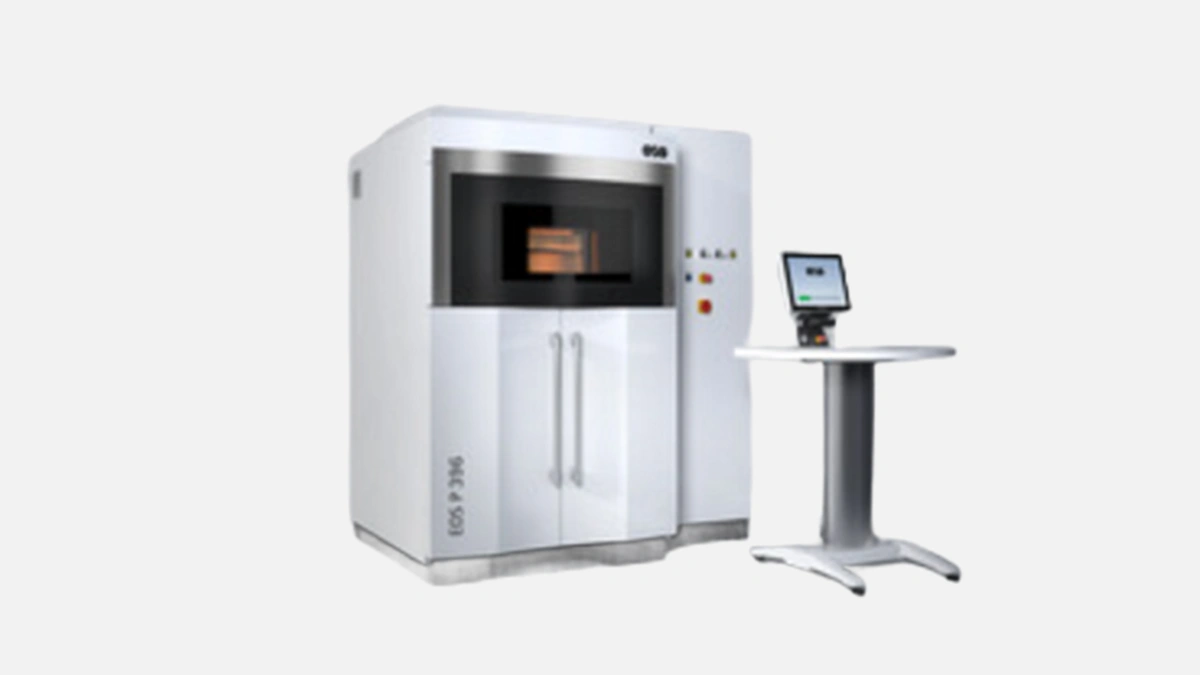
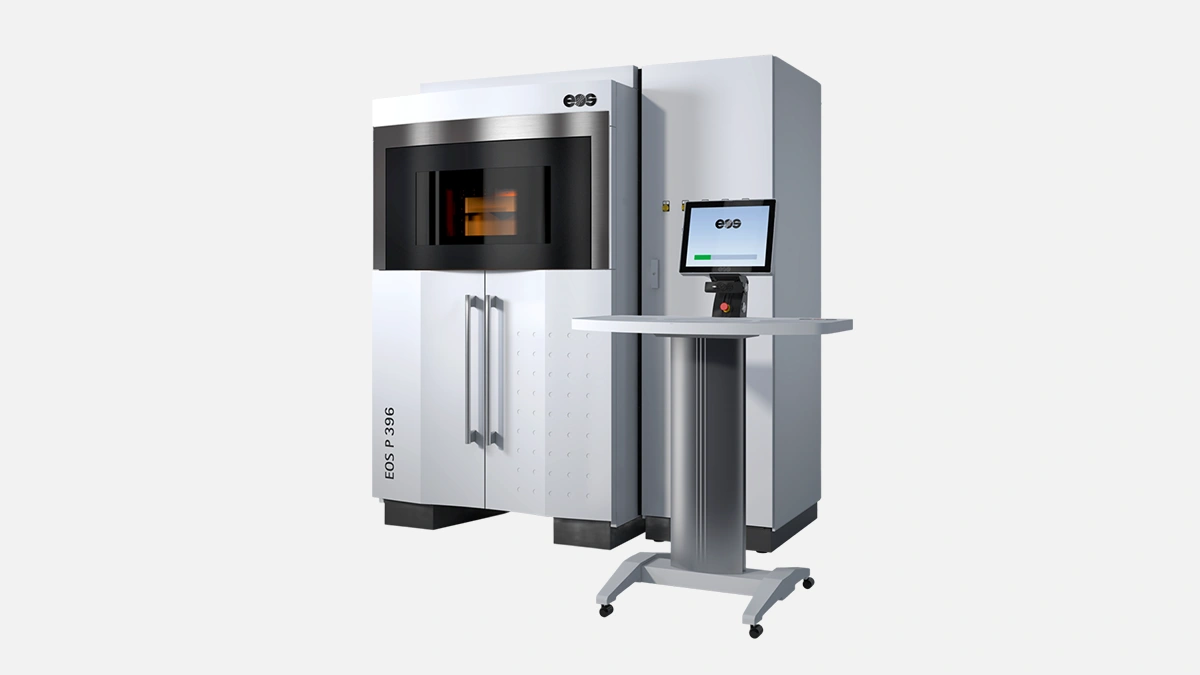
Mid-volume SLS 3D printer, 340×340×600 mm, 70 W CO₂ laser, steady for UAE production.
Hard edges, matte panels, soft whirring from the recirculation fans. That is the first feel when you walk past the EOS P 396 on a shop floor. Big, but not gigantic. Roughly chest-high for most operators which somehow makes it feel approachable. The touch screen blinks, the status LED bar glows green, somebody forgot to close the hatch two minutes ago, so the machine politely refuses to start the next layer. Typical.
EOS, the German giant that has been shipping SLS units since 1989, keeps this model in the catalogue for a simple reason – it works, day in, day out. They ship a few hundred polymer systems every year, around 60 % of them end up in serial production clusters rather than prototyping labs, at least that is what the last public annual report whispered.
CO₂ laser, 70 W, galvanometer steering that flicks the beam at up to 6 m s⁻¹ across the powder bed. Nothing exotic here. Yet, when you pair that with the slightly re-designed recoater arm that came with the third hardware revision of the P 396 (mid-2019, if memory serves), you suddenly gain a tiny bit of uniformity at the edges of the build box. People on the German Rapid Pro forum even posted micrographs showing less un-melted grains compared with the older P 395. Take it with a grain of salt, still neat.
Before we drown in talk, let us anchor the key metrics.
Two sentences done, time for the promised table.
| Metric | Value |
|---|---|
| Nominal build volume | 340 × 340 × 600 mm |
| Layer range | 0.06-0.15 mm |
| Laser power | 70 W CO₂ |
| Focus dia. | 0.42 mm |
| Max scan speed | 6 m s⁻¹ |
| Machine footprint | 3.4 × 1.2 × 2.1 m |
| Net weight | 2450 kg |
Funny enough, that footprint sits comfortably inside a standard 40-foot container, so shipping to Jebel Ali or Khalifa Port is less drama than moving a five-axis mill.
Two more lines so the table is not lonely. Powder handling is external, via the IPCM-P system, meaning the messy part stays away from the laser cavity. Operators in Sharjah swear by it, mainly because the un-forgiving UAE dust mixes with PA 12 powder if the loop is open.
Short, direct, mechanical. Pre-heat to 170 °C, spread the first layer, blast it with the laser, drop 0.12 mm, rinse, repeat. A full 600 mm build can still stretch towards 12 hours if you are packing dense lattice parts or turbine prototypes. Once the bed cools to 80 °C**, the cake slides into the unpacking station and yields parts that are greyish white before blasting.
Things people forget:
– Nitrogen supply must hit at least 99.5 % purity, otherwise the auto-purge sequence hangs.
– The chiller sits on a separate circuit, pulling roughly 5 kW, so count that into the HVAC calculation.
– Spare filters cost more in Dubai than in Düsseldorf, stock at least 4 sets.
The machine firmware (EOSYSTEM 2.6) finally got an English-Arabic toggle last year, saves a minute per shift in bilingual shops.
You cannot throw any random powder in, but the choice is broad enough for 90 % of daily work.
Bullet list done, let us wrap context. Each of those powders ships in sealed 15 kg buckets, you will burn through two buckets on a tall build. Recycling ratio sits near 50 %, steady but not infinite – after 6 cycles the grain size distribution drifts, surface finishes dull out. EOSPRINT software flags the lot automatically now.
Ambient temperature inside Abu Dhabi fab shops floats around 28-32 °C even with AC, which actually helps, less thermal delta means fewer curled corners. What really bites is power grid stability. The P 396 draws a peak of roughly 12 kW when heaters and laser ramp up together. A cheap UPS will not cut it. One client in Ras Al Khaimah plugged it straight into a diesel genset, the harmonic distortion freaked the galvo drivers, they lost 3 builds before installing a line reactor. Lesson learned.
Another datapoint, actual production numbers. A medical device subcontractor averaged 22 build cycles per week across two shifts, netting around 280 knee spacer shells weekly. Part cost trimmed because the same machine sinters four different SKUs without fixturing, something no CNC line could mimic without changeover pain.
Comparison time, no mercy. Formlabs Fuse 1 + 30 W laser, build box 165 × 165 × 300 mm, decent for spare brackets, dies on large housings. 3D Systems sPro 60 HD-HS hits 381 × 330 × 460, but official install base in GCC is under 10 units, service engineers fly in from Belgium, downtime stretches. The big brother EOS P 770 dwarfs them all with 700 mm in X, yet eats floor space and liquid funds.
So the P 396 lands in that goldilocks middle – bigger than a desktop, smaller than a room, serviceable by the local EOS tech hub in Dubai Silicon Oasis, response time under 24 hours. Yes, I just contradicted myself praising and then dampening, welcome to reality.
There have been three hardware revisions so far. Rev A (2014) shipped with a 50 W laser only. Rev B (2017) bumped power and added the protective frame around the scan optics. The current Rev C (2019-present) integrates the upgraded recoater and smarter inert-gas valve block. Firmware updates carry across, which is nice, nobody wants orphaned gear.
If you already own a P 110, stepping up is painless, the build-prep software is identical. From P 396 to P 770, however, you rewrite nesting macros, because the dual-laser setup messes with scan orders.
Before signing any PO, grab a coffee and inspect the spot where the machine will live.
Stick that on the notice board, half the install headaches disappear.
EOS keeps shipping the P 396 because it covers real production ground without bloating cost or complexity, especially for mid-size Gulf manufacturers chasing batches from 50 to 5 000 parts. The laser is strong enough, the volume generous, the material catalogue proven. Companies that print jigs for aluminum extrusion lines, orthopedic implant shells, or custom air-duct elbows keep reordering the same model because downtime stats look boringly low.
It is hardly the shiniest gadget yet it delivers, and that explains why aerospace tier-twos and fresh additive bureaus in Dubai Internet City alike put their purchase orders on the table, quietly, without champagne, just a nod toward the loading bay.