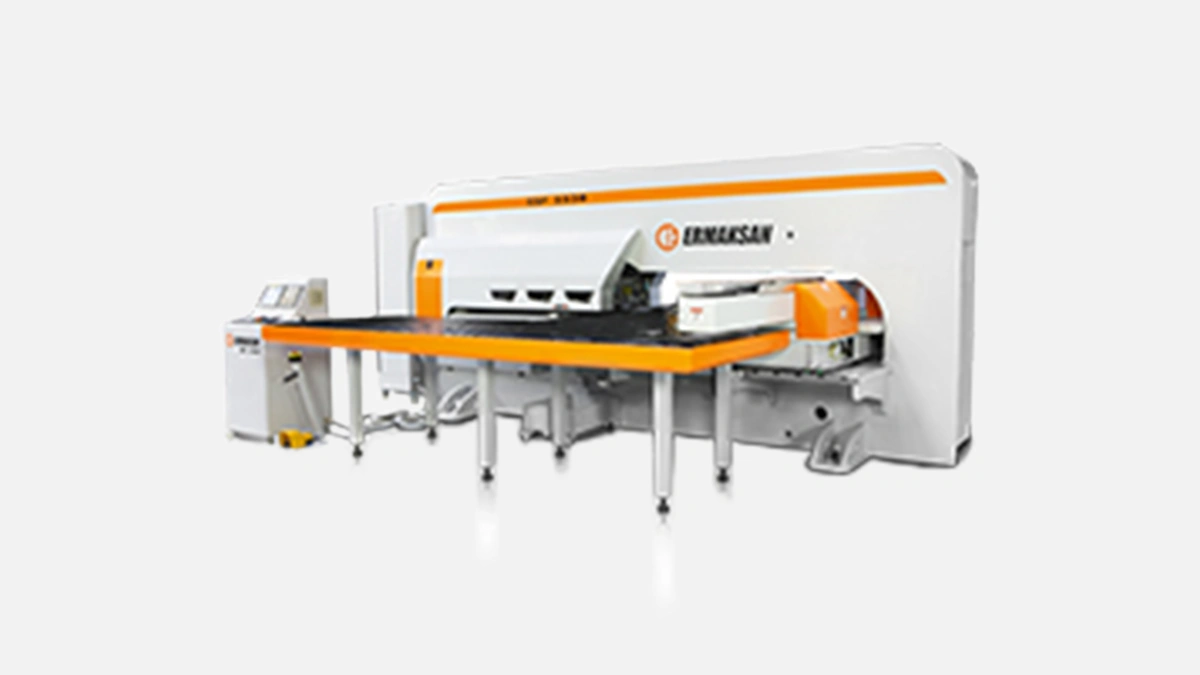
Ermaksan ETP/ETP-S turret punch press, 30 t force, 2550×1280 mm sheet, 1000 HPM.
Quick glance, straight to the point. Big orange frame, flashy servo whine, touch panel glowing. Looks sturdy. You feel like it could punch through a ship hull, yet it behaves politely, no rattling. That contrast hooks you.
Ermaksan is not a newcomer. Turkish soil, 1965, a small workshop, couple of mechanical presses. Today, roughly 3000 machines roll out every year, half of them leave the country, the rest stay around Bursa. The ETP family showed up in 2006, now it is already the fourth face-lift, darker paint, faster drives, smarter CNC.
Punching, nibbling, forming, tapping, even small louvers. The ETP / ETP-S uses a 300 kN ram. For thin aluminium panels you rarely go above 50 kN, steel doors ask for 120 kN, the press keeps spare muscle.
Before we drown in metaphors, hard facts sit better in a table.
| Key spec | Value |
|---|---|
| Punch capacity | 300 kN |
| Stations | 32 |
| Servo drive | Hybrid hydraulic on ETP, full servo on ETP-S |
| Max sheet (no reposition) | 2550 × 1280 mm |
| Max thickness | 6.35 mm mild steel |
| Accuracy | ±0.05 mm |
| Rapid speed (X+Y) | 85 m/min |
| CNC | FANUC 0i-PB |
The digits alone look cold, so a little story. One UAE subcontractor in Sharjah runs an early 2018 ETP-S on 2 mm stainless nameplates. Shift hits around 28 000 parts, scrap under 1 %. The supervisor claims they changed the main punch cylinder seal only once.
Fast for a turret. Linear guides, ball screws, and on the S version a servo powered ram. The servo profile shortens dwell time which bumps hit rate from 850 HPM to roughly 1000 HPM on light gauge work. Does that matter in real life. If you cut ventilation grills for AC cabinets by the thousand, yes, every minute saved counts and the operators can clock out before midnight.
People fear large sheets waving like flags. The clamp system rides on double rails, automatically picks the best clamp pattern based on nest data, you can still override it manually when the sheet is scratched, quite handy.
A machinist from Abu Dhabi told me he once forgot to tighten the front brush table after transport, machine still held tolerance, the sheet just made a funny squeak. Not recommended, but gives confidence.
Thick turret, nothing exotic. You probably keep Amada-style punches in stock already. Auto-index stations rotate 360°, resolution 0.01°. Forming tools up to 25 mm height, embosses, knockouts, bridge tabs are all doable.
Electricity is pricey in Dubai. Standard ETP uses hydraulic intensifier which idles at 5 kW, peaks at 18 kW. The S version swaps most hydraulics for servo, average draw falls to 11 kW on mixed program. Not a miracle but visible on the DEWA bill after a month.
Filters every 2000 hours, axis lube automatic, just top up the grease cartridge. Fanuc alarms are plain English, not cryptic hexadecimal gibberish. You can teach a fresh operator the basic recovery moves in an afternoon.
Within Ermaksan the ETP stands between the low cost Fibermak SL punch-laser combo and the heavy-duty TP Series punching centre. Against competitors, picture below.
| Model | Force | Stations | Hits per min | Sheet area | Comment |
|---|---|---|---|---|---|
| Ermaksan ETP-S | 300 kN | 32 | 1000 | 2550 × 1280 | Servo ram, mid price |
| Amada EMZ-3610 | 300 kN | 58 | 1200 | 3000 × 1500 | Bigger turret, higher price |
| Trumpf TruPunch 3000 | 180 kN | 21 | 900 | 2500 × 1250 | Sheet shuttle integrated |
| LVD Strippit PX | 300 kN | 20 | 1250 | 2500 × 1250 | Single head multipunch |
The ETP-S sits closest to Amada on force, lags on station count, yet tooling is cheaper and you avoid proprietary parts. Compared with Trumpf, you get more punch force, lose on automation unless you add optional load/unload tower.
Climate can hit 45 °C inside a poorly cooled warehouse. Cooling fans on the control cabinet are oversize, thermal cutout sits at 55 °C, never seen it trip so far. Optional sand filters for the side air intake cost a few hundred dirhams, worth every one when a dust storm rolls in from the desert.
Typical jobs here:
The press finishes raw blanks, edges are smooth enough to skip deburr on gauges under 3 mm. That saves one operation and a pair of hands.
You plug DXF into Metalix or Lantek, post as *.cnc, drop to the Fanuc via Ethernet. Tool assignment wizard chooses station, auto-index angle, even cluster tools. One click, coffee, done. If you are old school and still love G-code, you can write a line starting with G67 for nibbling macro, press cycle start, the machine will not complain.
Time to breathe, bullet time.
Sheet metal job shops, HVAC contractors, switchgear builders, sign makers. They need a press that hits fast yet does not bankrupt them on maintenance. The ETP plays that role convincingly. You could call it a workhorse. I just call it handy.