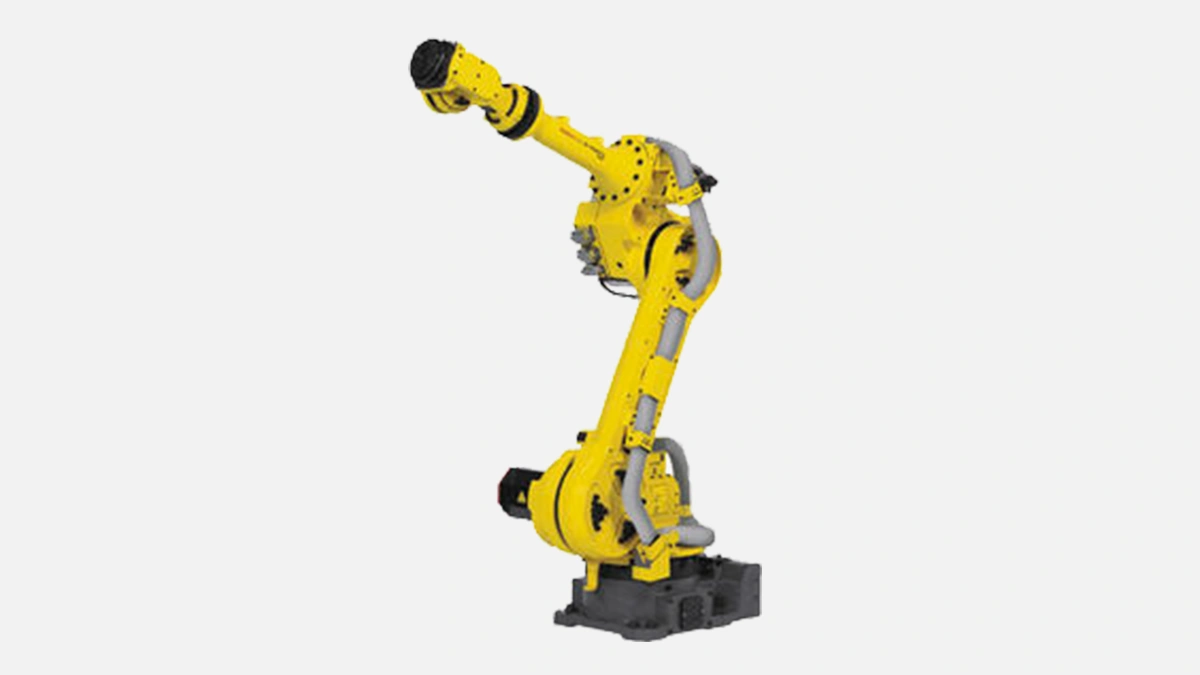
FANUC R-1000A/100F, 100 kg payload robot, 2230 mm reach, tight footprint.
Short intro, no fuss. You look at the yellow frame, you immediately get why people in Ajman or Sharjah keep ordering it. The R-1000A/100F is part of the R-1000 family that FANUC began shipping back in 2010. Four revisions already, small tweaks in the wrist, faster drives, better cabling. The current “100F” suffix means 100 kg payload, fast wrist, slim profile.
The company itself is a heavyweight, over 60 years on the market, more than 750 000 robots shipped worldwide, something like 11 000 units yearly just from the Oshino complex. Japanese consistency, you feel it even while unpacking the crate. Tight bolts, no overkill plastic, manual printed on thick paper.
Now, what does that give a metalworking workshop in Dubai Investment Park. Speed. Also reliability. And yes, the yellow paint sticks out in the shop among grey machining centers, easier to see from a forklift, fewer accidents.
Before we slide into opinions, numbers first. The table is dry on purpose, helps managers during presentation slides.
| Spec | Value |
|---|---|
| Payload | 100 kg |
| Horizontal reach | 2230 mm |
| Repeatability | ±0.03 mm |
| Axis count | 6 |
| Wrist IP rating | IP67 |
| Controller | R-30iB Plus |
| Typical cycle time (100 kg) | 1.9 s |
| Net weight | 990 kg |
Those eight lines hide a lot of detail, yet they tell a maintenance engineer all he really needs on a Monday morning when production chief nags about takt time.
Metal furniture guys in Al Quoz, truck body fabricators in Abu Dhabi, even a copper busbar shop near Ras Al Khaimah. They weld mild steel, stainless, aluminium, sometimes brass fittings. They need a balanced robot, something that swings a 100 kg gun or gripper yet parks close to the floor without occupying half the bay. R-1000A/100F fits that slot, plain and simple.
The list above is short, on purpose. I keep seeing tenders overcomplicate things with twenty bullet points, no one reads them.
A shop in Jebel Ali free zone put two of these robots on a linear rail, feeding laser cut blanks to a press brake. Blank hits rail, robot grabs, orients, presses, back on pallet. They reported average 52 s per 3-bend part, down from 83 s when an operator was doing it. Not Hollywood speed records, just dependable flow shift after shift. The chief engineer there, Ahmad, told me during coffee, “I care less about ultimate speed, I need predictable Tuesday afternoon after lunch.” His words, not corporate marketing.
We love cold facts, so here you go.
That quick rundown shows why the FANUC piece remains favourite. Slightly better accuracy, smaller footprint, calmer servo acoustics. All three matter when you rinse parts in coolant daily and every dB of noise adds to operator fatigue.
I ran through two complete cells last month, and a pattern emerged. With R-1000A/100F you skip three typical headaches.
You might shrug, yet these things burn hours during commissioning. Hours turn into dirhams, just saying.
Small detour into the teach pendant experience. Some say FANUC UI looks stuck in 90s. True, grey screens, small font. But once you know HOT-KEYs, you blast through point teaching. And there is that handy POSITION RESET that lets you zero the wrist after a light crash without reboot. Competitors force a lengthy recovery procedure. If your cell runs 18 hours daily, such micro time savers add up.
A colleague from Khor Fakkan asked about offline programming. Yes, you can load paths from ROBOGUIDE, or generic STEP via DXF converter, or plain ASCII LS files. Ethernet/IP node mapping is two clicks, Profinet is still extra licence though. I wish FANUC bundled it, but you live with it.
Every moving machine chews grease, and this robot is no unicorn. Schedule looks like this:
I like that there is no hidden secret interval, all printed in manual. Spare parts readily stocked at JAFZA warehouse, typical lead 2-3 days if not on shelf.
The R-1000 line hosts four current siblings.
| Model | Payload | Reach |
|---|---|---|
| R-1000iA/80F | 80 kg | 2230 mm |
| R-1000iA/100F | 100 kg | 2230 mm |
| R-1000iA/120F | 120 kg | 2650 mm |
| R-1000iA/220F-7B | 220 kg | 2650 mm |
Same base casting, stronger wrist as you climb. If your gripper is still under 80 kg, cheaper 80F might work. Step to 120F when you need long guns on spot welding of SUVs. Nice that FANUC kept footprint identical, so you can swap units later without re-drilling floor plates.
Arm cables hide well, yet the casting around axis 2 collects dust. Regular air blast solves it, but still a chore. Paint chips after heavy sparks, powder coat would last longer. Also the R-30iB Plus door hinge looks flimsy, already saw two bent hinges at a customer site, keep a spare.
Though born for spot welding, the 100F finds its way into press loading, plasma cutting, even friction stir jobs. I saw it tending a DMG Mori NHX4000 horizontal mill, pallet to pallet, robot sits between two machines, swing on 160 degree. The repeatability of ±0.03 mm means you can place a part into hydraulic clamps without touch probes, time saved right there.
One cell, robot plus two positioners, replaces four welders paid 4500 AED monthly each. Even with overtime, holiday cover, insurance, you recover capital around 19-22 months under regular two shift mode. Throw in power saving and scrap reduction, the payback creeps below 18 months. Numbers belong to a Sharjah bus body manufacturer, but pattern holds for similar throughput lines.
I keep circling back to three traits. Accuracy that beats most in class, lean body that squeezes into crowded shops, parts and service that reach the Gulf fast. Stack these together and you get why procurement departments in the UAE push purchase orders for the R-1000A/100F despite its slightly older UI. Bells and whistles are nice, predictable uptime pays the rent.
The machine checks boxes other robots in the 100 kg band sometimes miss. It just runs shift after shift without nagging alarms, it cools itself in desert heat, and it gets back to work quickly after a minor bump. That combo keeps production planners and CFOs equally happy.