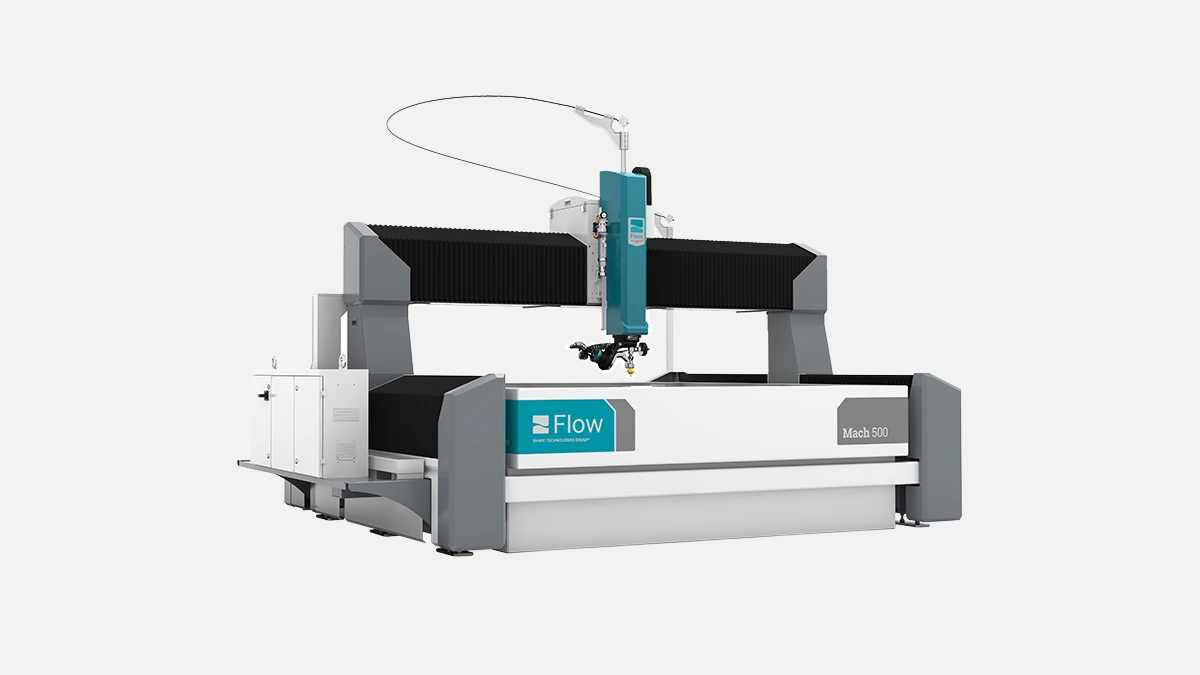
Flow Mach 500 waterjet: 4 × 2 m bed, up to 94 k psi, bevel 60°, shop-ready for UAE heat.
Fast intro, almost abrupt. Machinists in Sharjah ask, can it really slice 100 mm Inconel without drama, or is that just brochure talk. Hold on, let me ramble, numbers will come though, promise.
The Mach 500 sits in Flow’s waterjet family like the big cousin that already hit the gym, still friendly but clearly stronger. Flow has been building high-pressure rigs for over 45 years, shipping roughly 2 500 complete machines a year according to the 2022 annual report, and this series alone has seen three hardware revisions since 2017.
Short sentence. Long one next, because the way the steel weldment is stress-relieved twice, then milled on five-axis gantries in Flow’s Kent facility, matters, it kills the warp you usually fight after a year of Gulf humidity, makes calibration visits boring. Vibration damping pads come pre-bonded, you do not need local epoxy leveling unless floor slope exceeds 3 mm on three meters.
Two lines of context first. Facts are easier when parked in columns, yet specs alone never tell how the head behaves in a night shift. Still, numbers:
| Parameter | Mach 500 | Note |
|---|---|---|
| Working envelope | 4 000 × 2 000 mm | Standard 4020 bed |
| Z stroke | 305 mm | Servo-driven ball screw |
| Max pressure | 94 000 psi | HyperJet pump option |
| Flow rate | 3.8 l min | At 60 k psi nominal |
| Positioning accuracy | ±0.076 mm | ISO 230-2 verified |
| Repeatability | ±0.025 mm | Laser interferometer data |
| Rapid traverse | 17 m min | No load |
| Power draw | 110 kW | Pump plus auxiliaries |
| Noise at operator | 79 dB(A) | Enclosure closed |
The sheet above looks dry, yet every digit hides a shop floor story. Example, those 110 kW matter at DEWA billing, but the pump cycles, real average in Al Ain job shop charted at 62 kW over eight hours cutting 12 mm carbon plate.
People rarely rave about pendant layout, still, the 18-inch capacitive screen is glove-friendly. Jog wheel clicks feel solid, no mush. Software side, FlowXpert lets you drop SOLIDWORKS files straight in, auto lead-ins pick correct pierce distance most of the time, though I still tweak stainless because micro-pitting is annoying.
The bullet list above looks mundane but owners budget by those intervals. Skip them and the 94 k psi head spits garnet where you do not want it.
Humidity, salt dust from the coast, and power cost swings – these three keep GM’s awake here. Closed-loop chiller in Mach 500 is rated 52 °C ambient, I checked with a handheld probe at a site in Jebel Ali during August, coolant held 23 °C steady. That stops viscosity drift, hence geometry stays inside that sweet ±0.05 mm bracket even after lunch break.
Let me toss some real-world stacks, not catalogue fairy tales.
Cut edges came off with minimal striation, a quick orbital pass on a Scotch-Brite wheel and parts went to welding. Try that with plasma and you will be busy grinding oxide.
I skip fluffy accessories, only bits UAE buyers tick on the quote. Two sentences first, because context. Dry catcher or standard? Most shops choose dry, water reclamation is pricey in the desert.
Options above plug straight into Flow’s PLC without third party hacking, warranty unaffected.
Seldom polite to name names, yet comparison helps purchase committees. Omax OptiMax 80X runs 75 000 psi, table 4.2 × 2.0 m, price delta minor, but lacks Dynamic XD five-axis so bevel cuts mean second op on a machining center. WardJet X-2040 gives bigger bed 4 × 4 m, fine, yet footprint balloons past 9 m, not funny in Sharjah bays. Where Mach 500 really scores is the integrated 52 °C chiller, others quote that as an external rig, more hoses, more leaks.
Mach 200 is the entry unit, max 60 k psi, mechanical accuracy ±0.25 mm, about 30 percent slower cycle time. Mach 700 is the big bed, 14 m length, same pump choice, but logistics to UAE require flat-rack, customs paperwork adds a week. For most general job shops the 500 sits right between footprint sanity and plate size demand.
Three thoughts, rough and ready. Garnet is your consumable king, average 2.8 AED per kilo landed, so nesting software that squeezes scrap margin counts more than machine amortization rate. Electricity next, and I already hinted real draw. Finally labor. One operator can babysit two tables if you fit the light curtain and remote pendant, I saw it in Ras Al Khaimah on night shift, guy was calm, no frantic jogging between bridges.
Numbers again, but easier when stacked.
| Task | Interval | Time | Notes |
|---|---|---|---|
| Pump seal kit | 500 h | 1.5 h | Two techs recommended |
| Orifice and nozzle | 40 h | 10 min | Ceramic lasts longer |
| Filter elements | 250 h | 20 min | Factory part only |
| Ball screw lube | Monthly | 5 min | Auto greaser available |
Table above shows the boring bits that keep tolerances from drifting. Ignore them and the fancy numbers on page one fade fast.
Not everything roses. The abrasive hopper sensor sometimes lies when garnet is damp, shows half full, then starves the stream. Quick fix, mount a tiny compressed air purge line, costs pennies. Also, the factory bridge cover has bright yellow Flow logo, looks fine in brochure, but reflects shop light into cameras on cobots if you integrate one, stick matte wrap, solved.
I wandered, yes, yet the main bits stick. Mach 500 cuts thick exotic alloys, holds sub-tenth repeatability, fits average UAE bay, and the service chain in Dubai makes downtime tolerable. Get the dry catcher, budget garnet, teach the night guy to watch pressure spikes, you will likely forget your old plasma’s smoke extractor.
Mach 500’s blend of pump muscle, thermal discipline, and software shortcut is why shipyards in Umm Al Quwain and art fabricators in Dubai Design District both sign orders. Different worlds, same need: clean edge, first time.