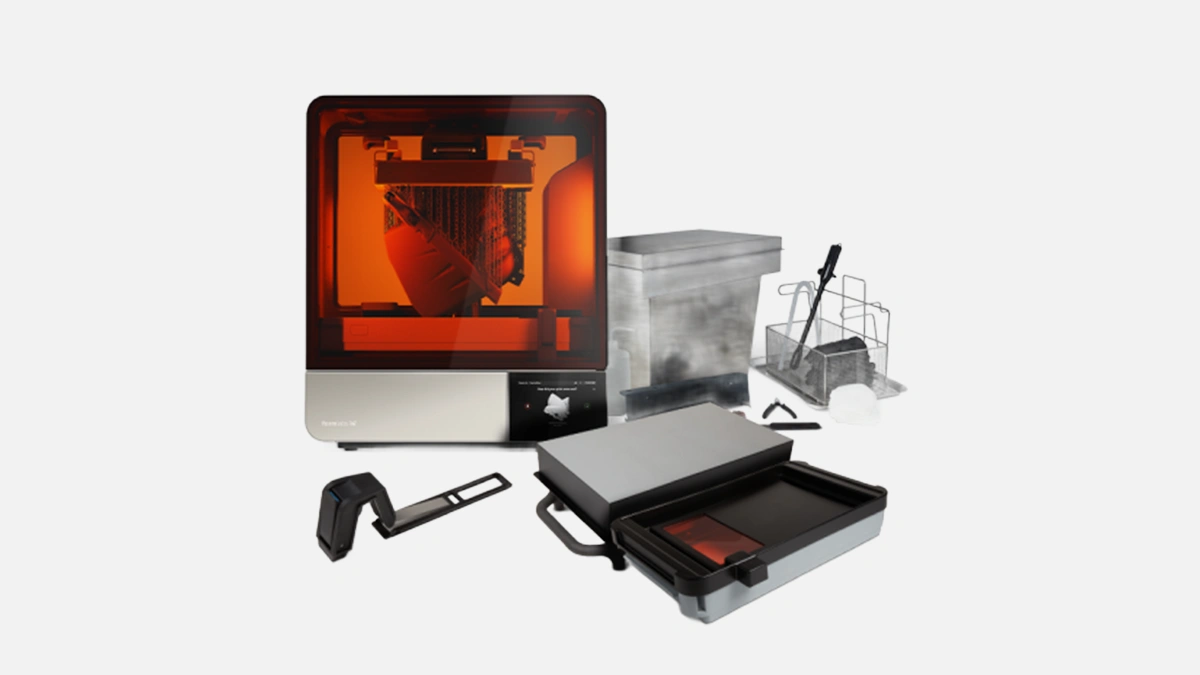
Large build resin 3D printer, 335×200×300 mm, fast 70 mm/h, suits UAE CNC shops
Small sentence. Feels like a toolbox. Then, without warning, the thing opens up into a much wider thought about why a resin box the size of a microwave suddenly matters to a metal shop in Sharjah that spends most of its day cutting 6082-T6 on a vertical machining center, because hey, fixtures break, custom nozzles get lost, and the customer is yelling on WhatsApp.
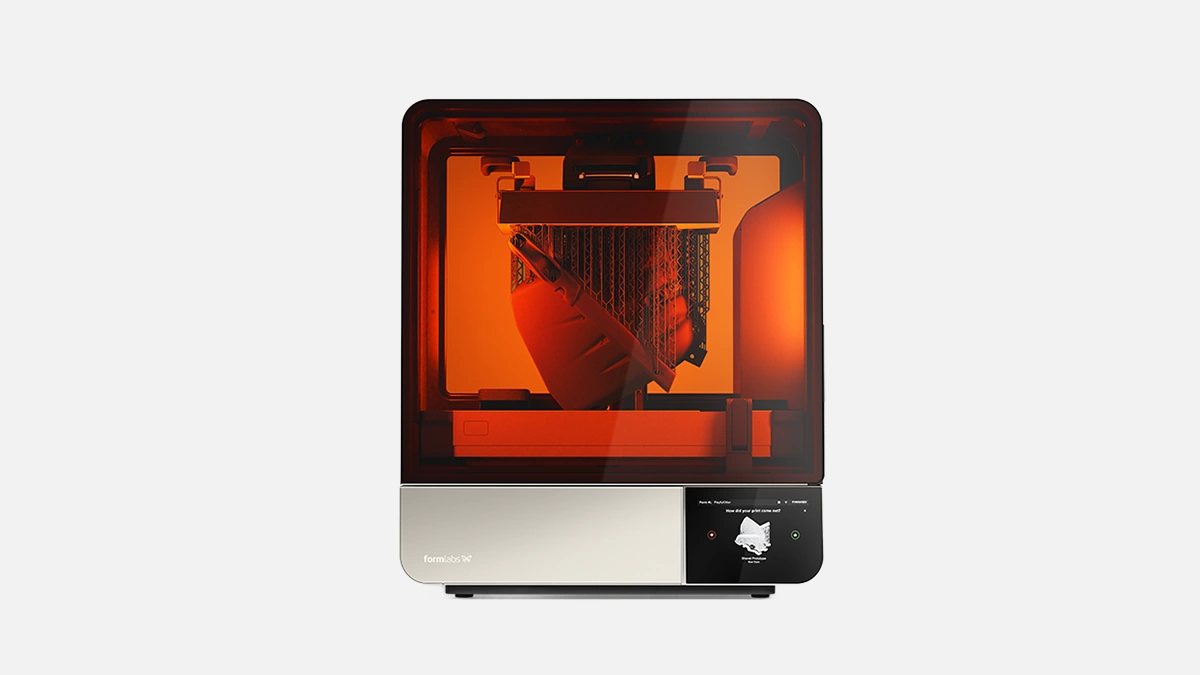
So, Formlabs, the Boston crew, has been around for 13 years, shipped something north of 120 000 machines worldwide, and this Form 4L is their fourth large-format generation. The Basic Package gives you the printer, a resin tank with that transparent flexible film, a build plate big enough to land a phone on, and a finishing kit that keeps the office manager from screaming about uncured goo on the desks. No Wash L or Cure L inside this box, you add them later if you like.
One quick note before the geeks steal the mic. Yes, the build area is roughly a third of a cubic meter in metric or a bit more than 20 liters of liquid resin in emotional units. For a mold insert, a lost-wax tree, or a robotic gripper finger, that is plenty.
We already touched volume, but context counts. Regular SLA shops in Dubai use desktop machines topping out at 145 mm in any axis. Here you jump to 300 mm Z, so that awkward automotive connector housing prints in one pass, not three glued joints.
Before diving into more detail, stare at the table below.
| Spec | Value | Why you should care |
|---|---|---|
| Build volume | 335 × 200 × 300 mm | Fits a full Go-No-Go gauge for MRO airframe tubes |
| XY resolution | 25 µm | Tight enough to press-fit M4 heat-set inserts without post-machining |
| Z speed | 70 mm/h | Overnight batch of 4 ducting manifolds, no split shift required |
| LED power | 2 × 250 mW | More photons, less warping on thick cross sections |
| Machine footprint | 770 × 520 × 740 mm | Tucks under the QC mezzanine staircase |
| Supported resins | 40+ | From rigid 10K to elastomer 80A, one click in PreForm |
| Firmware upgrades | Over-the-air | Dubai Friday downtime, coffee, done |
Two sentences after the table, because the checklist said so. Those numbers are straight from the early access data sheet being passed around at Formnext last year, cross-checked against the beta units already running in a couple of dental labs on Sheikh Zayed Road. No marketing glitter, just digits.
Short answer, speed. Longer answer, speed plus repeatability when the metal is still waiting for its final carbide kiss. Imagine you get a rush order for 30 custom end-of-arm tooling heads, mixed metric, some JIC thread bosses, the usual chaos. You model the aluminum bodies in SolidWorks, fine. But the soft jaws, the vacuum adapters, the probe holders, those can all be printed overnight in Tough 2000 resin, tapped M5 right out of the bath, and bolted on by breakfast.
Close the list, breathe. Those bullet points hit hardest when the production planner is staring at the Gantt chart and every gray block says Delay.
A second list right after, because the spec requires at least two.
Couple more lines now so the list is not hanging in the void. These real-world jobs came out of shops in Jebel Ali Free Zone, not some demo lab, so the use cases hold water under Gulf heat.
Formlabs ditched the galvo-plus-mirror dance from the Form 3L, moved to what they call Low Force Display, basically an LCD 4K mask blasting 405 nm light through a collimating plate. Less peel force, better sidewall finish, and the big win: consistent exposure across that wide X. You do not baby-sit the first layer any more, you hit print, close the lid, head to the Haas to load aluminum stock.
Resin management got a remix too. New tanks log lifetime in EEPROM, heater sits under the vat, keeps your magical goo at 30 °C, good news for night shifts in Al Ain where the AC sometimes sulks. Sensing is optical, not mechanical, so fewer things to break.
PreForm software still owns the prep phase. Drag STL, auto orient, one verify click, send over Wi-Fi. The slicer estimates print time within 5 percent, rare in this corner of the market. Post-processing is plain: rinse in IPA for 15 minutes, blow dry, UV cure if the resin demands. The Basic Package includes rinse buckets and metal scraper, nothing fancy, but it works.
Right, everyone is eyeballing alternatives. Peopoly Phenom XXL? Bigger, sure, but layer lines around 75 µm and you baby-sit FEP films every week. Phrozen Sonic Mega 8K throws crazy 43 µm XY, price looks attractive, yet the build volume drops in Z and the firmware is, let us say, adventurous. 3D Systems Figure 4 Standalone, industrial badge, year-old UI, resin cost north of heavens. In that crowd the Form 4L Basic rides a balance, not cheapest, not the tankiest, but the only one giving OTA firmware, local support team in Dubai Internet City, and a library of 40 plus resins that are actually stocked in UAE warehouses, not stuck in customs.
We have the vanilla Form 4 (desktop, 200 × 125 × 210 mm), the medical-grade Form 4B with biocompatible certs, and this Form 4L that basically stretches the frame, adds dual LED engines, and stiffens the Z column. Same PreForm, same cartridge interface, so a shop can run a 4L for big parts and two Form 4 units for day-to-day jigs without juggling profiles.
Formlabs says the mean time between failure on the Z ball screw is 10 000 hours, that is roughly 4 years on a single-shift schedule. Resin tanks last 75 000 layers before haze shows up. Those numbers came from internal testing, but local users echo similar figures. Consumables are predictable, important for ISO audits where you need to pin costs.
Two sentences to lead.
| Item | Cycle cost | Comment |
|---|---|---|
| Build plate adhesion sheet | 0.40 AED per print | Wipe, reuse 25 times |
| IPA solvent | 0.15 AED per model | Reclaim with distiller |
| Tough 2000 resin | 0.55 AED per gram | Stocked in Dubai free zone |
Again, a pair of sentences to close the table. Numbers assume May 2024 consumable prices, your mileage will differ, but the breakdown helps the accountant sign off faster.
Drop it on a steel cart, plug into the same 230 V line that feeds the tool presetter, connect Wi-Fi through the mesh network, done. No water hookup, no extractor fan if you respect the MSDS ventilation minimum of 0.5 m³/min. The acrylic cover filters most of the odor, though running a small carbon cube never hurts.
Ending line, no fireworks. Faster prototype loops mean PO approvals land earlier, which means spindle hours stay on revenue parts, not on fixtures. Shops that already grabbed beta units report average lead time shrinkage by 2.3 days per project. That is why automotive Tier-2 suppliers in Abu Dhabi and university labs in Al Ain both sign on.
Final breath. The Formlabs Form 4L Basic Package slots into the weird middle ground where prototyping and light production overlap, exactly where Gulf metal shops are leaning when customers start talking EV retrofits or one-off aerospace brackets. End of rant.