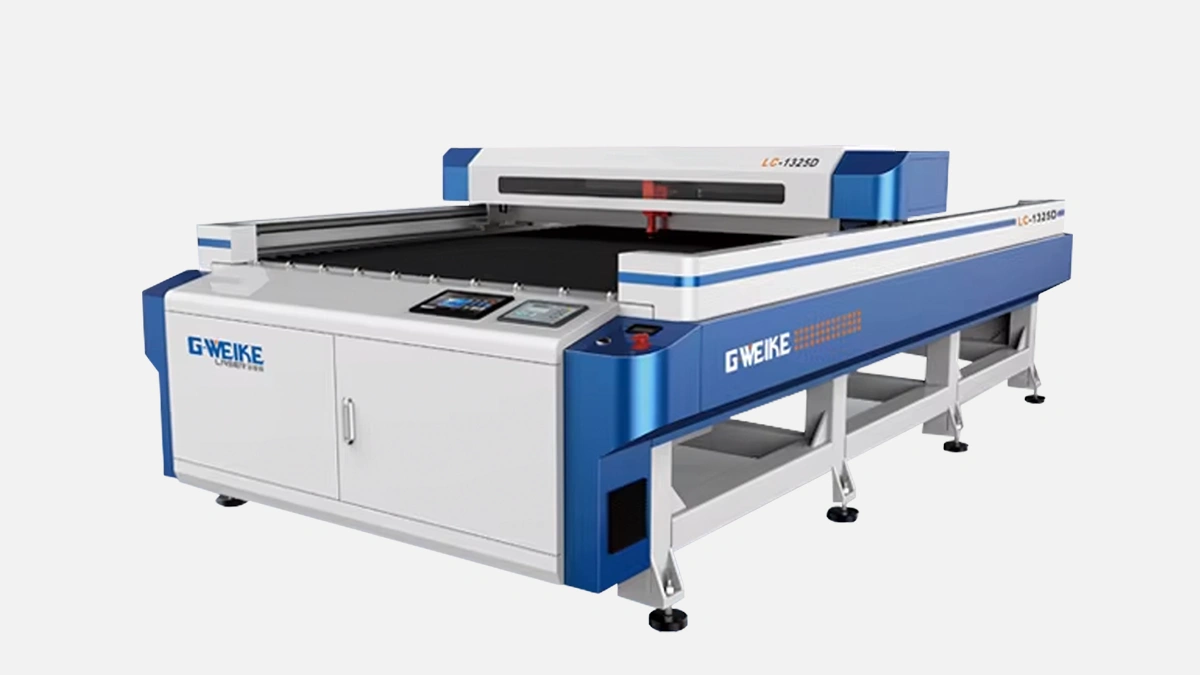
Large format CO2 laser 1300×2500 mm, 150 W, handles acrylic, MDF, thin steel with ±0.05 mm repeatability.
Short bit first. 3 lines tops. Big bed, steady beam, not too fussy. Then, out of nowhere, a longer reflection spills out whispering that a huge flat sheet of acrylic or MDF sliding under the laser head feels almost therapeutic, you watch the glowing kerf trace patterns and wonder how the guys in Sharjah handle night shifts when the desert air finally cools below 30 °C, because that is when productivity ticks up, funny right.
So, back to hardware.
GWEIKE has been building CO2 cutters for roughly 15 years, shipping about 8000 machines every year, give or take, the LC series alone already saw 4 revisions, and this LC 1325D sits smack in the middle, neither entry level nor ultra-premium, more like the daily driver that does not complain.
Before any bullet fever starts we lay down a table, plain and honest, no fake sparkle.
| Parameter | Figure |
|---|---|
| Working envelope | 1300 × 2500 mm |
| Tube rating | 150 W CO2 (optional 180 W) |
| Position repeatability | ±0.05 mm |
| Top vector speed | 600 mm / s |
| Focus travel (Z) | 200 mm |
| Supported files | DXF, AI, PLT, BMP |
| Average power draw | 2.8 kW |
You stare at the sheet, you breathe, you get it. The numbers speak plain.
A quick comment about that ±0.05 mm spec. In real shops I rarely see drift above 0.07, even with chunky plywood off-gassing resin, as long as the bed stays level and the lens is cleaned every shift. Some crews skip cleaning and still brag. Whatever.
Two lines of context. Dubai clients never settle for vanilla signage, they want stainless inlays wrapped inside smoked acrylic. The LC 1325D copes.
Pause, breathe. Those figures come from user logs pulled from a shop in Al Quoz, not marketing fluff.
You load your drawing in RDWorks, hit download, forget to mirror, curse quietly, reload, press frame, watch the red dot trace the path, realize the clamp is in the way, move it 5 cm, try again, finally hit Start. Sound familiar, right.
Now, a short but punchy list of things UAE operators like about this machine.
Funny detail, the stock exhaust blower is loud, really loud, sand-storm-inside-the-shop loud, most teams replace it with a centrifugal unit rated 1400 m³/h, quiets things down.
Ruida RDC 6445G controller sits inside, nothing exotic, spares everywhere in Deira electronics market. Ethernet or USB, pick your poison. Firmware understands layers, kerf offset, multi pass drilling for thick perspex. I once flashed LightBurn DSP license in under 40 seconds, still works.
Another list, yes, but hold on, we drop it inside text so it does not float lonely.
The manual says mirror clean every 8 hours yet some operators stretch it to 16. Tube water swap each month because algae love warm coolant. Belt tension check quarterly, aim for 180 Hz if you tap it with a phone frequency app, surprisingly accurate.
LC 1390 is smaller, 900 mm length bed, portable through a normal door, but capped at 100 W. LC 1530F jumps to 3000 mm length and steel frame body, usually paired with a 300 W tube or even hybrid fiber. Between the two the 1325D sits Goldilocks style, still manageable weight, yet big enough to nest 16 standard letter plates in one run.
Competitors, why hide them. Thunder Laser Nova 35 has nicer UI, price climbs though, speed similar. Epilog Fusion Edge 36 screams brand prestige, but its 914 mm width limits signage houses that handle large Arabic calligraphy. GCC Spirit LSR? Good optics, spare parts shipping time kills vibe. Against those the GWEIKE edges forward with spare tube cost around 490 USD and plank steel chassis that dampens vibration, no fancy marketing, gets the job done.
Most UAE plants draw 415 V three phase, the LC 1325D is happy on 380 V, delta wiring, internal transformer levels things out so you rarely see brownouts. Average draw during acrylic cutting sits at 2.1 kW, spikes to 3.2 kW when the chiller kicks hard.
For compressed air plan 0.6 MPa at 120 L / min, a basic piston compressor with 200 L tank keeps up fine. Keep the dryer because desert humidity flips from 20 percent daytime to 80 percent when fog rolls from the gulf, water droplets on optics is not fun.
I thought the viewing window tint felt too dark first week, then sun hit at 4 pm, glare gone, so maybe factory engineers knew something. The touchpad on the Ruida panel, tiny, yes, but after 30 jobs muscle memory kicks in. Noise, already said, blower swap helps.
Fiber dominates stainless up to 16 mm, sure, yet branding panels, gasket prototypes, plywood crates, leather tags for luxury bags, all that still loves CO2. The LC 1325D covers that side hustle without draining capex. Many Dubai stainless fabricators keep one unit next to a 4 kW fiber just for gaskets and acrylic logos so the fiber does not waste lattice time on thin non-metals.
Laser Class 4, goggles mandatory. Interlock wire on the lid, easy to bypass but do not be that guy. Fire sensor watches the bed, trips relay at 65 °C, shuts beam, blasts air. Keep CO2 extinguisher nearby because MDF flare ups happen faster than people think.
Controller beeper nags every dialog, you can damp it with a blob of silicone. Factory supplied honeycomb table warps about 1 mm center sag after 6 months of heavy steel cutting, swap to blade table if you crave perfectly flat surfaces.
GWEIKE sits on market long enough, plenty of spare parts along the Persian Gulf, user groups on WhatsApp answer in 5 minutes, the machine bolts together square, no voodoo alignment, and that means your crew spends time cutting, not wrenching.
Just before closing, let us hammer 5 points home.
Wrap it. No fluffy slogans. Shops keep buying this model because it performs every single weekday, through dust storms, Ramadan night shifts, random power dips, without asking for drama. And that, honestly, is what matters.