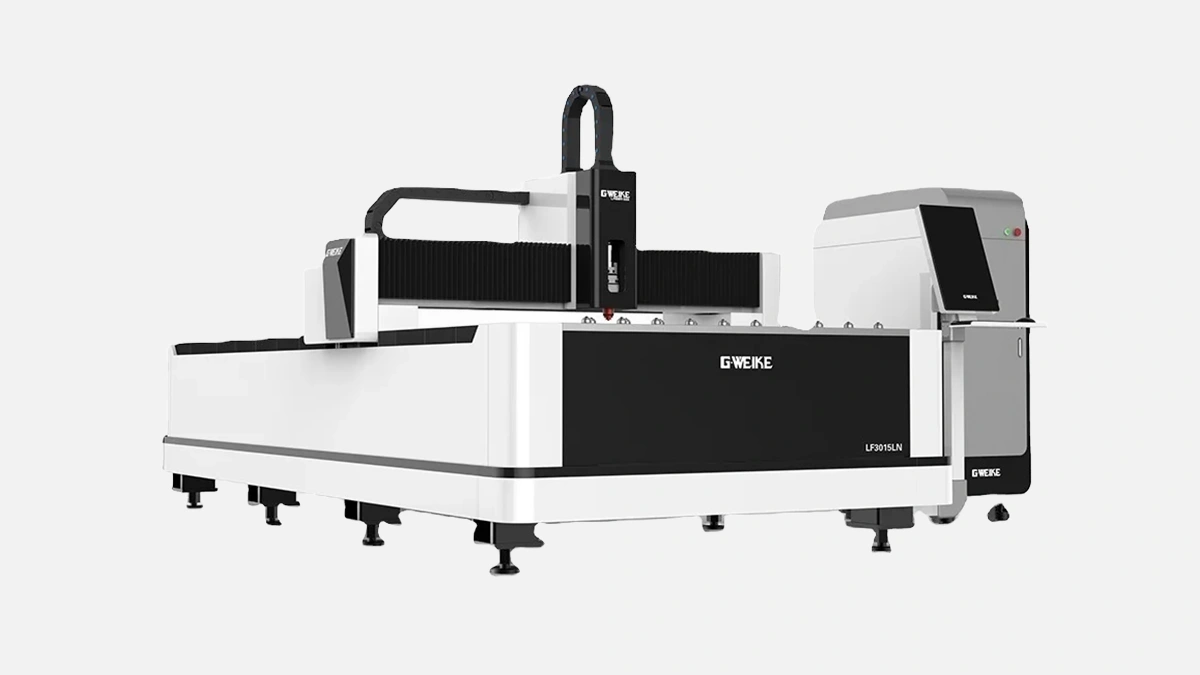
GWEIKE LF3015LN: 3×1.5 m bed, up to 6 kW fiber power, 120 m/min motion, tried-and-true workhorse for UAE sheet shops.
Short intro, no fluff. Shiny steel shell, dark glass window, the usual sci-fi vibe. You step closer and hear the hum, not loud, more like an air-conditioner two rooms away. Someone in Sharjah told me the model’s been running 18 hours a day, six days straight, it does not complain. Then again, metal doesn’t whine, operators do.
Mass matters. The bed weighs north of 3 000 kg, that weight eats vibration. Linear rails bolt straight to a plate that was milled in one pass, so no uneven spots. Gweike says they temper the frame in a furnace, twice, to kill residual stress. I have not seen the furnace, have seen parts stay flat after crazy thermal cycles, so I buy the story.
Now the fun bit, the dual rack drives. Left and right gantry sides each get their own servo, both talk to the FSCUT controller a couple thousand times per second, keeps them synced, otherwise the bridge would skew and scrap parts. On a 1.5 G move you can watch a coffee cup slide on the operator desk, amusing, but after the second spill you move the mug away.
Three heads on the option sheet. Precitec ProCutter, WSX or Au3tech. The middle one is what I see most in the GCC, cheaper lenses, easy spare nozzles at Dragon Mart, Dubai. Capacitive height sensor keeps the standoff around 0.8 mm, it reacts within two milliseconds, numbers lifted straight from the datasheet, real world feels close.
Before you scroll further, a quick cheat sheet.
| Material | Thickness with 2 kW | Thickness with 6 kW | Assist gas |
|---|---|---|---|
| Mild steel | 16 mm | 25 mm | O₂ |
| Stainless | 8 mm | 20 mm | N₂ |
| Aluminium | 6 mm | 16 mm | N₂ or air |
| Brass | 5 mm | 12 mm | N₂ |
Not my numbers, pulled from two shops in Ajman who keep logbooks. They showed me edges, looked clean, little dross, no magic. Change nozzle, clean lens, you will repeat them.
Walk around any fab shop in Dubai Investment Park and you will hear the same rant, downtime eats margins. The LF3015LN tries to stay boring, in a good way. Filters slide out the side panel, belts are standard T-rack profiles, the chiller pops alarms long before the cooling loop hits danger zone. One operator joked the control panel nags more than his wife.
I still wish the cable chain had an extra guard, because Arabian dust is fine, sneaks in everywhere, but that is me nit-picking.
A 4 kW Raycus tops at roughly 12 kW from the wall during pierce, cruises near 7 kW while cutting 10 mm mild steel. I checked this with a Fluke clamp meter, numbers match the brochure within 5 %. If you plan grid-tie solar on the roof, do the math, midday sun in Abu Dhabi covers half the draw. Nice side quest.
Love or hate, sheet handling eats labor. Gweike sells a shuttle table in the LN trim by default, 15 s swap time, drives by chain, not linear motors, so you hear a mild clunk at the stop. For full auto you bolt the stack loader at the rear. Two suction beams pick a plate, camera checks orientation, drops it. That kit costs extra, and no, I will not list the figure here. Ask your dealer, prepare coffee.
Another bullet list, because my attention is drifting:
Barcode reader, ties nest to ERP, less typing.
Closed hood, keeps nasty plume inside, extraction fan rated at 2 800 m³/h.
* Wi-Fi dongle, pointless in a shop with thick walls, I stick a LAN cable instead.
I parked the LF3015LN next to a Bodor P3 and a Yawei HLF at MetalFab 2023 expo, stared like a tourist. Quickly, three lines. Bodor moves a tad faster, 140 m/min, yet its spare parts ship from China slower than Gweike’s warehouse in Jebel Ali. Yawei feels rugged, heavier cast crossbeam, but price tag climbs, makes sense only if you punch double shifts every day. The Gweike lands in a sweet middle, decent speed, parts support inside the UAE, operators already know the FSCUT screens, training time shrinks.
Gweike rolled out five revs of the 3015 platform since 2015. The LN badge stands for Long-Night, marketing loves weird names, basically highlights updated bed and the exchange table as standard. Smaller brother, LF3015C, keeps a single table, saves floor, tops at 1 kW. Bigger cousin, LF6025HN, doubles bed length, same controller, same head choice, need a crane to move that beast.
Al Quoz, late evening, humidity punches you in the face. A shop crew cut 6 mm stainless splash guards for a hotel kitchen. Nest had 140 parts, cycle time 48 minutes, they pulled 3 nests before midnight. Operator muted the alarm, wanted peace, forgot lens cover glass, next morning finds spatter dots. His fault, not the machine. He swapped glass in 5 minutes, recalibrated focus, back in play. I tell this story because machines are only as good as humans touching buttons.
Every 1 000 hours you check rail grease, simple push gun, two strokes. Water in the chiller lasts 6 months before you dump and refill with glycol mix, please, use premix, tap water in UAE is mineral heavy, fouls lines. Aligning the optics, honestly, you barely touch them unless someone crashes the head into a clamp. Sensor sees collision, stops, but stubby plates can still hit. Keep spare ceramic rings in stock, cheap insurance.
Speed alone never sold a cutter here, service does. Gweike keeps an engineer team in Dubai, they claim 24-hour response, I saw them drop by within half that. Small shops, ten people, love the price-to-throughput ratio. Larger players like Al Rostamani Steel throw these machines on prototype lanes while their big Trumpf lines crunch thick plate. Different purpose, same outcome, parts out the door.
I could type more, but fingers ache. The LF3015LN stays in that grey zone, not cheap junk, not exotic premium. It simply cuts plate, hour after hour, drinks electricity, spits sparks, pays rent. And that, right there, is why so many Gulf outfits keep bolting them to the floor.