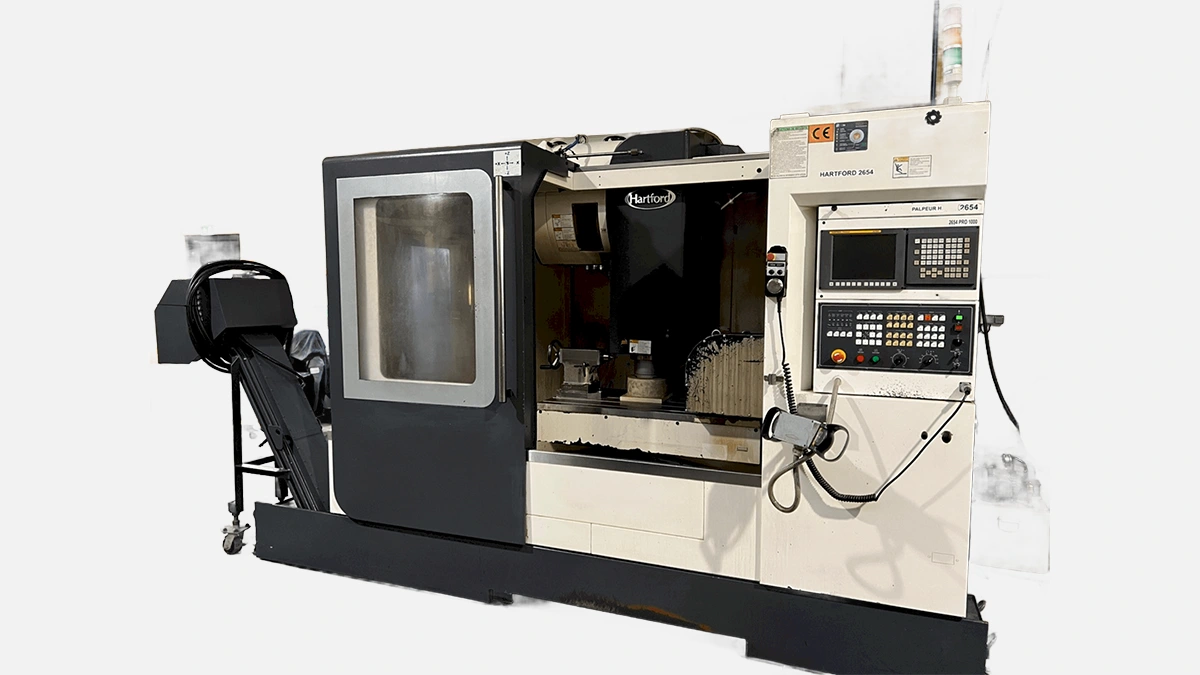
Hartford PRO1000: 1020 × 600 × 610 mm travel, 10000 rpm BT40, built for Gulf heat.
Cold shop floor, AC humming, coffee still hot. Hartford PRO1000 sits in the middle, light grey panels catching every beam coming through the skylight, looking stubborn in a good way, like it simply refuses to quit. I walk around it, tap the casting, knock knock, good dense sound, no hollow spots.
Then the numbers echo in my head, 1020 in X, 600 in Y, 610 in Z, more than enough for most mold bases we cut for perfume cap moulders in Sharjah. Funny thing, a few years ago we sweated over parts longer than 500 mm, now it is daily routine. Progress sneaks in quietly.
Hartford, real name She Hong Industrial, keeps churning out machines since 1965, more than 48 000 units shipped worldwide, about 18 vertical models in the current range, PRO line alone counts three sizes, PRO800, PRO1000, PRO1500, each one feels like a sibling, same face, slightly different height. The Taiwanese builder never screams glory, it just ships cast iron, period.
I drop the brochure on the desk, fold it once, again, do not tell the sales guy. Table is 1200 × 600 mm, T-slots are 18 mm, spacing 100 mm, simple, predictable, the way fixture guys like. Rapid moves? 36 m per minute, not the Formula-1 stuff Haas likes to brag about, but plenty to keep the spindle busy rather than crawling. Tool change time, magazine rotates, grabs, swaps, about 2.8 s from chip to chip according to the sheet, in reality closer to 3.4, still fine, my guys can live with it.
Up to 10000 rpm, belt driven, BT40, good compromise. We do not chase aerospace aluminium in Abu Dhabi every day, most orders are still stainless, P20, Duplex, the usual suspects. Torque curve peaks at 191 N·m around 1500 rpm, handy when a roughing insert wants to bite deep. Coolant through spindle is optional, we ticked that box, cannot imagine life otherwise under 38 °C summer heat where emulsions thin like juice.
And one more thing, the spindle chiller lives in a separate cabinet, easier to service, you do not need to clamber behind sheet metal like a contortionist.
Box in box, no fancy polymer fill, just Meehanite cast iron, ribs everywhere. The Y saddle rides on four box ways, scraped, Turcite in between, oil pockets shimmering. X axis is linear guide, 45 mm rail width, two trucks per rail. People love debating rigidity versus speed, my take, PRO1000 finds a middle road, rapids okay, chatter minimal even at 200 cm³/min removal on 1.2312 steel.
Do the three and you avoid half a day of arguing with tech support.
Hartford gives you Fanuc 0i-MF as baseline, we paid extra for Siemens 828D because our programmers enjoy ShopMill, and yeah, the jog wheel feels better. Alarms show up in plain text, no cryptic 414 servo nonsense. On-board memory 2 MB, small, so DNC drip feed from network share is standard procedure. Ethernet port straight on the panel, RJ-45 with a rubber cap that disappears in a week, count on that.
Immersion pump 1.5 kW, 20 bar through spindle, 2 bar flood, side auger dumps into a lift-up conveyor. Chips land in 300 L bin, about full after half shift on Inconel, less on 6061 obviously. Oil skimmer is basic belt type, but it does its job, we pull out 5 litres of tramp in a week, smells less fishy now.
| Axis | Travel | Rapid rate | Ballscrew diameter |
|---|---|---|---|
| X | 1020 mm | 36 m/min | 40 mm |
| Y | 600 mm | 36 m/min | 40 mm |
| Z | 610 mm | 30 m/min | 40 mm |
Numbers look tidy on paper, yet the real magic is how the machine keeps positioning within ±3 µm over six hours with the AC cycling on and off. We measured with Renishaw laser, not hearsay.
Humidity swings low, fine, but dust is everywhere, especially during Shamal winds. The electrical cabinet filter mat clogs fast, we replace weekly, costs pennies, saves drives. Voltage in Sharjah industrial zone drops at night, brownouts, so we added 30 kVA UPS inline, otherwise the control reboots and operators get cranky. Good news, the Siemens hardware handles 46 °C ambient once the panel fan runs at max.
Competitors? Haas VF-2, Doosan DNM 5700, DMG MORI DMC 1035V. Quick bite size opinions:
Our parts per hour spreadsheet shows PRO1000 within 4 % of the DMG while costing roughly half, numbers from real jobs, not brochures.
PRO800 is smaller, shares spindle, lighter casting, tops out at 7000 rpm optional high speed. PRO1500 stretches X to 1500 mm, needs extra floor space, same control. For aerospace ribs we think about adding PRO1500 next year, but for now the 1000 mm travel hits the sweet spot.
Honestly, no witchcraft. Grease guns once a week, way lube checks itself, hydraulic system has sight glass. Change spindle air purge filter every 1000 hours, otherwise condensation sneaks in during humid nights. Our oldest Hartford, a 2004 HCMC 1270, still holds tolerances fine after 38000 spindle hours, so we expect the PRO to behave similarly.
Speed matters, sure, but reliability under heat matters more. Hartford casts in Taiwan, ships with desiccant inside control, small detail yet speaks volumes. The servo tuning out of the box matches ISO g-code programs we already use, no need to tweak jerk settings for every job, that saves headaches when running night shift with trainee operators.
My mood swings from coffee buzz to calm satisfaction, machine keeps cutting, no drama, just next part, next cycle. Owners love the ROI calculus, operators love the roomy table, QA loves the repeatable CMM reports, everyone wins. If your shop churns medium moulds, precision plates, general subcontract parts and you live under Gulf sun, PRO1000 quietly fits the role, no fireworks, just chips flying.
And that, in the end, explains why more than 50 UAE shops added Hartford badges to their grid of logos on LinkedIn during the last two years, word gets around fast when a machine simply works.