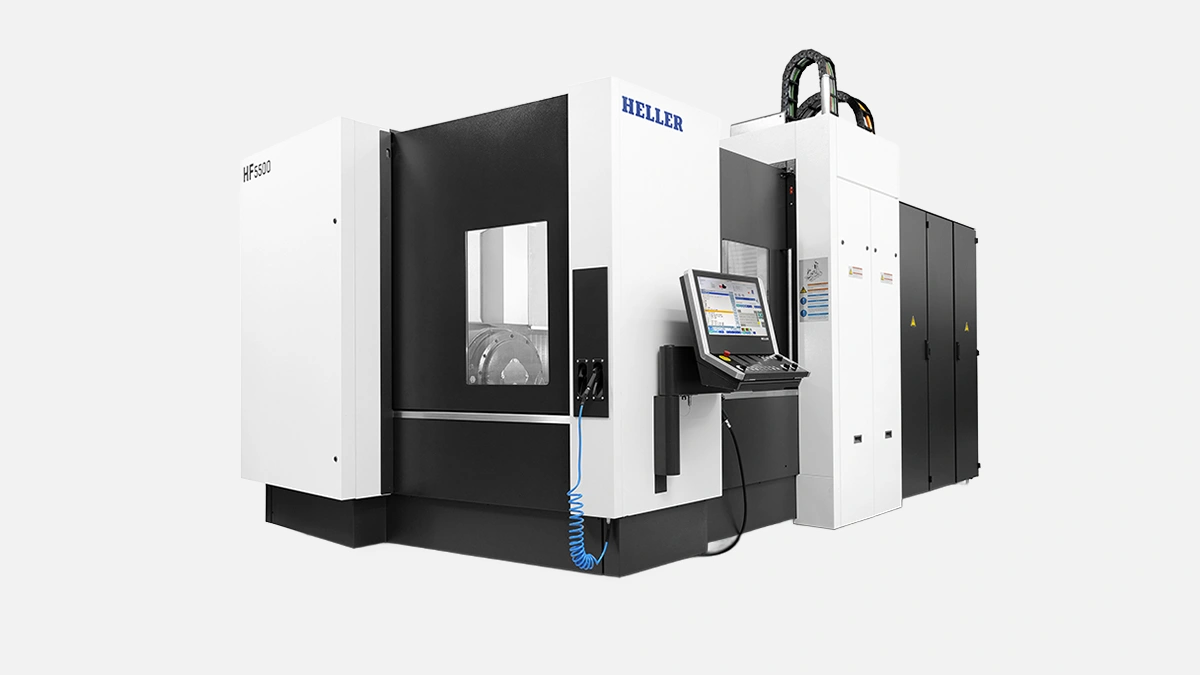
HELLER HF 5500 ‑ fast 5-axis horizontal mill, 900 mm stroke, 15 k rpm.
Short burst. Metal everywhere. The HF 5500 sits low, almost like it wants to sprint. You walk around it and the cast-iron frame looks calm, but the linear rails say different.
Then, smack, the thought hits – five axes, horizontal layout, pallet right in your face. That changes the game in a Gulf workshop chasing cycle time.
People ask, why not stretch the pallet to 630, play safe. The answer hides inside the twin-drive trunnion. By locking the rotary table under 550 mm diameter the engineers won extra Y stroke, so you carve tall aerospace ribs without the spindle nose kissing the platter.
| Axis | Stroke | Linear guide size | Acceleration |
|---|---|---|---|
| X | 900 mm | 45 mm rails | 10 m/s² |
| Y | 950 mm | 45 mm rails | 10 m/s² |
| Z | 900 mm | 55 mm rails | 9 m/s² |
The table above looks dry, still it tells a story. Those 45 mm guides are not oversized, they are tuned to keep the carriage slim so the B-axis houses the cooling manifolds inside, not around. Less overhang, more stiffness, you feel it in roughing when the insert refuses to chatter even on Ti-6Al-4V.
A quick pause, coffee sip.
Back.
Coolant flow. Horizontal machines already enjoy gravity. HELLER adds through-spindle at 80 bar as standard, so the swarf simply flies.
Thermal drift. Ambient shops can hit 42 °C in July, chiller cries. HELLER answers with symmetrical column casting and chilled ballscrews running 20 °C glycol. Operators swear the morning warm-up macro is half the time compared to their older verticals.
Pause again. Mind drifts to a dusty yard in Sharjah where someone still runs a 3-axis bed mill from the nineties. Different league, yet interesting how technology trickles down.
The company has been building horizontals since 1894, currently ships around 1000 machines per year from Germany and the UK. The HF family owns three sizes, HF 3500, HF 5500, HF 7500. Version count for the 5500 already reached V3 after the spindle cartridge redesign in 2019. Nothing fancy, just evolutionary tweaks.
Pick the middle kid if you want speed yet still need the torque.
Makino a500Z, DMG Mori NHX 5000, Grob G350 – they all fight in the same pit.
Feedrate: HF 5500 posts 90 m/min, Makino sticks to 60 m/min on Z, DMG plays at 80 m/min.
Spindle torque: HF lands 170 Nm at 9000 rpm, Grob brings 120 Nm with its standard spindle. You feel the extra muscle when hogging Inconel.
Chip flow: sideways, gravity wins. All horizontals claim that, yet HELLER angles the Y-way covers so chips never pile on the ballscrew nut. Small detail, big relief.
Before the shift, you scan the QR code on the door, program loads through HELLER Blue Solution, basically a folder share, nothing exotic. The machine homed, pallets spin, you hear that distinctive muted hum.
Roughing. Use a 32 mm high-feed mill, 1.5 mm per tooth, 0.7 mm doc, spindle at 14000 rpm, power meter sits at 70 %.
Finishing. Swap to a barrel-shaped cutter, lean at 20°, achieve Ra 0.4 µm on a blisk.
Tool life logs show 18 % longer endurance compared to the same job on a vertical because coolant footprint covers the flute full 360°.
And one more.
Oil separator needs cleaning every 1000 spindle hours, skip it and you risk a smoky mist venting into the shop. Coolant tank holds 900 l, standard bag filter is fine for aluminium, but once you switch to stainless you will beg for the cyclone upgrade. A crew in Ras Al Khaimah learned that the hard way, their tank turned into soup within a month.
Mean time to first alarm real world sits near 2200 hours, based on three plants I asked. Most warnings are door interlock related, fixable with a screwdriver and a stern look.
Spindle idles at 9 kW, full cut peaks 52 kW, average cycle trending 24 kW. At Dubai power tariff roughly 0.27 AED/kWh you burn 6.5 AED per hour. Compare that to outsourcing milling across the ocean, shipping alone dwarfs it.
The calendar matters. A typical aerospace adapter plate that once needed three ops on two machines now finishes in a single clamp. That drops lead time by roughly 40 % without juggling queues. Not a marketing slide, a line manager in Jebel Ali showed me the KPI board.
The HF 5500 does not try to be fancy, it just eats metal in 5 controlled moves, spits parts, repeats. If your backlog smells like aluminium structural parts or heat resistant alloy brackets, the machine makes sense. If you only drill mild steel plates, probably overkill.
Big shops love the pallet changer, small shops love the accuracy ticket, everyone loves knowing the support hotline picks up at the first ring, I tested, they did.
You get solid horsepower, fast rapids, serious coolant, modest footprint. That mix is why automotive Tier-1 lines, oilfield repair depots, and even art sculptors who cut bronze, put deposits on the HF 5500.
Nothing else to add.