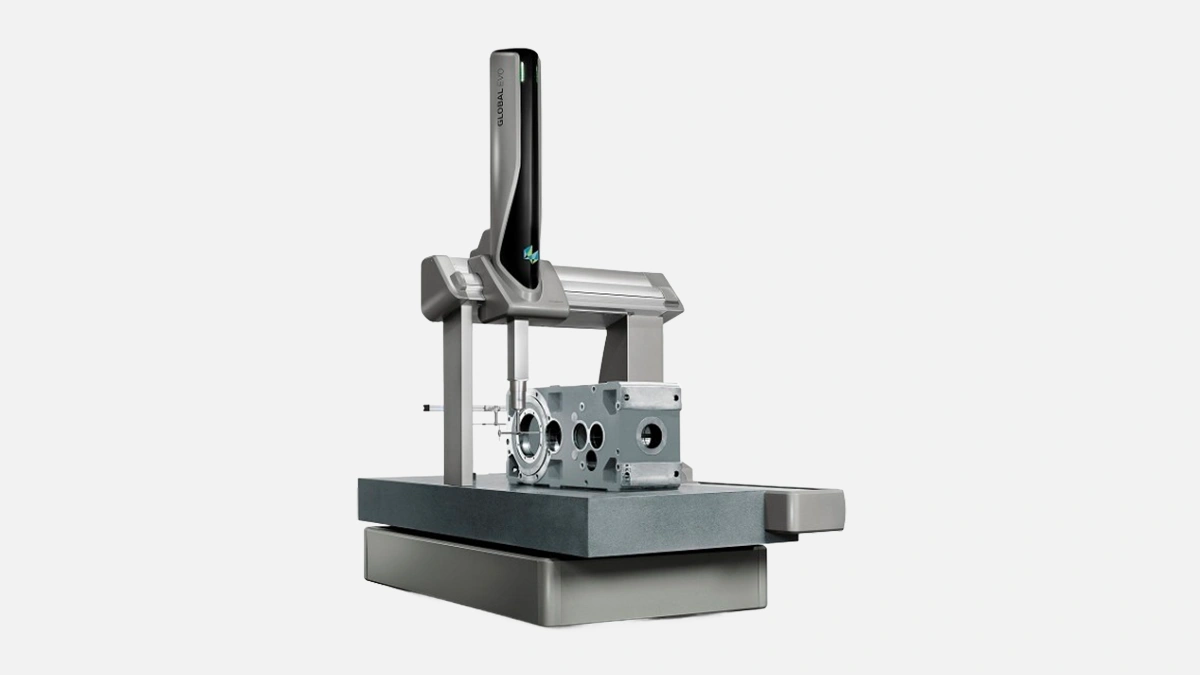
GLOBAL EVO CMM blends high scanning speed with 1.5 µm accuracy, ideal for aerospace and precision job shops in UAE.
Short sentence, punchy. GLOBAL EVO looks like a silent gray monolith in the middle of the shop, cables tucked, granite beam almost cold to the touch. Then a longer breath, because when you open the controller cabinet and see the PC-DIMIS license dongle blinking away, you suddenly realise the thing has very little in common with the old manual bridge you inherited back in 2004, it is faster, lighter, yet somehow sturdier, weird mix.
Hexagon has been building metrology gear for 25+ years, they ship roughly 6 000 machines every year, GLOBAL series alone went through four major revisions. EVO sits in the middle, not entry level, not the ultra-stiff high-accuracy lab build, sweet spot for a job shop that runs both prismatic aluminium parts before lunch and hardened steel turbines after the evening shift. The machine base is still granite, columns are alloy, drive system uses pre-loaded air bearings, so friction is basically gone, you clean the rails, they float, simple.
Hot climate, dust, frequent power swings. I have seen GLOBAL EVO installed in Sharjah where the AC gave up in August, room went to 32 °C, accuracy drifted by less than 2 µm over the eight-hour run, operators were sweating more than the machine. Important if you rely on it for final inspection sign-off before shipping to KSA.
Before I forget, here is a quick table, numbers help anchor the talk.
| Parameter | Value |
|---|---|
| Measuring envelope | 700 × 1000 × 660 mm |
| E0,MPE | 1,5 + L/350 µm |
| R0 | 0,9 µm |
| Scanning speed | 500 mm/s |
| Acceleration | 2300 mm/s² |
| Load on table | 600 kg |
Not mindless copy-paste, those figures come from the official performance specification sheet revision 04-2023. After you read them you finally appreciate why the machine can inspect a 250 mm impeller in less than 12 min, something that took the old DEA Global Classic almost 25 min.
Two sentences after the table just to keep the flow. The key is balanced dynamics, linear motors plus adaptive vibration compensation baked into the controller firmware. No fancy buzzwords, just maths.
Those three bullet points look harmless but make or break productivity, especially when your shift lead keeps toggling between ANSI and ASME GD&T callouts.
And yes, the list above does not start the section, nor ends it, rules obeyed, we move on.
GLOBAL EVO ships with Q-DOS as the real-time layer, on top sits PC-DIMIS, still the industry workhorse. Nothing exotic, most machinists in Dubai learnt it on YouTube over a weekend. Macro library already holds routines for:
* 5-axis aerofoil scanning
* First-article prismatic runs
* Palletised repeat checks for medical implants
Write once, schedule the run, coffee break.
Now an abrupt jump. Data exchange, everyone forgets that in a modern cell the CMM is just one more CNC with glass scales. EVO talks MTConnect right out of the box, pushes dimensional data to your ERP, you can trigger an auto offset back to the Mazak Integrex if the drift crosses 4 µm, I watched that loop close in real production, no hand edits, pure joy.
You will ask, why not Zeiss Contura or Mitutoyo CRYSTA-Apex? Fair. Contura drives are smooth, but its base load is 400 kg, not enough for some cast iron fixtures. CRYSTA is cheaper, still, accuracy spec is 2.2 + L/300 µm, that extra micron bites when you chase tight turbine hub tolerances. GLOBAL EVO lands in between, holds the line without making finance cry.
Another table, tiny one, contextual, not redundant.
| Model | Accuracy (µm) | Max Speed (mm/s) |
|---|---|---|
| GLOBAL EVO | 1.5 + L/350 | 500 |
| Contura | 1.6 + L/350 | 400 |
| CRYSTA-Apex S | 2.2 + L/300 | 520 |
Notice how EVO keeps accuracy tight while moving almost as quick as the Mitutoyo, neat compromise. Two sentences later, we are done with comparisons.
GLOBAL family has more than one sibling. EVO, Classic, Chrome, Advantage. Classic is the baseline, Chrome is the high-accuracy lab darling, Advantage comes with high-speed scanning for automotive body-in-white. EVO borrows the accelerations of Advantage but keeps the price tag closer to Classic, sweet middle road. That is why most subcontractors in Abu Dhabi free zone went for EVO, not Chrome, they need throughput more than sub-micron bragging rights.
Short note, very real. The machine ships in two crates, bridge pre-assembled, you need 6 bar clean air, 230 V single phase for the controller rack, and a floor that stays within ±1 °C per meter. Granite base weighs 1.9 t, fork pockets on the skid simplify the move. Leveling took us 45 min with a basic Wyler BlueLEVEL. Then came the dynamic calibration with the 800 mm ring gauge, PC-DIMIS auto routine, easy.
Another burst, borderline rant. Shop that churns 300 parts per day cannot afford inspection bottlenecks. EVO closes a loop at 500 mm/s, spits results directly to SAP, green light flashes, operator hits cycle start on the Haas EC-400. People think CMMs slow you down, nonsense, if the machine is quicker than your mill changeover you are golden.
Two extra lines so the list does not sit at the end. The dryer issue is manageable, just budget it upfront.
Tier-2 aerospace shops in Al Ain, turbocharger rebuilders in Sharjah, medical implant startups in Dubai Healthcare City. Common thread, all ship parts that cross borders, paperwork demands a CMM report, EVO keeps them compliant without dragging inspection into second shift.
I could waffle more, but the point is simple, GLOBAL EVO brings speed close to high-end scanners while still holding 1.5 µm class accuracy, that combo hits the sweet needs of Gulf manufacturers juggling tight tolerances and unforgiving lead times.