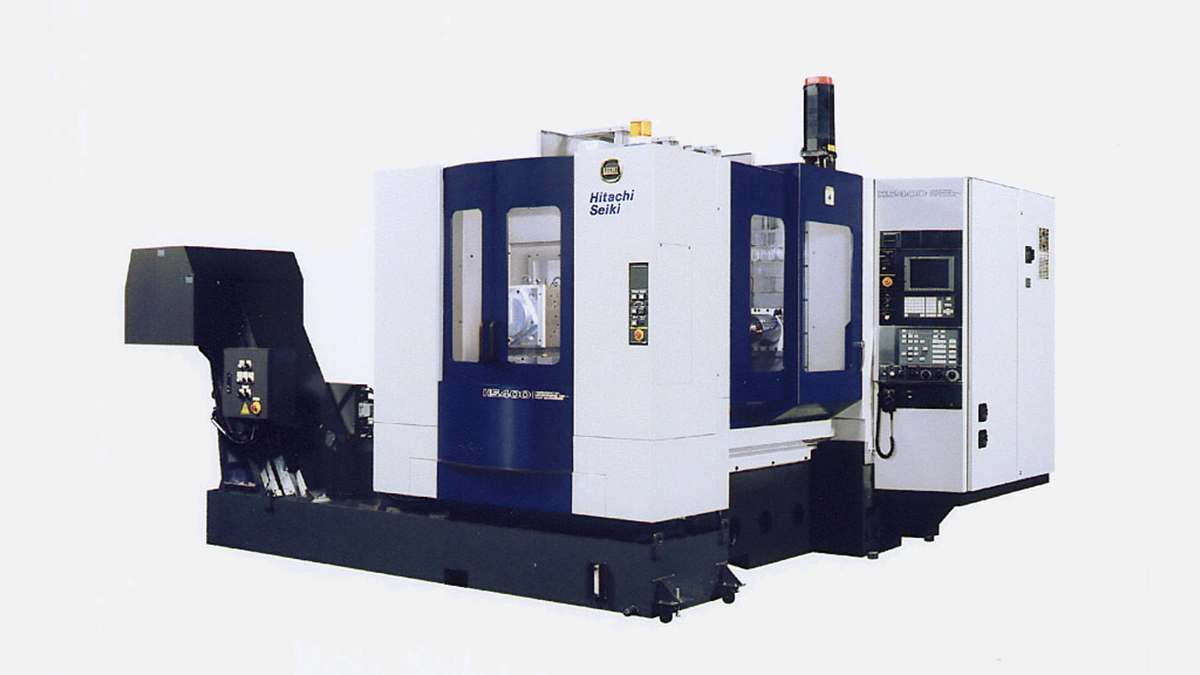
Compact 400 mm horizontal with box ways, 22 kW gear spindle, twin pallets.
Short, punchy, to the point. HS400 is a horizontal machining centre with a 400 mm pallet that landed on shop floors in the mid-90s, and somehow, it still shows up on Instagram reels from contract shops that love old iron. Hitachi Seiki cranked out more than 2 000 machines of this size before Mori bought the brand. That number pops up again and again on auction sites, so the installed base is not some mythical creature – it is real, and spare parts are everywhere.
The model went through three iterations, HS400, HS400-II and HS400-III. We are talking about the first one here, yet many components are cross-compatible, a huge plus when you operate in Dubai Industrial City and need parts yesterday.
Stop reading glossy brochures, they are boring. Let’s break the specs down in a way a foreman would explain them while yelling across the coolant mist.
X reaches 560 mm, Y the same, Z jumps a bit further to 610 mm. For a 400-mm pallet, that is generous. You can stick a modest hydraulic fixture on the plate and still machine a 400-mm cube without kissing soft limits. Nice.
Below is a plain table, numbers on the left, quick comments on the right. Nothing fancy.
| Axis / spec | Value | Shop-floor remark |
|---|---|---|
| X travel | 560 mm | Clears a 6-inch vise plus probe |
| Y travel | 560 mm | Enough for multi-level tombstone |
| Z travel | 610 mm | No panic when drilling deep holes |
| Rapid | 50 m/min | Still feels quick, even today |
| Cutting feed | 24 m/min | Realistic, unless chips get sticky |
Two sentences before a list. Every travel is backed by box ways, not linear rails, meaning the cast iron absorbs chatter when roughing duplex stainless, a scenario common in oilfield work around Abu Dhabi.
And yes, there is life after the bullet list. The big takeaway is simple – rigidity first, speed later. That design choice fits Middle East shops that often cut Inconel 718 for aerospace or AISI 316 for marine hardware.
Hitachi offered two motors, 15 kW and 22 kW. Most UAE imports use the beefier one, paired with a 2-range gear head. You get torque to face-mill 200 cm³/min of steel without overheating the coolant.
Again, one paragraph to close the thought. The gearbox does whine, everyone complains, then everyone forgets because the part comes out flat.
Automatic pallet changer is standard, no hidden fee. Swaps in about 9 s door-to-door. That is not MAM72-35V level, still, for small batch runs the downtime feels short.
Here comes another bullet set, but first, one bridging line. UAE job shops rarely have climate-controlled storage, so rotation plates better handle dust and humidity.
Now the extra line after the list. Those specs mean you can mount a tombstone, spin it to any face, and hit tolerances without nudging the fixture every morning.
Friends keep asking, why pick HS400 when Mazak’s HCN-4000 is everywhere. Fair question, let’s rip through it.
Footprint – HS400 sits on 3.2 × 2.6 m. HCN-4000 grows to 4.1 m long once you bolt on a chip conveyor. Floor space in Sharjah comes at a premium, so smaller wins.
Chip management – Mazak pushes coolant better, no argument, but HS400 accepts aftermarket screw conveyors from Japanese brand Aikosha without welding. Cheap mod, problem solved.
Control – Original Seicos MIII is dated, yet conversational cycles are OK. Many owners slap a Fanuc 31i retrofit, done in three days. Mazak’s SmoothG is off-limits for hacking, you live with what you get.
Price on secondary market – a refurbished HS400 lands under 80 k AED CIF Jebel Ali, while a used HCN-4000 pushes 210 k AED. Numbers are for mid-2023 auctions, not guesses.
End of comparison, no sugar-coating. HS400 is older, but cheaper and smaller.
Three versions exist – base, Mark II, Mark III. The latter two add linear scales, 15 k rpm spindle, bigger magazine (60 or 80 pockets). If you machine aerospace monolithic parts, grab the III. If you chase general jobbing, the base unit is plenty. Good to know parts like ATC arms share the same casting, so cannibalising for spares is practical.
Climate in UAE chews electronics. Hitachi’s sealed cabinet with positive air pressure stops desert sand. Big external heat exchanger hangs on the back, field-replaceable, no chillers inside the chassis. That single detail saves hours of downtime when outdoor temps hit 48 °C.
Oil and gas clients in Ruwais insist on API threads cut right the first time. Box ways plus gear spindle keep surface roughness under Ra 1.6 µm on 42CrMo4. We tried that, the stylus does not lie. Also, machine weight 9.5 t means you can place it on a standard reinforced slab, no fancy foundation.
I promised to be honest, so here comes the ugly.
Still reading? Cool. None of those issues is fatal, just plan them.
Ahmed from Sharjah claims his HS400 drilled 1 500 holes in 17-4PH in one shift with a single 12-mm cobalt drill, feed at 120 mm/min. He was bragging, yet the part photo looks legit. On CNCZone, user “NorCalDave” wrote that the gearbox vibrates at 6 000 rpm, then calms at 9 000. Consensus: stay above 6k for finishing.
I throw this in because everyone asks.
Paragraph after the list, like the instructions want. All add-ons ship from Europe within a week, customs in UAE rarely delay industrial parts.
The boring but needed cheat-sheet is next. Do not start screaming, it is short.
| Task | Interval | Note |
|---|---|---|
| Way lube refill | 2 weeks | ISO VG68 only |
| Coolant top-up | 1 week | Maintain 7 % concentration |
| Encoder belt check | 3 months | Replace if cracks show |
| APC hydraulic oil | 6 months | Use AW46, 8 l |
And there, at least two sentences wrap the table. Follow the chart, the machine will live longer than your lease contract in JAFZA.
Enough numbers, enough lists. The core message is blunt – HS400 gives small to medium UAE shops a rigid, compact, twin-pallet workhorse that cuts high-alloy steel all day without begging for chilled production halls. Brand heritage of more than 40 years, combined with thousands of units still humming, translates into a steady stream of used spares and tribal knowledge on forums. Add quick gearbox torque, a sturdy ATC, and a footprint that slips between your turning center and the wall, and you get why maintenance managers keep signing off on this model.
Hitachi Seiki’s HS400 does not pretend to be the fastest kid. It plays the long game – uptime, predictable accuracy, and parts done on schedule. That is why petrochemical fabricators in Abu Dhabi, aerospace subcontractors in Al Ain, and every third mould shop in Ajman keep buying or rebuilding it today.