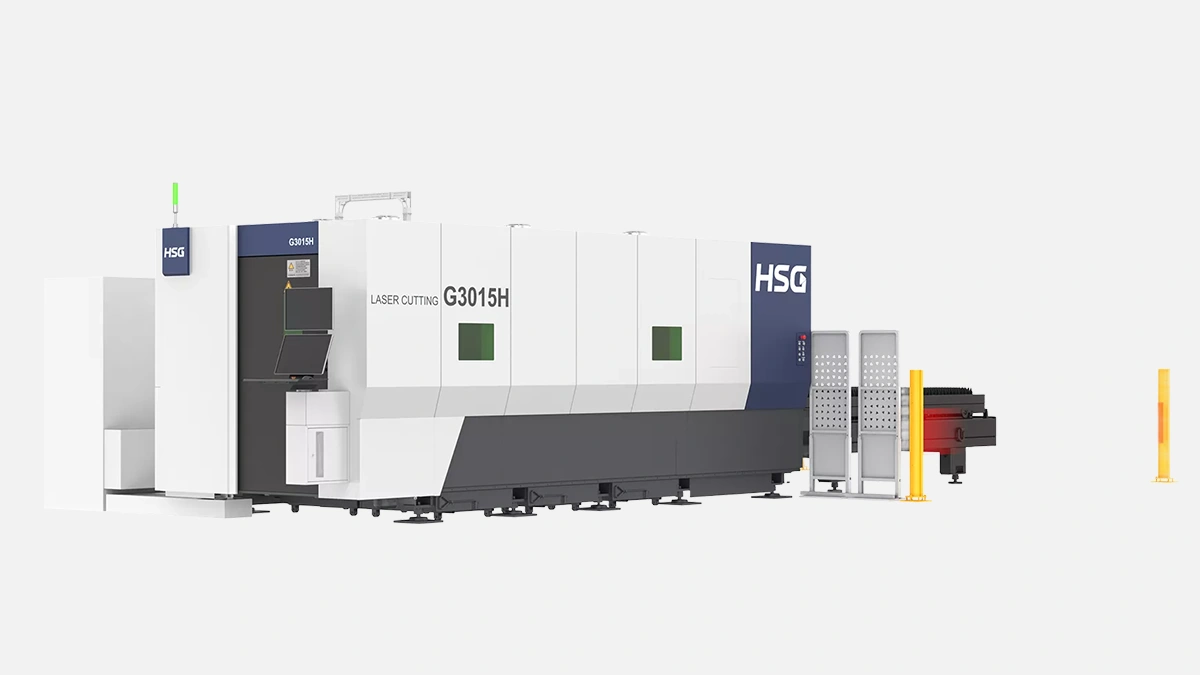
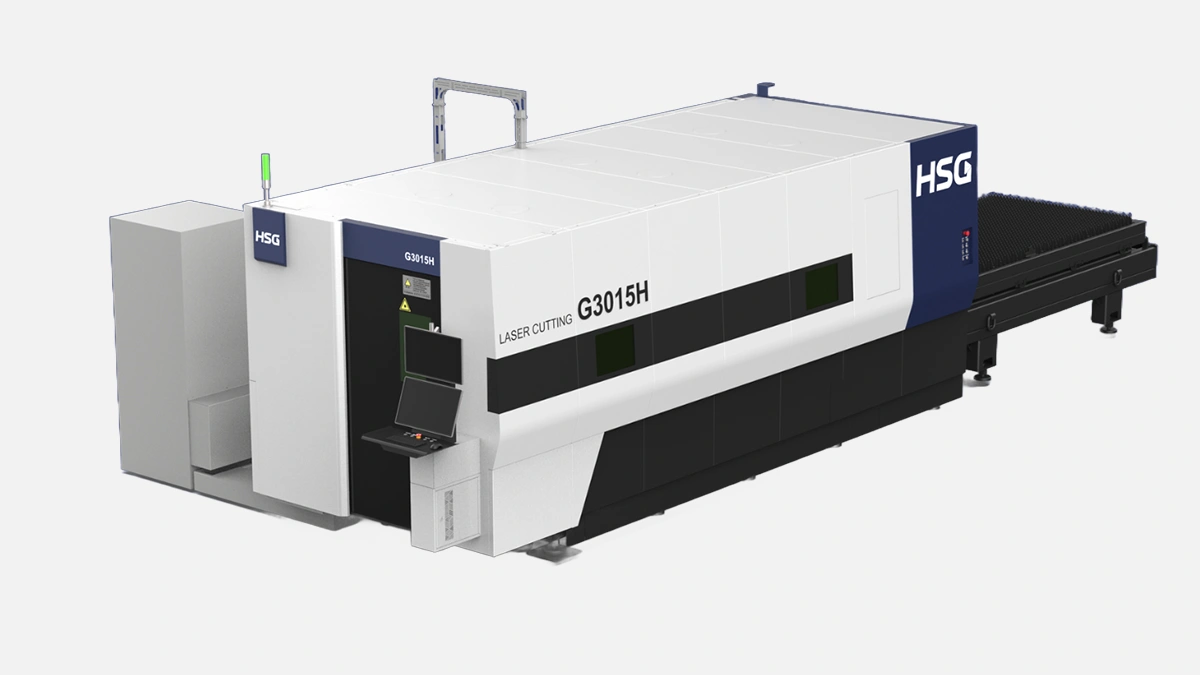
HSG G3015H cuts 3×1.5 m sheets up to 22 mm at 140 m/min with open Beckhoff control.
Sharp cut. Fast pace. Loud air hissing somewhere behind the safety glass. That is usually the first impression when the G3015H kicks in on a shop floor in Sharjah. The sheet vibrates a bit, the operator taps the touch panel, then suddenly a thin blue-white line races across mild steel and you can smell the fresh oxide even through the extraction.
Metal fab owners in the UAE keep telling the same story. Tight deadlines, scorching temperatures outside, mixed batches inside. One hour it is 3 mm stainless for kitchen equipment, the next it is 20 mm mild steel base plates for a desert solar farm. They want one machine that refuses to slow down. HSG decided to answer with the GH series, and the G3015H sits right in the middle of that range.
HSG started in 2006 with CO2 sets, launched the first fiber cutter in 2013 and now ships roughly 4500 machines a year. The GH line went through three revisions so far. Version one had belts on X, version two moved to rack drives, version three added the X9000 controller and a sharper cut head with ceramic rings rated for 25 bar nitrogen. Nothing flashy, just step by step hand-on improvements.
The frame looks chunky at first sight, then you remember it is cut from 16 mm plate and heat treated for 8 hours. No magic powder coating, just bare grey iron inside. The gantry rides on dual linear rails, size 35, preloaded class P. Travel stops vibrate like crazy during rapid moves yet the part geometry stays inside ±0.05 mm on a 300 piece job. That is the part the marketing slides rarely show.
Before we drown in chatter let me drop a small table, the numbers calm things down.
| Axis | Stroke | Drive | Peak speed |
|---|---|---|---|
| X | 3050 mm | Dual rack | 140 m/min |
| Y | 1550 mm | Dual rack | 140 m/min |
| Z | 220 mm | Ballscrew | 60 m/min |
Those figures sit somewhere between the Mazak Optiplex Nexus and the Trumpf TruLaser 3030. Close enough that you will not feel a gap on typical Gulf sheet work.
Two quick bullets before moving on, because I keep forgetting them in conversation:
Heat drift kills accuracy faster than a rookie forklift driver. GH counters it with a sealed frame, passive cooling channels and plain infrared probes on the gantry ends. Temperature goes up 9 °C during a full shift, the controller compensates on the fly. I watched a job switch from 0.8 mm brass to 16 mm black steel without a single offset tweak. Nice.
RayTools BM114H rides by default, but most Emirates shops tick the option for Precitec ProCutter when they spec 4 kW or bigger. Same nozzle library though, so changeover stays under 45 s. Kerf width on 6 mm stainless averages 0.15 mm, scallop height below 0.02 mm, I ran the dial gauge myself. Consumables bill, that is another talk, yet the saving against CO2 is still above 55 % per month in nitrogen heavy work.
You asked about gas, every buyer does, let me bullet the essentials:
Beckhoff IPC under the hood, Windows 10 IoT, HSG X9000 frontend. No locked menus, parameters pop up in clear text. Remote service via wired VPN, which matters because Etisalat blocks half of the usual ports. The screen is 21.5 inch capacitive, fingerprints everywhere, still readable under direct ceiling LED lights. Nested parts import directly from Lantek or Sigmanest without conversion. Arabic labels? Yes, but translation feels robotic, most Emirati operators stick to English anyway.
G3015H includes a shuttle table by default. Changeover under 13 s with a 1.5 ton sheet. Pneumatic clamps squeeze from both sides, so warped stock does not pop out. I had that happen on an early GF model, not funny.
Class 1 laser enclosure, dull grey panels, polycarbonate windows rated OD7 at 1064 nm. Fume extraction uses a segmented duct under the slats. Flow is around 5900 m³/h, one point for your HVAC calculation. UAE regulations ask for max 1 mg/m³ iron oxide at operator height, the default cartridge unit keeps it at 0.37 mg/m³, measured by a client in Dubai Investment Park during an afternoon shift on galvanized plate.
Electricity in the Emirates costs roughly 0.32 AED/kWh for industrial users. A 3 kW setup pulls about 19 kW during real cutting, so 6.08 AED per hour plus gas. That number sells machines faster than any brochure line.
Now a quick comparison block. People often weigh the G3015H against three faces in the same price neighborhood: Bystronic ByStar Fiber 3015, Trumpf TruLaser 3030 fiber and Bodor P3. Table below condenses what I saw in mixed production.
| Feature | HSG G3015H | TruLaser 3030 | ByStar 3015 | Bodor P3 |
|---|---|---|---|---|
| Top power option | 6 kW | 8 kW | 10 kW | 6 kW |
| Acceleration | 1.5 G | 1.4 G | 1.2 G | 1.5 G |
| Controller openness | Full | Partial locked | Locked | Full |
| Base frame mass | 7.2 t | 8.1 t | 8.6 t | 6.5 t |
| Lead time to UAE | 8 weeks | 16 weeks | 14 weeks | 10 weeks |
So, while the Europeans win on raw laser wattage, HSG ships faster and lets you tinker under the hood without a service key. For job shops juggling diverse batches that single openness line tilts the decision.
GH shares DNA with GF and GX lines. GF carries lighter gantries, max 1 kW. GX goes heavy, up to 20 kW and 50 mm plate. G3015H stands in the middle, good for 22 mm mild steel daily, yet still fits through a 3.5 m factory door. Many Sharjah workshops pair one GH with a cheaper GF for thin sheet and call it a day.
Ali from Ajman claims he runs 14 hours straight on Fridays, mostly decorative screens for villas. His tip, keep the lens window fresh, swap every 120 h not the 200 h the manual pretends, dust storms make a mess. Another operator, Rakesh in Ras Al Khaimah, uses the built-in camera to live map the sheet edges because his floor guys never load it square, he says that alone saved him 3 % material.
Bullet recap, because I know somebody will skip the long sentences:
Predictive logs live inside the X9000. It counts laser on time, pierce events, rapid distance. When the chiller filter hits 250 h it flashes yellow. If you ignore it, red comes at 300 h, then the power supply derates by 5 % to protect diodes. Clever nudge. Belt tension is gone on GH, racks only, so alignment is basically about tightening grub screws once a year.
Here comes a short list of spares you will order often:
Architectural panel cutters in Dubai Marina, switchgear fabricators in Abu Dhabi, offshore skid builders in Sharjah free zone, they all stand in line. Common factor, high mix low volume. They like that the machine jumps from 0.5 mm aluminum to 22 mm black steel without mood swings. The fast shuttle table also matches the UAE habit of having one operator run two machines side by side.
Speed, open controller, decent warranty. That trio pulls the trigger for most Gulf buyers. If you are a job shop chasing batch size 1 today and a full truck tomorrow you will probably smile after the first week. The rest is paperwork.
End of rant, get coffee, run parts.