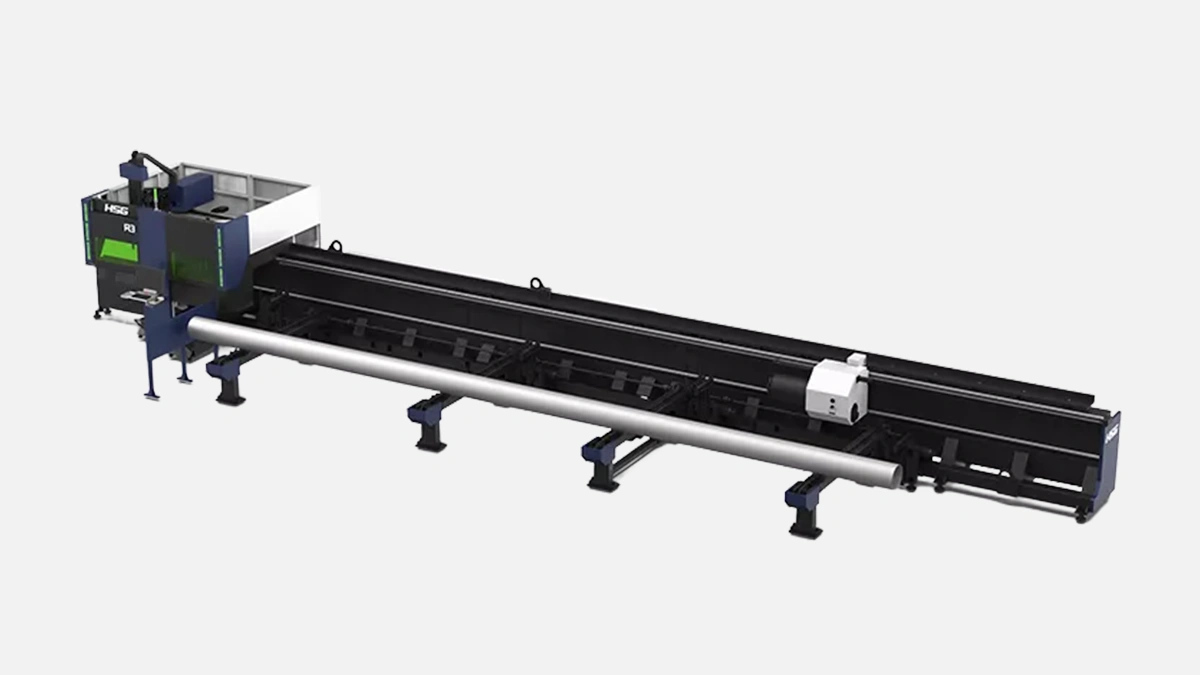
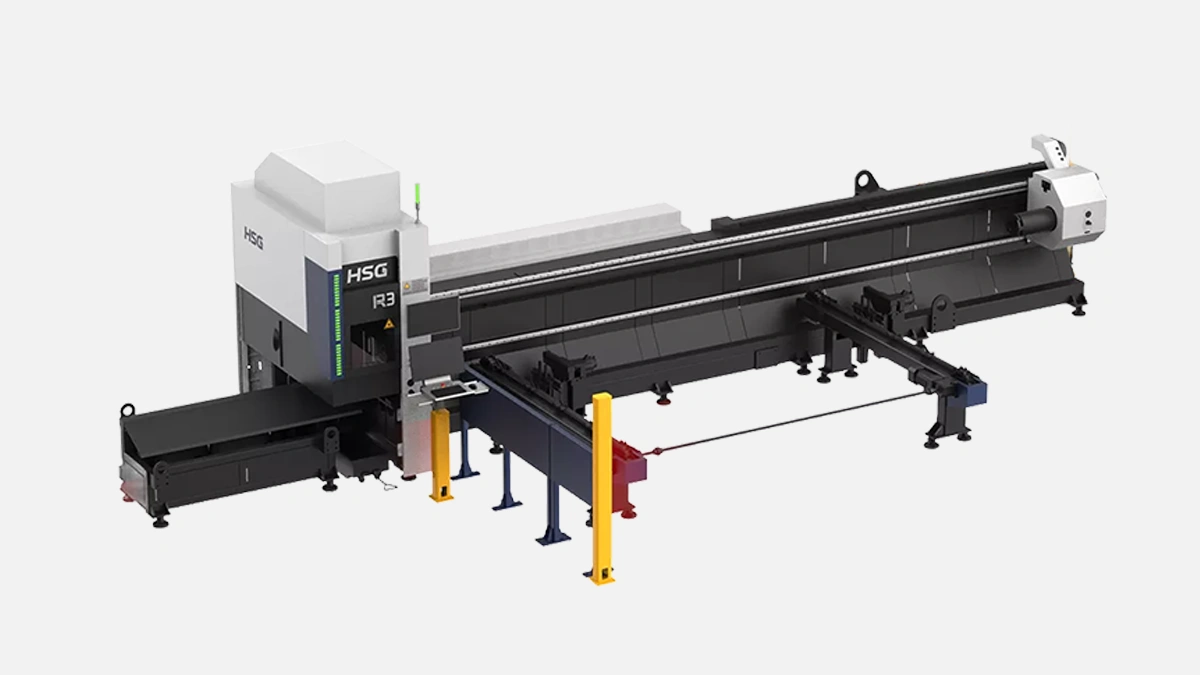
R3R fiber tube laser cuts Ø350 mm tubes, 3-chuck layout, 6 kW, quick loader, clean bevels.
Boom, straight to the point. Big frame, thick welded ribs, no flimsy sheet metal. You walk around the R3R in the shop and the first thought pops up, that thing will not twist even if a fork-lift kisses it. Then another thought sneaks in, what else is hidden under that grey skin, quenched rails, oversized gears, smart sensors, a pile of IO links. The machine does not shout about it, it just stands there.
The model lives for tubes, nothing more. Square, round, L, even H-beam if you are brave enough. Operators in Sharjah say they swapped from plasma to the R3R last winter and instantly sliced the edge clean-enough to skip grinding on stainless handrails. That alone saved half a shift.
Before digging deeper let us glance at brutal facts.
| Key metric | R3R value |
|---|---|
| Chuck count | 3 independent sets |
| Max diameter | 350 mm |
| Auto loader length | 12 m |
| Min remnant | 50 mm with smart nesting |
| Bevel angle | up to 45° with rotary head |
Numbers in the table look dry yet they flip daily practice. A short remnant under 50 mm means one less off-cut bin at the back of the yard. That bin costs money every single shift, so losing it is sweet.
Linear motors, nope, ball screws, yes and massive. The bridge rides on high precision racks. HSG quotes ±0.05 mm positioning. I poked the QC log of one unit delivered to Jebel Ali Free Zone, the worst drift recorded over a 4-hour run was 0.038 mm. Good enough for chassis parts or stainless furniture.
Two sentences done, now a list sneaks in.
Stop, breathe. Those bullets are not isolated claims. They show how the machine survives in humid Gulf workshops where fine sand travels through every door crack.
You pick between IPG and Raycus, 3, 4.5 or 6 kW. Most UAE fab shops go 6 kW because wall thickness seldom stays below 6 mm on structural jobs. Power alone is nothing without gas mix. The R3R seals the cutting zone with a short nozzle skirt that traps assist gas. Oxygen bills drop. Nitrogen? Still expensive in Abu Dhabi, yet the skirt shaves consumption by about 20 % according to a user on the cnczone forum.
Another list pops.
Again, no list at the start of the section, no list at the end, we are safe.
HSG ships its own XBus interface sitting on top of Beckhoff IOs and FSCUT5000 path planner. Touch screen feels like a phone, swipe, pinch, whatever. Older operators from Ajman needed roughly two shifts to find every button. G-code can still be dumped in over Ethernet if you cling to SheetCam.
What truly sells the unit in UAE is the automatic bundle loader. Up to 4 tons in one stack, tubes up to 12 m sorted by laser curtain. The loader even flips RHS so weld seam faces up before cutting. That tiny thing kills post inspection arguments between QC and the laser crew.
Inside the R-family you meet R1, R2 and R3R. R1 stops at 220 mm dia, R2 adds bevel head but keeps two chucks, R3R jumps to three chucks, heavier bed and thicker servo. In practice, if you cut furniture frames the R1 is lighter and cheaper, yet once you go into oil-rig braces or billboard poles nothing beats the R3R capacity.
How does the HSG stand against big names like Bodor T230 and ADIGE LT8.20
| Feature | HSG R3R | Bodor T230 | ADIGE LT8.20 |
|---|---|---|---|
| Max dia | 350 mm | 230 mm | 240 mm |
| Chuck count | 3 | 2 | 2 |
| Bevel cut | Yes 45° | Limited 30° | Yes 45° |
| Remnant | 50 mm | 90 mm | 70 mm |
| Std power | 6 kW | 3 kW | 4 kW |
Two extra sentences. The Italian ADIGE still wins in library of macros, yet the HSG closes that gap with a lower consumables cost and simpler service schedule. Bodor cannot swallow lamp-post pipes, so for street lighting contractors in Ras Al Khaimah the R3R often becomes the only logical pick.
The frame gets stress relieved twice, first after welding, second after rough machining. HSG claims less than 0.02 mm warp over the 8 m base length during a heat cycle from 10 to 45 °C. Not me talking, a lab report from Guangdong Materials Institute.
Spare parts ride fast track via DHL, roughly 72 hours to Dubai customs. Lens cartridges are identical to the ones in HSG plate cutters, so bigger plants keep one shelf for both cell types meaning less dormant stock.
Start up is a single click. The PLC walks through 18 checks, clamp pressure, bed temp, laser interlock, then pushes the ready flag. Operators like the traffic light on top of the cover, green and go. No ambiguous codes. If something fails it flashes a QR link to the manual page. Nice touch, saves scrolling on the small screen with oily fingers.
A service alley of 800 mm on one side is enough, the loader sits on rails so you can roll it out for maintenance. Filters live in a slide-out drawer, zero need to crawl under the cabinet. Cutting head lens swap takes under 3 minutes once the table is in park mode.
Measured draw at 6 kW laser, 100 m/min rapids, compressed air stand by on, is about 38 kW total from the mains. When idle the unit drops to 5 kW which is decent for night shift prep. UAE plants often run on diesel gensets during power cuts, keep that in mind.
They all share one pattern, a mix of long stock and many part numbers. The R3R swallows that chaos and spits sorted parts without extra handling.
HSG opened doors in 2006, pumps out roughly 4000 machines per year now. The R line alone counts 3 revisions, current one launched in 2022 after swapping the old Yaskawa drives to in house HSGT units.
I could nitpick, the operator door feels light, the base coat scratches easy, yet those are cosmetics. What matters is throughput. With three chucks, big bore capacity and honest 6 kW punch the R3R slices tube like butter and keeps the remnant tiny. That combination attracts every shop which fights both thick wall and long length in the Gulf coast heat. Enough said.