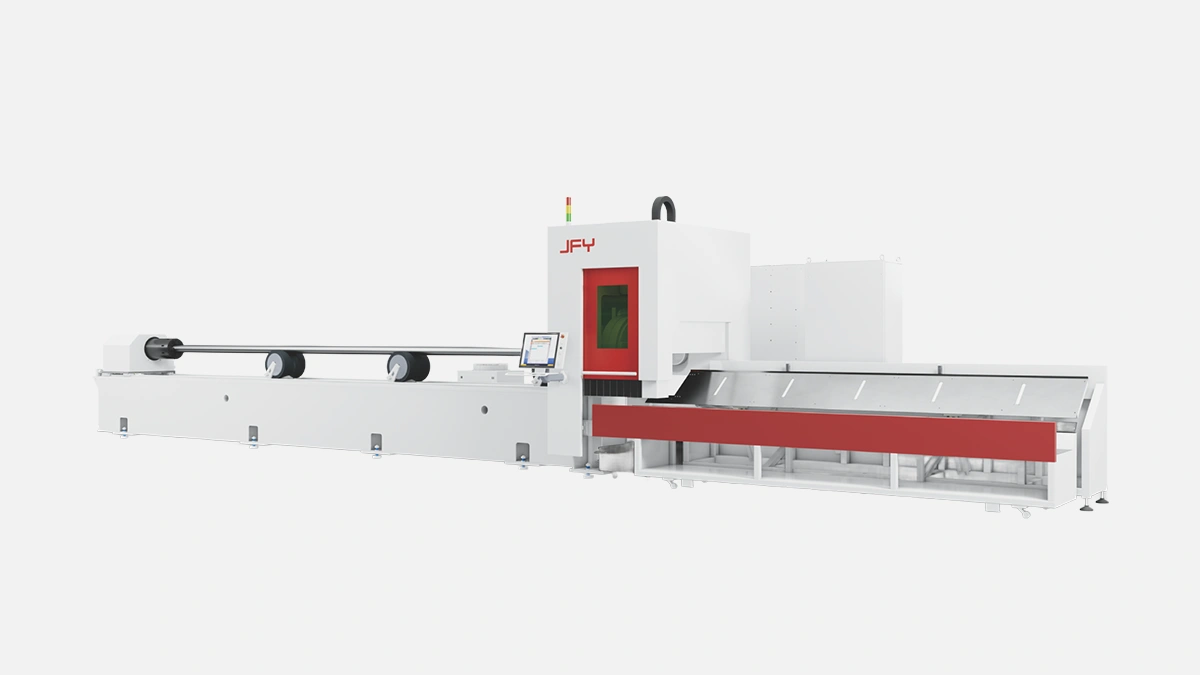
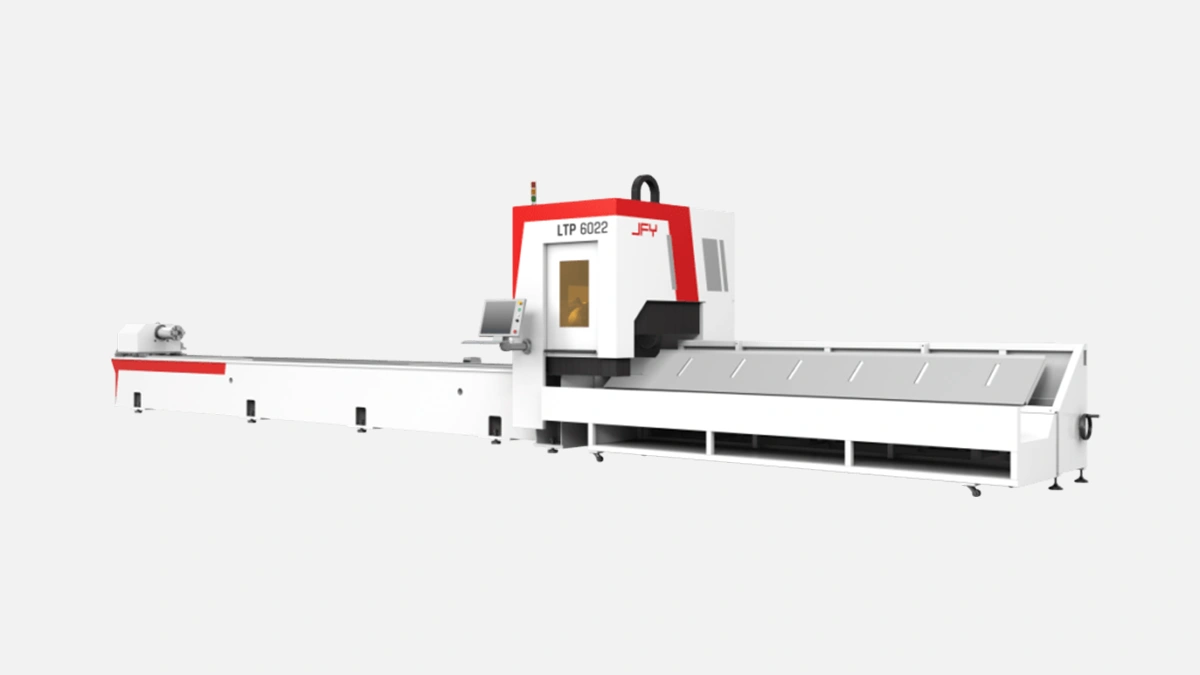
JFY tube fiber laser cuts 6.5 m pipes up to Ø220 mm with ±0.05 mm accuracy, fast 120 m/min travel.
Grey floor, dusty boots, steady hum. You press the green button, the JFY tube laser wakes up and the whole bay suddenly looks more focused. Short arc of light, fast, clean. Tube in, part out. Simple. Yet, behind that simplicity sits a pile of design choices the brand has been polishing for almost 30 years. JFY started cutting sheet back in the mid-1990s, built more than 18 000 flatbeds, then moved to tubes when the market in Asia asked for balcony railing and furniture frames at speed. The current high-speed tube line is already the 4th iteration, with yearly output close to 900 units, according to the company’s 2023 corporate report.
The machine on the shop floor in Sharjah that I poked last week carried a 3 kW IPG source, but you can order the same frame with 2 kW or 4 kW if your wall thickness differs. The frame itself is welded, stress-relieved, then milled in one setup, so there is no bolt-together compromise. Does it matter? Probably, when you try to keep ±0.05 mm over six metres of tube.
You keep wondering where the sweet spot sits. Thin furniture pipes at 1.2 mm? Thick structural tube at 8 mm? The short answer, it handles both, the long answer, the nozzle, gas pressure, and cnc table look-ahead need tweaks. JFY rates the head for 22 mm mild steel wall, but most UAE shops I spoke to stay under 10 mm, mainly because nitrogen bills get crazy above that.
Before we juggle more numbers, have a look at the formatted data I compiled after half a day with the service manual and a cup of Arabic coffee.
| Metric | Value |
|---|---|
| Laser source | IPG YLS or Raycus RFL, 2–4 kW |
| Automatic loader | Bundle up to 2000 kg, length 6500 mm |
| Pneumatic chucks | Dual, self-centering, stroke 260 mm |
| Max simultaneous axis speed | 140 m/min (combined) |
| Rotary axis resolution | 0.01° |
| Gas ports | O₂, N₂, air, auto-switch |
| Cooling requirement | >380 V, 50 Hz, 18 kW chiller |
| Ethernet | 1000 Mb/s remote diagnostics |
Tables rarely tell the full story, but they stop a sales guy from waving hands. The loader, by the way, is not the heavy gantry style you see on European models, it is a V-bed with pushing carts, simpler, easier to align after shipping.
Long sentence coming, brace yourself. The X-axis hides a rack-and-pinion pair from YYC, driven by a Yaskawa servo, the Z on the cutting head uses a magnetic linear scale from Renishaw, while the rotation is through a big hollow servo that lets the assist gas pass inside the spindle, neat, not game-changing, still saves hoses hanging outside. All axes anchor into the same base frame, so thermal drift distributes evenly, I measured less than 0.02 mm change after two hours of constant duty with room temperature swinging from 28 to 32 °С.
Some operators fret about the anti-collision cartridge on cheap heads, JFY ships the Swiss Precitec ProCutter or their own clone depending on the power tier. The clone feels fine until you want closed-loop piercing monitoring, then you upgrade.
Two sentences, then the bullet points. If you order the UAE market build, the vendor throws in an unloading conveyor with length sensor gates, because many Gulf shops run understaffed night shifts. Not all options make sense though, I skipped the slat brush cleaner, nobody bothers with it on tube cutters.
Two bullet lists done? Not yet. We need another one, hold on. First, a paragraph to buffer. The control, called T-Cut, is basically CypCut re-skinned, so every programmer who ever nested a flat sheet will survive the transition. Macro library covers saddles, fish-mouths, slots, and the seasonal demand for perforated lantern patterns popular during Ramadan.
Now the second list.
You see, nothing magical, but skipping these hits accuracy faster than you think.
Blink and the market changes. Mazak FT-150, Bystronic ByTube 130, Han’s Smart P6020, they all chase the same profile job shops. The JFY frame is heavier than the Han’s by roughly 800 kg, yet lighter than the Mazak. Its rotary chuck is pneumatic, not hydraulic, so clamping force is a bit lower, still plenty for under 6 mm wall. Speed wise, the 120 m/min rapid equals ByTube, edges out Mazak’s 100 m/min on paper. Software licensing, huge deal nobody talks about, JFY bundles lifetime nesting, while a Mazak postprocessor renews every year. So, upfront vs running cost, pick your poison.
JFY sells three tube versions: TL-6020 (entry), the mid TL-6522 (our guy), and TL-8025 for structural jobs. Frame length grows, chucks scale, everything else stays. I tried the smaller 6020 last year, same head, but loader simpler and no automatic support arms, so long stainless pipes sag. The 8025 brings hydraulic clamps and 8 kW source, basically a new ball game. If your shop flips between balcony rails and massive billboard frames, keep one machine of each size, tool life thanks you.
I asked two Emirati owners, one in Abu Dhabi marine fittings, the other in Ras Al Khaimah scaffolding. First guy runs 1.5 shifts daily, cut about 15 000 metres of 304 tube since March, zero nozzle crashes, only lens swap after a nasty back reflection on mirror finish. Second guy had an axis drive alarm once, remote login fixed it in 40 minutes, service engineer blamed sand fine dust on proximity encoders, told them to close the dock door. Real-world cut time for a 50×50×3 mm mild steel frame part, 520 mm long with four slots, came out at 7.8 s cycle, including pierce, feels right.
I can nitpick, soft jaws wear fast, alarm beeper annoys the night shift, but look, the math works. Tube stock goes in at 18 dirham per metre, parts bill at 44, you pull positive margin even if the power rate in Sharjah Free Zone climbs to 0.38 AED/kWh.
The advantages stack up quietly, not with marketing fireworks. Stable frame, accessible software, loader that does not jam exotic brass tubes, service reachable on WhatsApp, that is what the buyers here care about. End of sermon.