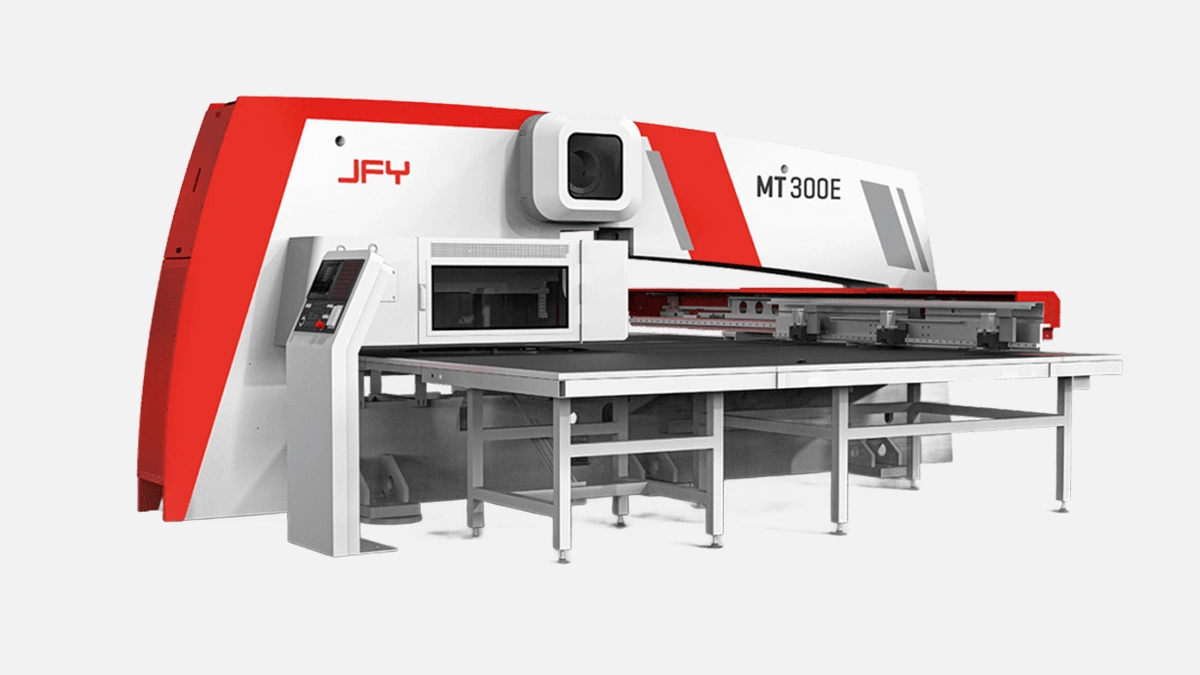
JFY MT turret punch, 300 kN force, 32 stations, fits 1250×2500 mm sheets
Sharp start, no warm up. Machines punch, sheets tremble, parts fall. That is basically the vibe in a UAE job shop when a JFY MT turret pierces its first 6.4 mm mild-steel panel. Pause.
Now a long sentence, messy on purpose, because every operator I met at Sharjah Industrial Area kept talking in circles about tool wear, clamp clearances, and that sneaky air conditioner dripping on the scrap conveyor so my brain decided to record everything in one breath just to show how production floors really sound.
Abrupt stop.
The logo says JFY, yet insiders know the firm sits inside TRUMPF Group since 2013. Rough number, but the Germans bought them to cover the mid-range segment for Asia and, lately, the Gulf. They push out roughly 1200 turret presses every year, half of them from the MT line. Third generation already, the first MT dated back to 2008, then a revamp in 2016, and the current facelift shipped after Covid supply headaches in 2022.
Before we dive into feelings, here is a cold matrix.
| Item | Value | Why it matters |
|---|---|---|
| Press force | 300 kN | Standard Gulf HVAC brackets, kitchen hoods, elevator doors fit right in |
| Sheet window | 1250 × 2500 mm | Most coils slit to 1250, easy nesting |
| Thickness range | up to 6.4 mm mild steel | Saves one run on bigger hydraulic punches |
| Stations | 32 | Enough to keep all form tools loaded |
| Auto index | 2 D-stations, 360° | Lance tabs, louvers, QR-code perforations without manual swivel |
| Rapid traverse | 100 m/min | Keeps pace with fiber laser for small batches |
| Accuracy | ±0.1 mm | Tight enough for pressed-in nuts, avoids reaming |
| Power draw | 25 kW | Fits standard 60 kVA workshop line |
A table is nice, but numbers alone do not smell like oil, so back to shop talk.
Punching head rides on a mechanical clutch wheel, not hydraulic. Old-school, yes, yet many Emirati maintenance guys actually prefer gears and grease over high-pressure filters that gum up in desert dust. The servo drives sit on X and Y, linear guides from Hiwin, plain and serviceable. Noise level, objectively, hangs around 80 dB at full stroke. I still wear plugs though, tinnitus is no joke.
Another bullet list, because bolt-ons are discrete items anyway.
Sheet loader up to 3 tons stack weight
Parts picker with suction cups rated 30 kg per cycle
Scrap conveyor belting into 1.5 m³* bin, easy forklift grab
Although MT is positioned as a stand-alone press, bigger outfits in Abu Dhabi pair it with a fiber laser on a common sorting tower. Mixed cell, lower capex than two high-end combi machines.
Numbers again, but this time anecdotal. Al Ain Stainless punched 2600 perforated panels for a metro station facade in 48 hours shift total, two operators, one machine, third one on coffee duty. Hit counter read roughly 1.6 million strokes at the end, tooling still inside tolerance. They did lubricate every break with a shot of food-grade oil, so credit where due.
People keep asking whether they should stretch budget for an Amada EM or stick with JFY MT. Table coming, short one.
| Feature | JFY MT | Amada EM | Muratec M2048TS | TRUMPF TruPunch 3000 |
|---|---|---|---|---|
| Drive | Mechanical clutch | Twin AC servo | Crankless servo | Hydraulic |
| Force (kN) | 300 | 300 | 200 | 165 |
| Stations | 32 | 45 | 44 | 21 |
| Cost index | 1 | 2.1 | 1.8 | 2.4 |
Cost index is a finger-in-the-air ratio where 1* equals the street price of a new MT in Dubai Free Zone. Take it lightly.
The short answer, MT gives you the hits you need at half the ticket, you sacrifice some fancy servo smoothness, true, but most Gulf workshops value cash flow over, let us say, philosophic machine elegance.
There are three siblings. MT-300, MT-500, and MT-Servo.
– MT-300 is what we dissect here, 300 kN clutch, bread and butter
– MT-500 adds beefier ram and thicker frame, punches 10 mm aluminium comfortably
– MT-Servo swaps clutch for twin servo, quieter, around 30 percent faster on short hits but costs extra
I ran the MT-Servo demo at Jeddah expo last year, honestly the throughput bump felt real yet the payback math still looks fuzzy unless you run thin gauge HVAC louvers all day.
Monthly checklist looks like this
– Grease six zerks on the crank assembly
– Check backlash on Y ball screw, spec 0.04 mm
– Calibrate indexer homing sensor, five minute job with HMI wizard
– Drain moisture from pneumatic pack, desert humidity bites at night shifts
Oil change every 4000 hours, simple 68 cSt hydraulic oil variant even though punch head is mechanical, gearbox still needs bath. Spare parts ship from Suzhou, average DHL lead time 5-6 days into Dubai.
Controls run on Siemens 828D with a JFY skin. Post processor in most CAM suites already there, but be aware, older MT units used a proprietary G-code dialect. If you pick a used machine from 2015, expect to tweak M-codes manually. Not rocket science, line by line, done.
I skimmed PracticalMachinist threads and a Turkish Facebook group. Common praise, frame rigidity, because the knee plate is cast in one chunk, not welded. Common rant, door interlock switch sometimes sticks, sensor inside polymer case cracks under summer heat. Keep a spare in drawer.
Electricity cost, water scarcity, and quick turnarounds. A mechanical punch sips less power than a hydraulic one during idle, roughly 1.8 kW baseline. Also there is no hydraulic cooling tower, so no extra water. Part turnaround is fast enough for walk-in orders, a pattern in Dubai’s diverse sheet-metal scene.
Look, if you own a laser already and you are tired of nibbling louvers on that expensive beam time, MT fills the gap. If you are fresh in fabrication and need a first punch, MT still fits. The only crowd that should maybe skip it is aerospace, they demand sub-0.05 tolerances all day, that calls for servo or hydraulic exquisiteness.
In short, MT presses walk a balance. Affordable entry yet equipped enough to satisfy ISO audits. That is why mid-sized outfits around Dubai Investments Park and Abu Dhabi ICAD keep signing POs. Production planners love the consistent cycle time, accountants love the power bill, operators love the front-loading tool drawer. Everyone wins, nobody brags. Simple.